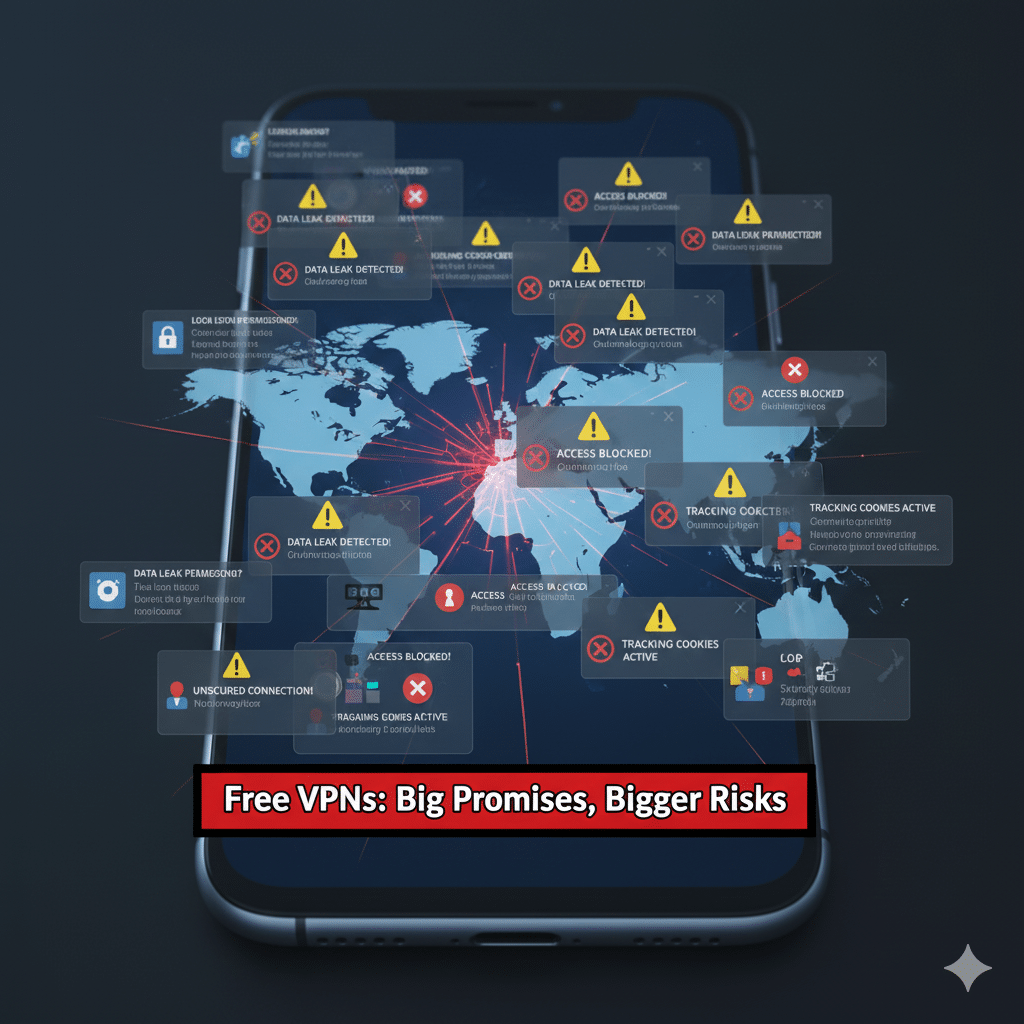

The appeal of “free VPN apps” — offering privacy, anonymity, and unrestricted browsing with zero cost — has made them immensely popular. But fresh research from 2025 demolishes that appeal for many consumers and organisations (800 Free VPN Apps) . Rather than safeguarding users’ online activity, a new study finds hundreds of free VPN apps do the opposite: exposing sensitive data, leaking internet traffic, requesting intrusive permissions, and even using outdated, insecure code. The result is a growing privacy and security crisis for anyone relying on “free” VPNs.
In this article, we’ll explore the major findings, assess why so many free VPNs are unsafe, compare with safer alternatives, and conclude with practical advice if you still rely on VPNs to protect your privacy.
What the 2025 Study Revealed
The research — conducted by the security firm Zimperium (zLabs) — involved a sweeping analysis of 800 free VPN applications available on Android and iOS. The findings were alarming: these apps often failed the basic standards expected of a VPN.
Key issues uncovered include:
Outdated encryption libraries: Some apps still shipped with old versions of OpenSSL, making them vulnerable to well-known exploits (such as the infamous “Heartbleed” bug).
Missing or invalid privacy disclosures: Roughly 25% of iOS VPN apps lacked a valid “privacy manifest,” leaving users in the dark about what data is collected and how it’s used.
Excessive, unjustified permissions: Many asked for access to microphones, system logs, always-on location tracking — permissions that have nothing to do with standard VPN functions.
Potential for Man-in-the-Middle (MitM) attacks: A small but significant portion of apps accepted self-signed or malicious certificates, allowing attackers to intercept what was supposed to be secure traffic.
Misleading security claims: Despite marketing themselves as privacy tools, many of these apps did not encrypt traffic properly — or at all — and even leaked DNS or IP data.
As one security analyst put it, “these apps promise protection but instead create new pathways for surveillance, data theft, and exploitation.”
In short: instead of shielding your data from prying eyes, many free VPNs are handing your data over on a silver platter.
Why “Free” VPNs Are Especially Risky
1. Lack of sustainable business model
A truly secure VPN service requires resources: robust encryption, secure server infrastructure, regular maintenance, and transparent policies. Free apps often lack this investment. As a result, many turn to monetizing user data, intrusive ads, or embedded tracking to generate revenue — fundamentally conflicting with the principle of privacy.
2. Outsourced or outdated code
Maintaining secure cryptographic code is non-trivial. Some free VPNs skip ongoing security updates, ship with decades-old libraries, or copy code from public repositories — all while advertising themselves as “secure.” The Zimperium study found many such cases.
3. Permission creep & overreach
Where a legitimate VPN only needs permissions to manage network traffic, some free apps request far broader privileges — including microphone, location, device logs — enabling potential abuse such as tracking, surveillance, or data harvesting.
4. False sense of security
Perhaps worst of all: many users assume “if it’s on Google Play / App Store it must be safe.” This false trust means users may use a flawed VPN for sensitive tasks — banking, messaging, work — when in reality their traffic could be exposed to attackers.
How Free VPNs Compare to Trusted, Paid VPN Services
AspectFree VPNs (risky)Trusted / Paid VPNsEncryption libraries & updatesOften outdated or insecure; may use vulnerable codeRegularly updated, modern protocols (AES-256, WireGuard, OpenVPN)Permissions & transparencyExcessive permissions; obscure or missing privacy disclosuresMinimal necessary permissions; transparent privacy policy & auditsData handling & loggingOften log user data, may share with third partiesStrict no-logging commitments, often independently auditedTraffic security integrityRisk of DNS/IP leaks, MitM vulnerabilities, sometimes no real encryptionProper DNS/IP leak protection, certificate validation, kill switchesBusiness modelOften ad/tracker-based; monetizes user dataSubscription-based; relies on revenue from users, not data
In short: while “free VPN” often means “high risk,” reputable paid VPNs tend to deliver on the core promises of encryption, privacy, anonymity, and reliable performance.
What Experts Are Saying
Security professionals and privacy advocates are uniformly warning against casual use of free VPNs. As one writer in Forbes cautions: “These mobile VPN apps … can become the weakest link in an organization’s security posture, exposing sensitive business data to unnecessary risk.”
The authors of the Zimperium report stress that what should have been a protective tool “inadvertently introduces new attack surfaces,” especially dangerous in the context of Bring-Your-Own-Device (BYOD) policies or remote work setups.
In the words of one security researcher quoted in coverage of the report: “These apps promise protection but instead create new pathways for surveillance, data theft, and exploitation.”
What You Should Do — Safely Using a VPN
Avoid free, unknown VPN apps altogether. Given the extensive risks, a free VPN is often worse than no VPN.
Choose a well-reviewed, paid VPN service with transparent privacy policy, audited no-logging practices, and modern encryption — better short-term cost, long-term peace of mind.
Check permissions carefully. Legitimate VPN apps only need network-related permissions. If an app asks for microphone, contacts, location, or log access — avoid it.
Use leak-testing tools. If you insist on using any VPN (free or paid), test it with DNS/IP leak detection services to ensure it hides traffic properly.
For enterprises or BYOD environments: treat free VPNs as untrusted — prohibit their use or enforce strict vetting before allowing them on corporate devices.
Conclusion
The 2025 zLabs study from Zimperium makes one thing painfully clear: hundreds of free VPN apps — many available on official app stores — fail to meet even basic privacy and security standards. Rather than shielding users from snoopers, these apps may expose them to far greater risk: data leaks, surveillance, malware, and traffic interception.