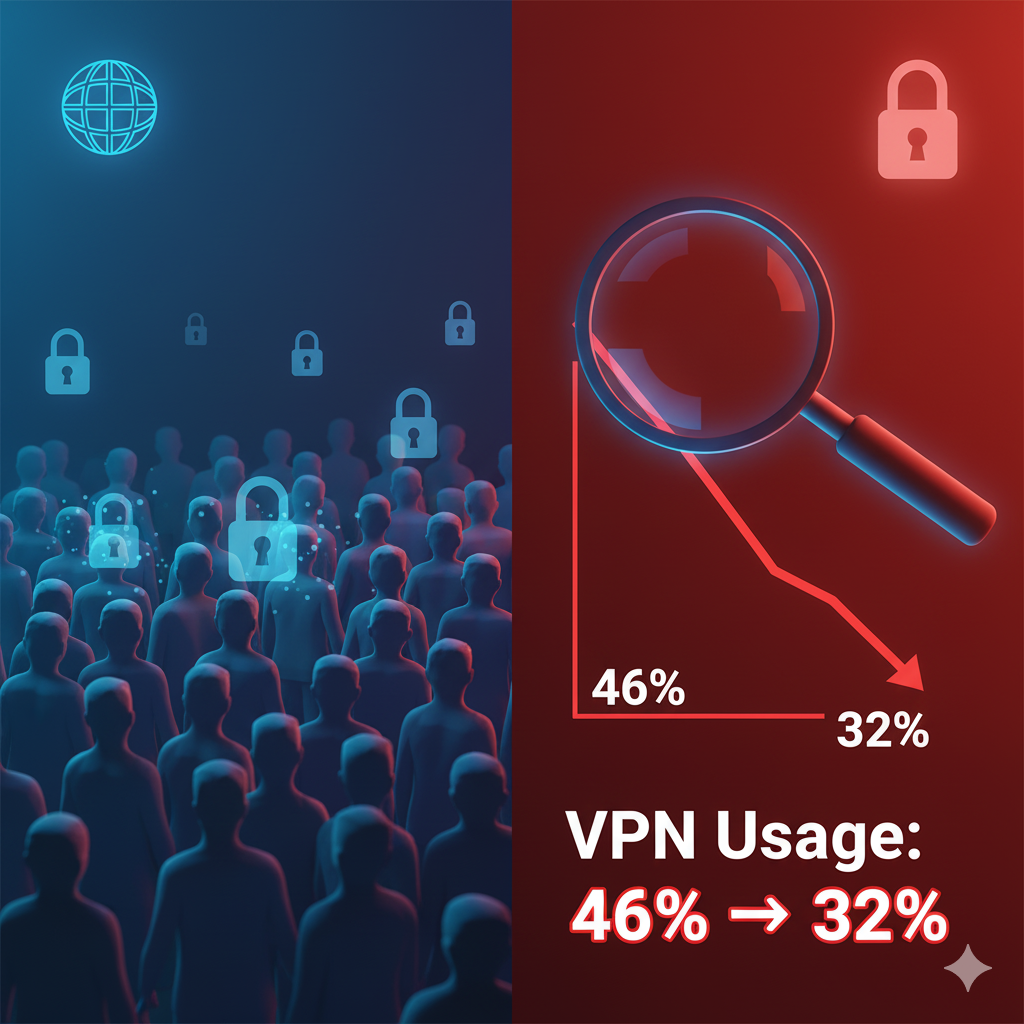

A surprising trend has emerged in 2025: VPN usage is falling even as privacy concerns grow. Security.org’s annual consumer study finds U.S. VPN adoption dropped from 46% in 2023 to 32% in 2025, a sharp decline that raises questions about how people perceive and use privacy tools today (Global report ). This article unpacks the findings, examines why the decline is happening, compares personal and business use trends, and offers practical takeaways for readers wondering whether a VPN is still worth it.
What the report found — the hard numbers
Security.org’s 2025 report, based on a nationally representative survey of 1,009 U.S. adults, highlights several headline trends: overall VPN usage fell to 32%, business-use declined fastest (only 8% use VPNs solely for work), while privacy-motivated uses — like avoiding tracking by search engines and securing public Wi-Fi — remain strong among the users who do keep VPNs. “VPN usage has dropped, from 46 percent in 2024 to 32 percent this year,” writes Brett Cruz, Security.org’s digital security expert.
Key stats from the report:
32% of U.S. adults currently use a VPN (down from 46%).
Only 8% of adults now use VPNs solely for work (vs. 13% previously).
Top reasons users keep VPNs: privacy (60%) and security (57%).
Why VPN usage is falling despite rising privacy concerns
At first glance the trend seems paradoxical: privacy worries are up, yet fewer people use VPNs. The report and industry observers point to several overlapping reasons:
Shift away from workplace VPN requirements. As companies adopt cloud-native architectures and zero-trust access models, many employees no longer need a corporate VPN to do their jobs — cutting a major source of VPN usage. Security.org notes a sharp drop in business-only VPN users.
User friction and perceived complexity. For many nontechnical users, VPNs remain “too much trouble” to set up or maintain. The report finds a sizable share of non-users say they “don’t need one” or find them “too expensive” or “too hard” — barriers that reduce adoption despite privacy concerns. (Security.org)
Skepticism about effectiveness and trust. High-profile security stories and concerns about free VPNs (tracking, leaks, bundled SDKs) have made some consumers wary. Many prefer simpler privacy tools (browser trackers, private modes) or rely on platform-level protections. Security.org’s data shows 68% of adults either don’t use VPNs or are unaware of them. (Security.org)
Fragmentation of privacy tooling. Users now choose from many privacy layers — private search engines, privacy browsers, tracker-blocking extensions, and built-in operating-system protections — reducing the sense that a VPN is the default privacy step for everyone.
What this means for consumers and privacy advocates
The decline doesn’t mean VPNs are obsolete. Among the 32% who still use them, VPNs remain a core tool for certain scenarios: public Wi-Fi protection, hiding IP from trackers, and accessing geo-restricted content. But the market is maturing and more specialized:
Privacy-conscious users are doubling down on better, audited VPNs and layered defenses (Tor, tracker blockers).
Enterprises are increasingly shifting to zero-trust models that reduce reliance on traditional VPNs for day-to-day access.
Vendors face pressure to improve transparency, independent audits, and user experience to win back skeptical consumers.
Security.org’s report also warns of survey limitations (the data-collection platform can’t be accessed via VPN, possibly undercounting actual users), so the real picture could be somewhat different — but the year-over-year decline is still notable and worth attention.
Expert perspective & practical advice
Brett Cruz (Security.org) frames the result as market evolution: VPNs are becoming more specialized rather than universally adopted. For readers wondering what to do:
If you value privacy on public networks, a reputable paid VPN remains a strong choice.
Avoid unknown or “free forever” VPN apps — the industry study of free VPN security (covered elsewhere) shows several risks.
Combine tools: privacy browsers, tracker blockers, regular software updates, and strong passwords remain essential complements to any VPN usage.
Learn more than Firms shift from VPN to Zero Trust for remote access
Conclusiorn
The Security.org consumer report reveals a counterintuitive but credible trend: VPN usage has dropped even as privacy awareness grows. The reasons range from fewer workplace requirements to user friction and skepticism about certain free services. For privacy-minded individuals and organizations, the takeaway is to be selective: choose audited, transparent VPNs when needed, and combine them with other privacy practices. For the industry, the decline is a wake-up call — improve trust, usability and education if VPNs are to remain central to consumer privacy strategies. (Security.org)
Sources & verification
Security.org — “VPN Use in 2025: Trends, Statistics, and Consumer Sentiment.” (Security.org)
Betanews — coverage summarizing Security.org findings. (BetaNews)