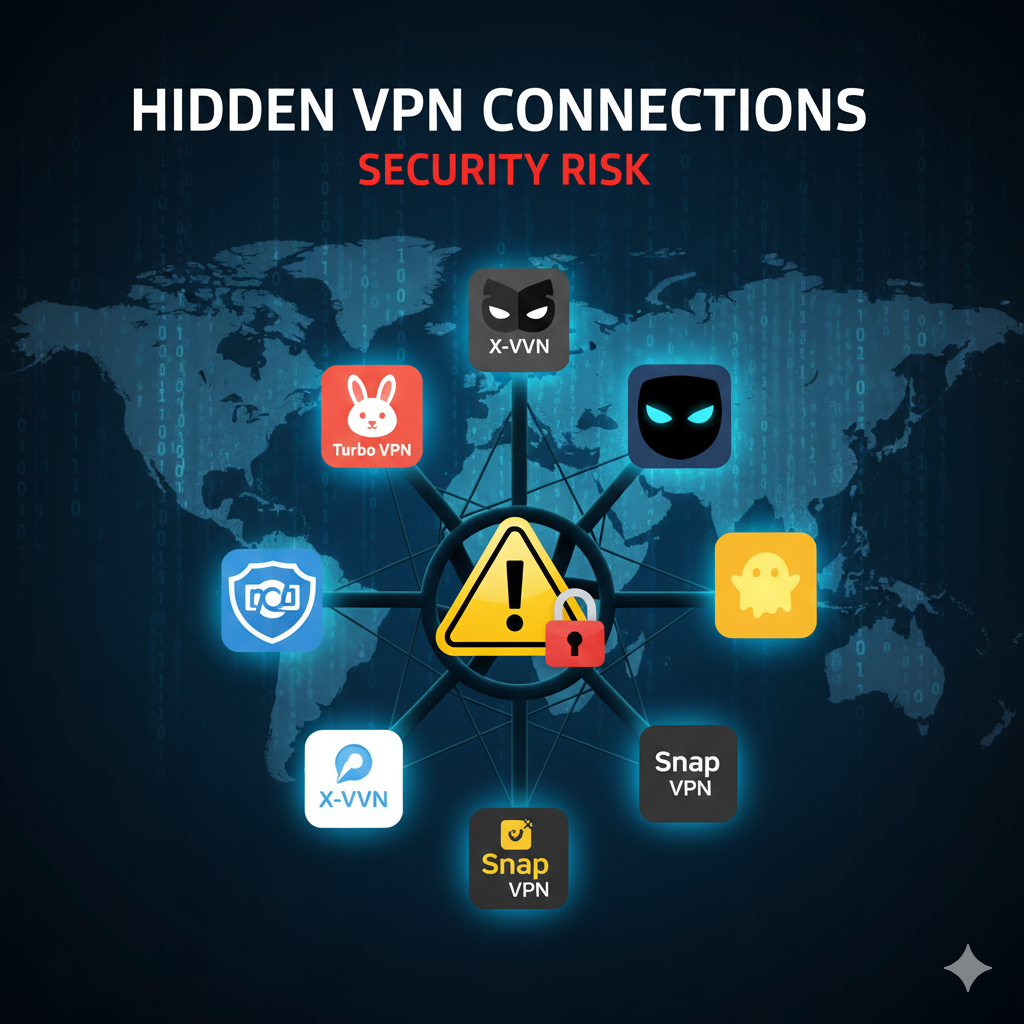

Virtual Private Networks (VPNs) are widely marketed as tools to protect privacy, encrypt traffic, and secure users’ online activities (Hidden VPN). However, **new research has revealed that more than 20 popular Android VPN apps — collectively downloaded over 700 million times — may pose serious security and privacy risks due to undisclosed ownership ties and shared vulnerabilities.
The findings, published by a team of researchers including Citizen Lab and Arizona State University experts, expose how these VPN apps, which appear independent in app stores, actually belong to a few hidden “families” of providers that share codebases, infrastructure, and even critical encryption weaknesses.
This revelation challenges assumptions about VPN trustworthiness and underscores how lack of transparency can undermine user security at massive scale.
What the Research Found
The academic study titled “Hidden Links: Analyzing Secret Families of VPN Apps” examined the 100 most downloaded VPN apps on the Google Play Store and discovered a surprising pattern of hidden connections.
Three “Hidden Families” Identified
Researchers identified three distinct families of VPN apps that, despite appearing independent, share deep similarities in code, libraries, assets, and even server infrastructure. These families include:
Family A: Apps from providers like Innovative Connecting, Autumn Breeze, and Lemon Clove, which include well‑known clients like Turbo VPN, VPN Proxy Master, and Snap VPN.
Family B: Apps tied to companies such as Matrix Mobile, ForeRaya Technology, and Wildlook Tech, including XY VPN and Melon VPN.
Family C: Providers like Fast Potato Pte. Ltd. and Free Connected Limited, responsible for Fast Potato VPN and X‑VPN.
Despite differences in branding, these VPNs share strikingly similar code and cryptographic implementations, which allowed researchers to link them back to the same operational groups.
Together, these connected apps have been downloaded well over 700 million times, representing a substantial portion of global VPN usage on Android. (TechRadar)
Why Hidden Ownership Matters
Most users choose VPN apps under the assumption that each provider operates independently with transparent ownership and strong privacy practices. But the study shows that many of the most popular VPNs are in fact owned or operated by a handful of entities, some with ties to sanctioned organizations.
For example, researchers noted that Family A’s providers have been linked — through business filings and code analysis — to the Chinese cybersecurity firm Qihoo 360, which has previously faced U.S. sanctions due to ties with the Chinese military and national security apparatus.
This kind of obfuscation — where ownership, operations, and code signatures are hidden from users — raises serious data sovereignty and privacy concerns, especially for users in regions where data protection and trust are paramount.
Security Risks Amplified
Beyond opaque ownership, the study uncovered shared security flaws across these VPN families that could directly impact user privacy and safety:
Hard‑Coded Credentials
Some VPN apps contained hard‑coded Shadowsocks passwords embedded in their binaries. These static credentials allow attackers who extract them to potentially decrypt user traffic across multiple VPN brands that use the same protocol and keys.
Reused Infrastructure
Shared server IPs, common cryptographic libraries, and overlapping assets mean that a compromise in one VPN application could cascade into vulnerabilities across others.
Susceptibility to Interception
Across the families, there were instances of weak encryption and vulnerabilities to blind on‑path attacks, where an attacker on the same network (e.g., public Wi‑Fi) could infer or intercept encrypted traffic — undermining the VPN’s core promise of privacy.
These issues not only expose users’ browsing habits but could also allow sensitive metadata — like destination sites or user behavior — to be observed or manipulated.
The False Sense of Security
VPN users often rely on these tools less for anonymity than for secure connections, access to blocked content, and protection on public networks. But when multiple brands operate on the same hidden infrastructure with shared vulnerabilities, trust is severely compromised.
A related analysis by eSecurity Planet highlights that many VPN clients also suffer from routing leaks, weak cryptographic ciphers, and inadequate DNS protections, further contributing to data exposure risks even when encrypted tunnels exist.
Additionally, apps that do not publicly disclose ownership or jurisdiction can create uncertainty around data handling practices and legal obligations — especially in regions with strong data privacy laws or restrictive surveillance regimes.
How Users Should Respond
Given these findings, users are encouraged to:
Stick with reputable VPN brands that conduct independent security audits.
Verify ownership transparency and jurisdiction, especially for free or “lite” VPN apps.
Avoid apps with no clear privacy policy or third‑party oversight.
Use paid VPN services when possible, as research suggests free commercial VPNs tend to exhibit greater structural and security risks.
Experts also stress that app stores should tighten verification and vetting processes, not just for malware, but for ownership disclosure, code provenance, and infrastructure transparency.
learn more about VPN Usage Soars with Social Media Bans in Afghanistan
Conclusion
The revelation that VPN apps with more than 700 million downloads share hidden ownership ties and serious security flaws is a wake‑up call for users, developers, and regulators alike.