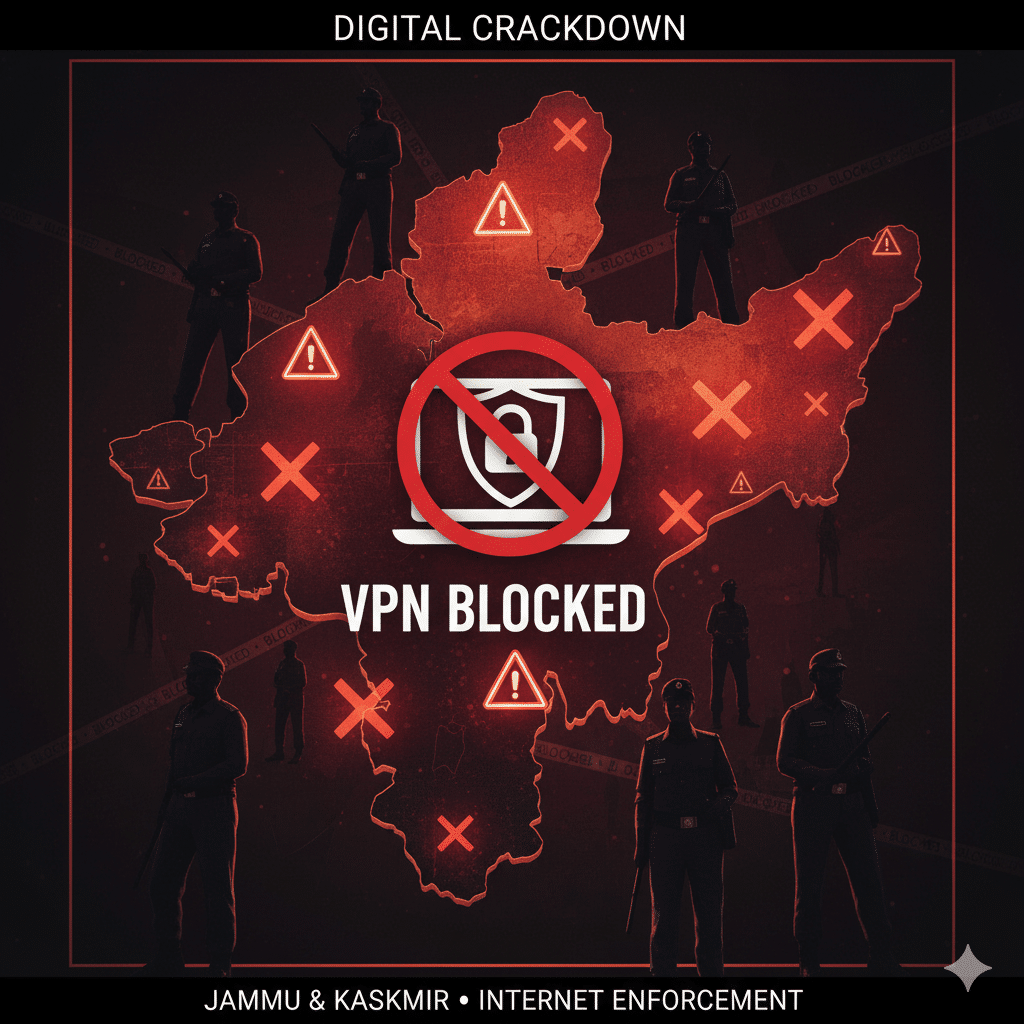

In late December 2025 and early January 2026, authorities in the Indian Union Territory of Jammu & Kashmir (J&K VPN) significantly widened geographic restrictions on Virtual Private Network (VPN) services as part of a broader security and public order initiative. District administrations invoked emergency powers and security laws to suspend the use of VPNs across multiple districts, including Kupwara, Shopian, Kulgam, Srinagar, and Budgam, with similar directives in Rajouri and other regions. This marked expansion followed earlier actions and reflects a growing emphasis on controlling encrypted internet traffic amid ongoing security concerns. (J&K VPN)
The move has stirred debate between public safety imperatives and digital privacy rights, as restrictions directly affect both everyday internet users and those relying on VPNs for secure connectivity. Here’s the latest verified overview and implications of the expanding VPN crackdown in J&K.
Security Rationale: Why VPNs Are Targeted
District authorities have repeatedly cited “security, public order and cyber security” as the core reasons for banning VPNs in several parts of J&K. In Kupwara and Shopian — both border districts with heightened sensitivities — officials noted a reported surge in suspicious VPN use by unidentified users, raising fears that encrypted traffic could be exploited to conceal unlawful activity, dissemination of inflammatory content and coordination of actions prejudicial to law and order.
Under the Bharatiya Nagrik Suraksha Sanhita (BNSS), 2023, especially Section 163, district magistrates have the authority to impose temporary prohibitory orders when there is perceived risk to public safety or national security. Across J&K, orders have typically been issued with immediate effect and span two months unless extended or modified.
Officials contend that unrestricted VPN use — by providing encrypted connections and IP masking — can make lawful monitoring difficult, potentially benefitting individuals or groups intending to commit cybercrimes or coordinate unrest.
District-Level Enforcement: Kupwara, Kulgam, Shopian & Beyond
Kupwara:
The district magistrate issued an order imposing a two-month suspension of all VPN services, citing police reports of increased suspicious activity. The ban applies to individuals, institutions, cyber cafés and ISPs within the district, with exemptions allowed only for explicitly government-authorized VPN use.
Shopian & Kulgam:
Similar prohibitory measures were issued in Shopian and Kulgam districts, where authorities echoed Kupwara’s security concerns and directed strict enforcement against any unauthorized VPN usage.
Srinagar:
The capital district administration ordered the immediate suspension of all VPN services for two months, highlighting risks related to public order and cyber security, and emphasizing the potential for encrypted traffic to bypass lawful restrictions. (
Budgam:
Budgam Police carried out a systematic verification drive and acted against 24 individuals found violating the VPN ban. In several cases, legal action including FIRs was taken where individuals were believed to have adverse terror-related backgrounds, underscoring authorities’ security rationale.
These enforcement actions illustrate how multiple administrative and police units are collaborating to implement the bans across districts in the Kashmir Valley and beyond.
Legal Mechanisms and Public Order Justifications
Authorities base their decisions on provisions within the BNSS law that allow immediate protective actions in the face of perceived threats. Violations of prohibitory orders — such as continuing to use VPN apps — can lead to legal action, including FIRs, security proceedings, and potential penalties under relevant criminal and public safety statutes.
According to local orders, the encrypted nature of VPN traffic can:
Hide identities and locations, complicating surveillance and investigations.
Facilitate circumvention of digital controls or restrictions imposed for security reasons.
Enable dissemination of misleading or inflammatory content without easy traceability. (
District administrations argue that these risks — particularly in security-sensitive regions — justify temporary restrictions when there is reasonable belief of misuse and potential threat to public order.
Criticism and Digital Rights Concerns
Digital rights advocates and some civil liberties commentators have criticized the blanket nature of VPN bans, noting that VPN technology itself is not illegal under Indian law, and that suspensions can disproportionately impact lawful users. Privacy experts argue that VPNs are legitimate tools for encrypted communication, data protection on public Wi-Fi, and general online privacy — not inherently tools of malicious intent.
Critics also stress that broad restrictions may set precedents for digital governance that could erode public trust and restrict access to secure communications. The debate touches on wider questions of balancing national security priorities with individual digital freedoms, particularly in regions already accustomed to significant internet restrictions and monitoring.
Conclusion: A Contested Digital Policy Shift
The expansion of VPN restrictions across Kupwara, Kulgam, Shopian, Srinagar, Budgam and other Jammu & Kashmir districts reflects a coordinated effort by local administrations to address perceived security threats linked to encrypted internet usage. While authorities emphasize public order and cyber safety, critics counter that the bans may impede legitimate privacy practices and free access to secure communications.
As enforcement continues, closely watched developments — including legal challenges, public response, and future policy refinements — will shape how digital freedoms and security are balanced in J&K’s evolving governance landscape.