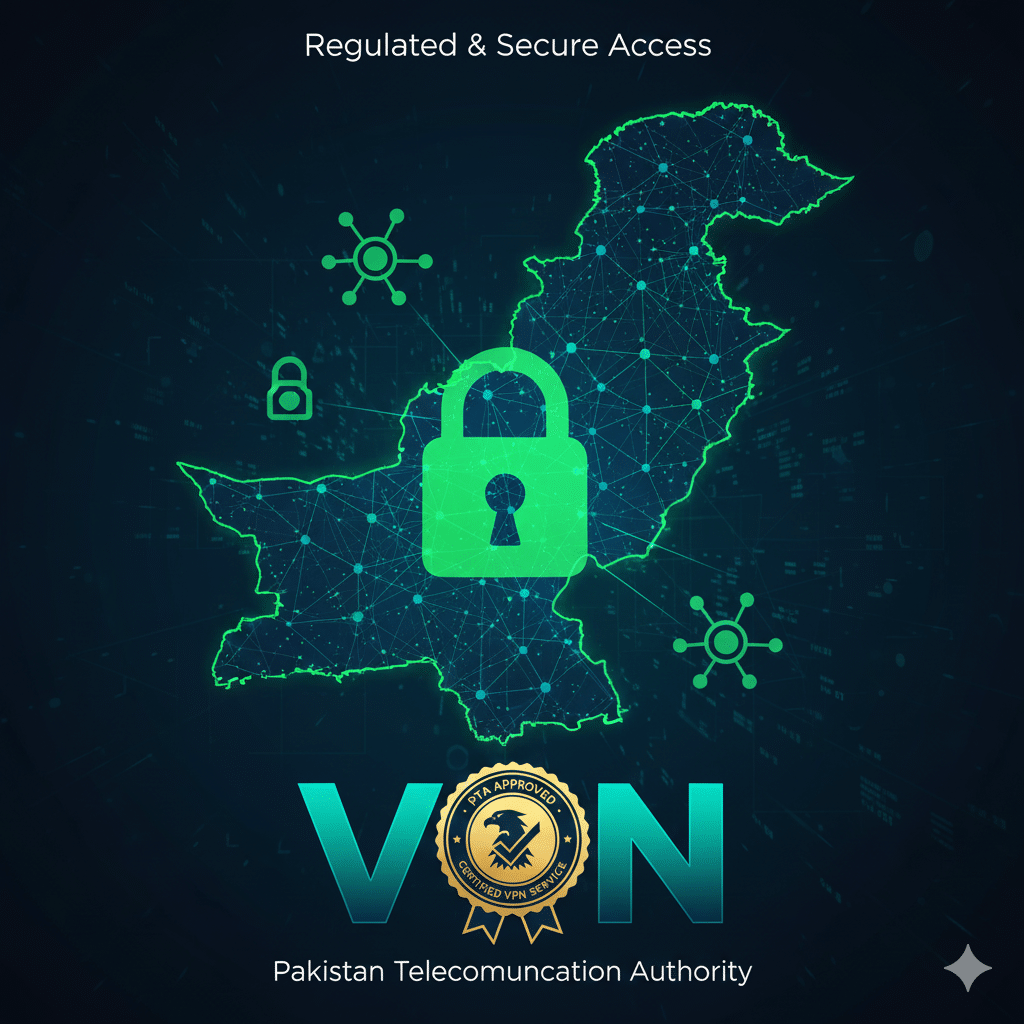

In a major move reshaping how internet privacy tools operate in Pakistan, the Pakistan Telecommunication Authority (PTA) has formally resumed licensing of VPN service providers under the reinstated Class Value Added Services for Data (CVAS-Data) regime(Licensing VPN).
On November 13, 2025, PTA announced it granted Class Licenses to several companies to legally provide VPN services to individuals and organizations — a clear signal that the regulatory framework will now guide which VPNs are allowed, under what conditions, and how they operate in Pakistan.
The move marks a turning point for internet users: VPNs are no longer in a legal grey zone — only “licensed” services will officially be considered lawful. But this also raises questions about privacy, access, and oversight. Let’s explore what this licensing push means, who is licensed so far, and what to expect moving forward.
What changed: PTA’s renewed licensing under CVAS-Data
✅ Resumption of CVAS-Data licensing for VPNs
PTA originally reactivated its class-licence framework for data services in December 2024, signaling that VPN and related services would need to obtain proper authorization to operate legally.
After several months of preparation, by November 2025 the licensing began in earnest. The regulator issued Class Licenses to multiple VPN service providers, bringing them under regulatory oversight.
📝 Authorized providers list — who’s official now
According to official PTA statements, the following companies have received CVAS-Data licenses to offer VPN services in Pakistan:
Alpha 3 Cubic (Pvt) Ltd — “Steer Lucid VPN”
Zettabyte (Pvt) Ltd — “Crest VPN”
Nexilium Tech (SMC-Pvt) Ltd — “Kestrel VPN”
UKI Conic Solutions (SMC-Pvt) Ltd — “QuiXure VPN”
Vision Tech 360 (Pvt) Ltd — “Kryptonyme VPN”
With this licensing, users can now subscribe directly to licensed VPN services — without separately registering their IP addresses or mobile numbers with PTA.
🎯 What PTA says: aims and justification
PTA frames this licensing push as a way to ensure “secure and lawful VPN services,” with compliance to data protection standards and national regulations. The move aims to reduce the prevalence of unregulated VPNs, which may be used to bypass censorship or hide malicious activity, while offering users legitimate access under regulatory oversight.
In its announcement, PTA emphasized user convenience: licensed providers now offer VPN services without requiring users to individually register each VPN connection — a simplification of prior cumbersome processes.
Why this matters — Impacts and potential effects
🔐 For cybersecurity and regulation: legal clarity
For years, VPN use in Pakistan existed in a murky space — with intermittent crackdowns, demands for IP-registration, and fears of outright bans. The new licensing framework gives legal clarity: only PSV (licensed VPN services) will be officially deemed lawful. That could make compliance and enforcement more straightforward for both providers and users.
Licensed VPNs will likely be subject to regulatory obligations: registering data centers, retaining compliance with PTA oversight, and possibly cooperating with government monitoring when required. Indeed, under previous licensing framework guidance, providers were expected to operate using locally registered data centers.
If fully enforced, this could significantly reduce the market of global/unregistered VPNs — pushing users toward domestic, regulated options.
🛠️ For businesses, freelancers, and remote workers — a path forward
Providers and freelance groups welcomed the licensing move. The Pakistan Software Houses Association (P@SHA) had previously advocated for licensing as a way to streamline legal VPN access for companies and freelancers.
PTA’s licensing allows licensed VPN services to serve individuals and organizations — which could benefit freelancers needing stable, legitimate VPN connections for remote work, encrypted communication, and secure project access.
⚠️ For privacy advocates and everyday users — trade-offs and concerns
However, this regulatory push raises significant privacy and freedom concerns. By centralizing legal VPN provision, the state potentially increases oversight and surveillance capability — VPN traffic could be more easily logged or monitored under legal mandate. Data-protection standards and enforcement transparency will matter a great deal if this regulatory model is to respect user privacy.
Also, many previously used international VPN providers (foreign-based, unlicensed) might be blocked — forcing users to choose local, licensed VPNs, which may or may not offer the same level of privacy or server diversity. Early reporting suggested that only a limited set of providers are licensed, possibly restricting options for users seeking robust, global VPN services.
Indeed, a March 2025 article from a Pakistani news site warned that the government may block certain VPNs once registration completes — reinforcing concern that unlicensed VPNs may face shutdowns.
What comes next — what to watch for
Adoption by more providers: Right now, PTA licensed a limited number of VPN services. Over time, more providers may apply for CVAS-Data licences — especially if demand from businesses and freelancers grows.
Regulatory enforcement vs. user privacy: The balance between lawful surveillance prevention and user privacy is delicate. Users and civil-rights groups will likely demand transparency from licensed providers on logging practices, data retention policies, and government access.
Possible blocking of unlicensed VPNs: PTA’s prior statements and warnings suggest unlicensed VPNs — especially foreign-based, anonymous ones — may become inaccessible or outright banned. Users relying on such services may need to migrate to licensed alternatives.
Impact on remote-work economy: For many Pakistani freelancers and IT professionals working with overseas clients, regulated VPN provision could ease compliance while preserving some connectivity — but only if licensed services offer reliable performance and accessibility.
Conclusion
The 2025 restart of VPN licensing by the Pakistan Telecommunication Authority under the CVAS-Data regime marks a watershed moment for digital privacy and regulation in Pakistan. For the first time in a long time, VPN use isn’t just tolerated — it’s regulated, formalized, and tied to legal authorization.