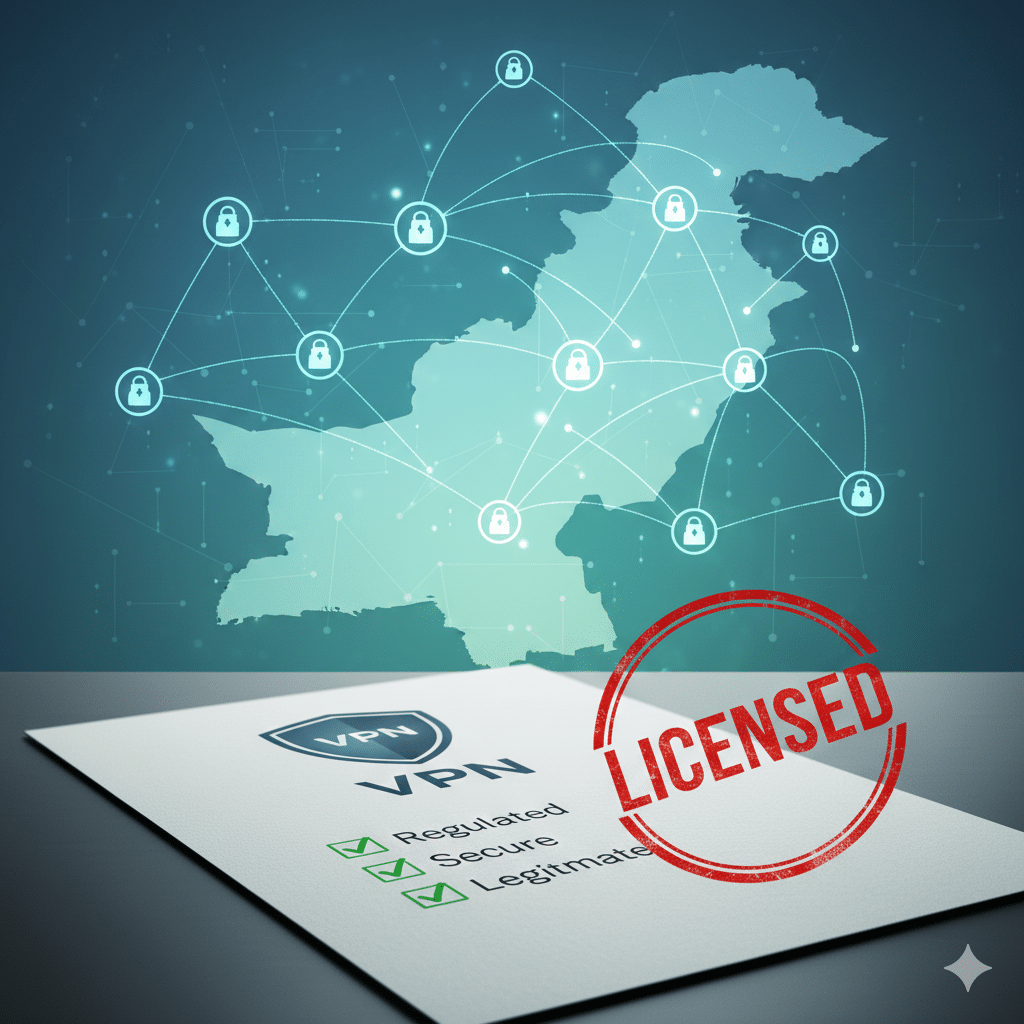

In a major shift for internet regulation and digital services in Pakistan, the PTA has officially begun licensing virtual private network (VPN) service providers under the reinstated CVAS-Data (Class Value Added Services – Data) regime.
Granting class licenses to a set of companies signals a move toward formalizing and regulating secure VPN access — a notable departure from prior crackdowns and unregulated, often opaque VPN usage. This change could reshape how individuals and organizations access encrypted internet services in Pakistan(PTA licenses VPN).
In this article, we analyze what the licensing means, who’s licensed, what users should expect, and the broader implications for privacy, compliance, and internet freedom in Pakistan.
What’s changed: PTA’s new VPN licensing framework
From unregulated VPN use to licensed providers
VPN usage in Pakistan has long been contentious. Following a crackdown on unregistered VPNs, the government and the PTA tried requiring businesses, freelancers, and technology firms to register their VPN usage.
But in late 2025, the PTA reinstated Class Licences for data services and relaunched VPN regulation under a new structured framework: the CVAS-Data regime.
On November 13, 2025, the PTA announced that several companies have now been granted licenses, authorizing them to legally offer VPN services to individuals and organizations under defined regulatory standards.
Licensed VPN providers so far
The first group of licensed providers includes:
Alpha 3 Cubic (Pvt.) Ltd. (Steer Lucid)
Zettabyte (Pvt.) Ltd. (Crest VPN)
Nexilium Tech (SMC‑Pvt.) Ltd. (Kestrel VPN)
UKI Conic Solutions (SMC‑Pvt.) Ltd. (QuiXure VPN)
Vision Tech 360 (Pvt.) Ltd. (Kryptonyme VPN)
These class licences mean the providers can offer VPN services under a general set of regulatory conditions — eliminating the need for individual users or companies to register their IP addresses or mobile numbers separately with the PTA.
According to officials, this step is aimed at “regulatory facilitation, user convenience and enhanced cybersecurity across Pakistan’s digital ecosystem.”
What the licensing means for users & businesses
✅ Legal and regulated access
With these licenses, VPN use becomes formally legal under regulated providers. Users and organizations no longer need to jump through registration hoops — they can subscribe to a licensed provider and start using VPN services without separate PTA registration of IPs or mobile numbers.
This could greatly benefit remote workers, freelancers, businesses, and citizens needing secure internet access — especially in an environment where content restrictions or censorship had previously driven widespread VPN use. (Pave)
🔐 Regulatory compliance and data oversight
By licensing VPN providers under CVAS-Data, PTA aims to monitor and regulate data services. Licensed providers must comply with national data protection and cybersecurity standards, theoretically ensuring lawful, secure VPN operations in the country.
This could reduce misuse of unregistered VPNs for illicit activities, cybercrime, or bypassing lawful restrictions — aligning VPN usage with regulatory requirements.
⚠️ Possible implications for privacy, oversight, and user freedom
Regulated VPNs can be a double-edged sword. While regulation provides legal clarity and cybersecurity oversight, it may also bring increased monitoring, logging obligations, or restrictions compared with global, privacy-focused VPN providers.
Critics warn that centralized regulation and licensing could compromise user privacy — especially if providers are required to retain logs or cooperate with surveillance agencies. There’s concern this may undermine the traditional privacy promise of VPNs, turning them into state-approved gates rather than private tunnels.
In fact, some voices in Pakistani tech and digital-rights forums already view the move skeptically, fearing that the licensing regime could pave the way for a more controlled, less private internet environment.
Why the PTA acted — and what led to the revival of the licensing framework
Rising VPN demand and inconsistent regulation
VPN usage surged in recent years in Pakistan — driven by internet censorship, access restrictions (e.g., to social media platforms), remote working growth, and a growing freelancing industry.
Previous attempts by the PTA to crack down on unregistered VPN use or require individual registrations failed to fully curb unregulated VPNs. As a result, many users continued using foreign VPNs or unregistered services, sometimes putting them at risk of legal or security issues.
By reintroducing a structured licensing regime under CVAS-Data, the PTA aims to bring VPN services into a transparent, regulated, and legally compliant framework — balancing the demand for VPNs with regulatory and security concerns.
Government’s balancing act between control and utility
On one hand, VPNs offer privacy, access to global internet, and flexible work opportunities; on the other, regulators worry about misuse, cybercrime, and content bypass. The licensing approach serves as a compromise: allowing VPNs for “legitimate and lawful purposes” while subjecting providers to oversight.
What users should do now — practical guidance
Use only PTA-licensed VPN providers if you’re in Pakistan. Licensed providers have been publicly listed by PTA — check that the provider appears on the official list before subscribing.
Read the provider’s terms carefully. Understand what “lawful purposes” entail. Licensed providers may still be subject to data policies, logging requirements, or regulatory oversight.
Expect possible limitations compared with global VPNs. Licensed VPNs may offer fewer server locations or have restrictions, especially if compliance demands apply; privacy-oriented global VPNs may offer stronger anonymity — but may now be operating in a legal grey zone in Pakistan.
For businesses and freelancers: Licensing under CVAS-Data may simplify compliance and operations, but confirm that your VPN use aligns with legitimate and lawful purposes as defined by PTA.
Keep an eye on regulatory developments. As PTA climbs further into regulating data and internet services, policies may evolve — and compliance obligations may increase accordingly.
Conclusion
The PTA’s move to license VPN service providers under the CVAS-Data regime is a landmark decision — transforming VPN services in Pakistan from a largely unregulated, legally murky space into a formally sanctioned, regulated sector. For users and businesses, this could mean easier legal access to VPNs, clearer regulatory compliance, and potentially improved cybersecurity standards.
However, the shift also raises critical questions about privacy, data oversight, and the balance between regulation and internet freedom. For many users, whether this licensing improves safety — or undermines privacy — will depend heavily on how these providers handle data, what obligations they follow, and whether oversight remains transparent.