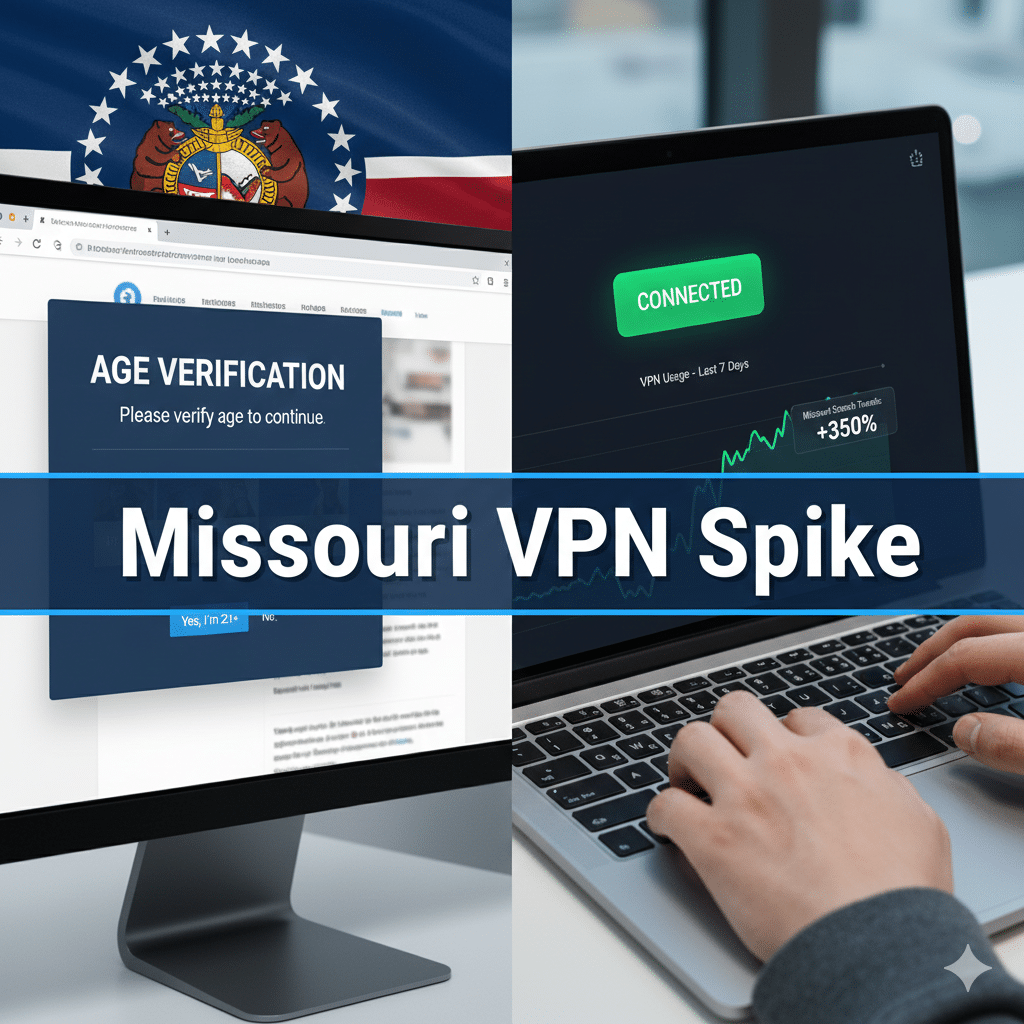

When Missouri’s age-verification rule took effect on November 30, 2025, residents and privacy advocates reacted quickly — and the response is measurable. Multiple outlets report that searches for VPNs in Missouri surged immediately after the new rule became active, with some sources noting a fourfold increase in local VPN interest as users sought ways to protect personal data or maintain access to sites subject to the verification requirement. This spike highlights a common pattern: regulatory changes affecting online access often drive consumers to seek privacy tools like VPNs.
What the Missouri law requires — and why people worry
Missouri’s rule mandates that commercial websites where one-third or more of the content is pornographic or “harmful to minors” must verify that users are over 18 before granting access. Verification methods can include government ID checks, biometric confirmation, or trusted digital-ID services — all of which involve handing sensitive personal data to third parties. The Attorney General’s office framed the rule as child-protection policy, but privacy groups warn the approach creates new data-collection risks.
The immediate concerns are twofold: (1) privacy — requiring ID or biometric checks funnels personal data to verification services that could be breached or repurposed; and (2) access — some major platforms may choose to block Missouri users rather than implement state-specific verification workflows. Both outcomes push users toward tools they believe preserve anonymity.
Evidence of the VPN search spike
Journalists monitoring trends reported a sharp uptick in searches for VPNs tied to the law’s enforcement date. Tech outlets covering the rollout observed that Missouri’s VPN search volume “quadrupled” on or around November 30 compared with recent baselines, mirroring earlier patterns seen in states that enacted similar rules. Local reporting and search-trend snapshots corroborate the surge.
However, experts caution that search spikes don’t automatically equal safe outcomes: many users drawn to “free” VPN offerings risk installing low-quality apps that leak data or carry malware. Advocacy groups (and prior reporting) emphasize that a rush to the cheapest VPN solution can expose users to worse privacy harms than the law itself intends to prevent.
Why people turn to VPNs — and what they actually do
A Virtual Private Network (VPN) masks a device’s public IP address and encrypts traffic between the device and the VPN provider’s servers. For many, that creates an illusion of anonymity and the ability to appear to be browsing from another location — useful both for bypassing geoblocking and for avoiding local content restrictions. But VPNs are not a magic bullet:
VPNs may help obscure a user’s IP from a website performing simple geolocation checks, but they do not prevent ID-based verification if the site requires an uploaded document or biometric check.
Using a VPN may raise legal or terms-of-service questions depending on the site and jurisdiction.
Crucially, a VPN shifts trust from your ISP to the VPN provider — so selecting a reputable, audited service matters.
The Electronic Frontier Foundation and other privacy groups have explicitly argued that VPNs aren’t a robust solution to age-verification mandates because they don’t stop identity collection when sites demand credentials or biometric confirmation.
Practical guidance for Missourians and others
If you’re concerned about the law’s privacy implications or are considering a VPN, keep these points in mind:
Know the limit of what a VPN does. It can mask IP location and encrypt network traffic, but it won’t bypass identity checks that require official documents or biometric verification.
Avoid dubious free VPNs. Choose providers with transparent privacy policies, independent audits, and a strong no-logs stance. Reports warn that many free VPNs monetize through tracking or worse.
Consider alternative privacy steps. If privacy is the main concern, minimize data shared with verification services (where possible), use disposable payment methods, and enable two-factor authentication on critical accounts.
Follow official guidance. Monitor state and platform notices: some large sites may geo-block Missouri rather than implement local verification; that affects whether a VPN would even help.
Conclusion
Missouri’s November 30, 2025 age-verification rule has done more than change site workflows — it has produced a measurable, immediate behavioral response among residents seeking privacy and access. The quadrupling of VPN interest in many reports underlines a predictable effect: policies that increase identity checks online will drive users toward privacy tools. But the spike also raises risk — users hurriedly downloading the first “free VPN” could inadvertently trade one set of privacy problems for another. The steady takeaway is clear: legal and technical solutions must be designed with privacy in mind, and consumers should choose vetted tools rather than quick fixes.