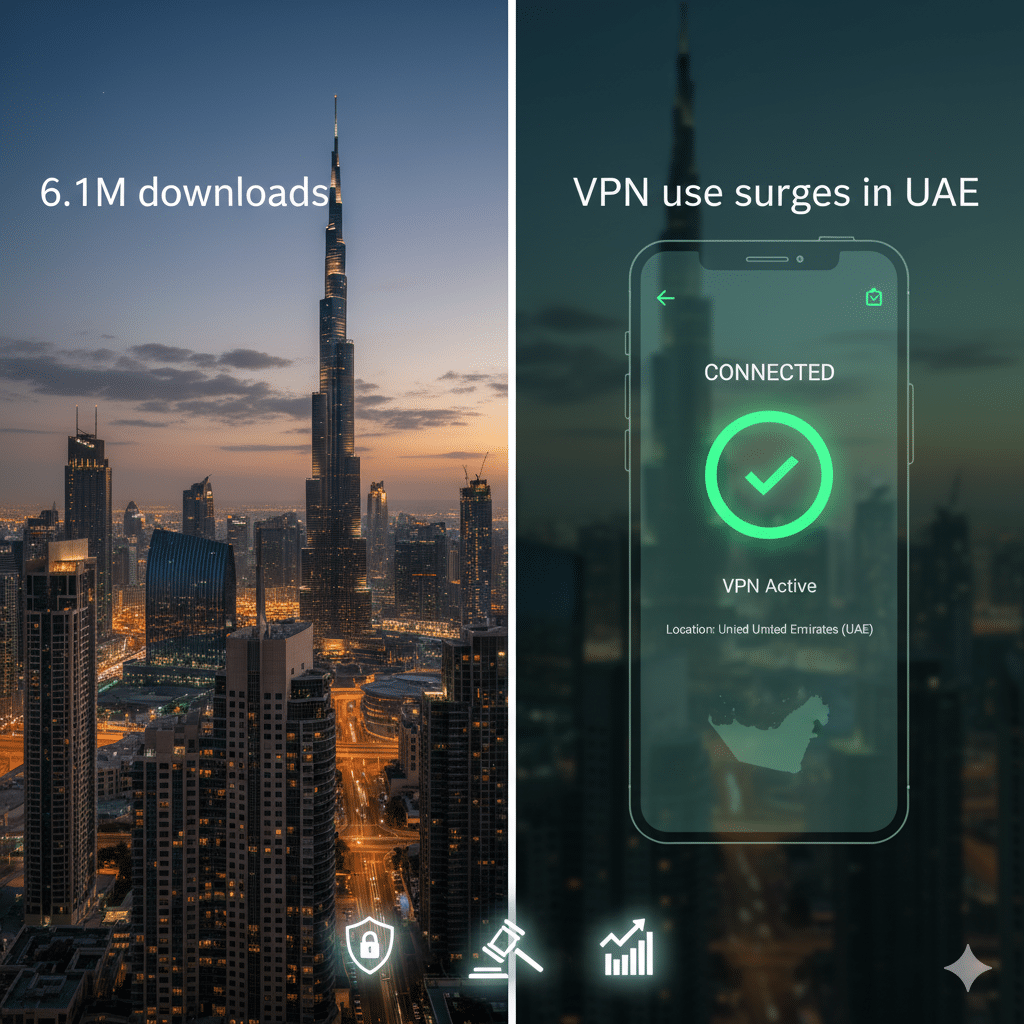

The United Arab Emirates has surged to the top of global VPN adoption charts in 2025, recording roughly 6.0–6.1 million VPN app downloads in the first half of the year and showing an average adoption rate of ~65.78% for the 2020–mid-2025 period. That spike places the UAE ahead of every other country in the latest industry analyses — a development that matters for consumers, regulators and VPN providers alike.
What the numbers show
Multiple industry trackers reported the same pattern: heavy VPN uptake across Gulf countries with the UAE leading. Cybernews’ Global VPN Adoption Index and related reporting put the UAE’s average adoption at about 65.78% from 2020 through H1-2025, while local and regional outlets note ~6 million downloads in the first half of 2025 alone. That growth is driven by residents seeking private communications, access to blocked services (VoIP, streaming), and general online privacy.
Comparatively, the Gulf region shows some of the world’s highest adoption rates: Qatar and Singapore follow, but none match the UAE’s combined downloads and penetration during this recent measurement window. Analysts attribute this to a mixture of strict content controls, high smartphone penetration, and a cultural preference for secure messaging and VoIP.
Why UAE users are installing VPNs
Several practical reasons underpin the surge:
Access to restricted services and VoIP: Residents often use VPNs to access VoIP and other apps that face restrictions or inconsistent availability.
Privacy and anonymity: With increased public awareness of tracking and data collection, many users turn to VPNs as a basic privacy layer.
Streaming and geo-unlocking: Demand for international streaming libraries and gaming content pushes many consumers to VPNs that can reliably unblock services.
Risks, regulation and official response
The rise in downloads has also drawn regulatory and law-enforcement attention. UAE authorities have repeatedly warned against the misuse of VPNs to commit illegal acts, and misuse can attract heavy fines or criminal penalties under existing cybercrime laws. Officials emphasize that while using a VPN itself is not automatically illegal, using it to conceal criminal behaviour is punishable. This regulatory stance adds nuance for users — widespread adoption does not mean unchecked freedom.
From a provider perspective, high adoption in a jurisdiction that enforces strict rules creates compliance and reputational challenges. VPN firms that advertise anonymity must be careful about how they present services and where they host servers and legal entities.
What this means for VPN companies
For VPN vendors, the UAE trend is both an opportunity and a risk:
Market opportunity: Millions of downloads indicate a sizeable consumer market for both paid and freemium services. Localized apps, Arabic language support, and reliable obfuscation (to avoid detection) are differentiators.
Legal exposure: Providers must weigh whether to offer certain features in jurisdictions with strict enforcement, and to be transparent about logging practices, local servers, and legal requests.
How users should respond (practical advice)
If you’re in the UAE or traveling there and considering a VPN:
Know the law: Using a VPN to break local laws (e.g., to access prohibited content) can be prosecuted. Install and configure services with awareness of local rules.
Prefer audited, reputable providers: Choose VPNs with third-party audits, clear no-logs policies, and transparent jurisdictional arrangements.
Avoid sketchy free apps: Investigations repeatedly show that some free or obscure VPN apps collect user data or are linked to companies with questionable practices. Investing in reputable services reduces risk.
Expert & industry perspectives
Industry reports and local coverage converge on a theme: high demand plus tight regulation equals a complex market. Cybersecurity analysts point out that the UAE’s combination of heavy smartphone usage and appetite for private comms naturally produces high download counts, while regulators stress responsible use. VPN market analysts see strong commercial opportunity but warn providers to be explicit about legal boundaries and data practices.
Conclusion
The UAE’s leading position in VPN downloads — roughly 6.0–6.1 million installs in H1-2025 and an average adoption rate near 65.8% over five years — signals both strong consumer demand for privacy and content access and a policy environment that complicates how those tools can be used. For users, the takeaway is straightforward: choose reputable, audited VPN services and stay informed about local laws. For providers, the UAE is an attractive but legally sensitive market that rewards transparency and compliance-minded product design.
Sources & verification
Cybernews — Global VPN Adoption Index (VPN adoption stats; UAE lead). (Cybernews)
Khaleej Times — “VPN in UAE: 6 million downloads in half a year” (regional coverage & fines). (Khaleej Times)
Times of India — reporting on UAE VPN download surge and context. (The Times of India)
TechRadar — VPN guides and regional VPN behaviour insights. (TechRadar)
DarkReading — historical context on UAE VPN downloads and official warnings. (Dark Reading)