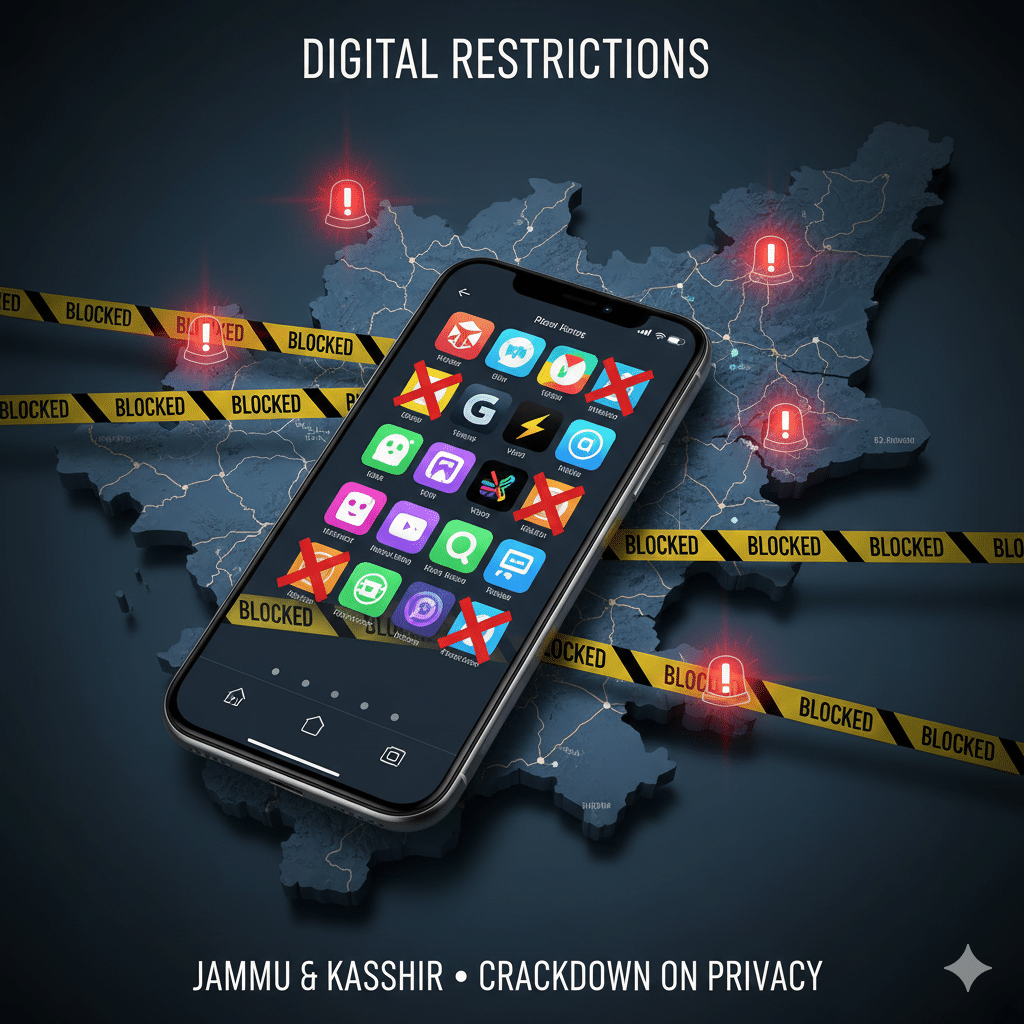

In early 2026, authorities in Jammu & Kashmir significantly stepped up enforcement actions against the use of Virtual Private Network (VPN) services across multiple districts — citing public safety, cyber security, and law-and-order concerns. The move has sparked both operational challenges and heated debates over digital privacy and internet access in a region already accustomed to connectivity restrictions and surveillance.(VPN Crackdown)
What began as administrative orders restricting VPN use has now escalated to FIRs, legal charges, and widespread identification of individuals allegedly violating the prohibitions. This article explores the policy catalyst, enforcement actions, local impacts, and wider debates surrounding the VPN crackdown in Jammu & Kashmir.
Policy and Enforcement: From Suspensions to Criminal Charges
Blanket Bans Under Emergency Powers
In late December 2025, district authorities in Jammu & Kashmir began issuing orders to suspend or ban VPN services for up to two months, often under Section 163 of the Bharatiya Nagarik Suraksha Sanhita (BNSS), 2023 — a provision enabling preventive action in situations deemed threatening to public order.
These bans affected several border and valley districts, including:
Rajouri and Poonch, where VPN services were suspended citing misuse and potential threats.
Budgam, where mobile VPN use was ordered suspended for public safety and digital security reasons.
Kulgam and Kupwara, where authorities similarly restricted VPN use, emphasizing risks to law and order.
Officials claimed widespread VPN usage by “suspicious internet users,” and warned of potential exploitation of encrypted traffic for unlawful activities, such as evading firewalls or spreading inflammatory material.
Crackdown Intensifies: Dozens Identified, FIRs Filed
While bans were first administrative, enforcement rapidly intensified. According to multiple regional sources:
Dozens of individuals have been charged for continuing to use VPNs despite prohibitory orders. Law enforcement reportedly verified mobile phones and checked for VPN apps to enforce compliance.
Authorities identified around 800 residents in the Kashmir Valley for alleged VPN use violations, with some cases leading to FIRs under prohibitory orders.
Police actions included inspection drives and legal processes in districts such as Budgam and others where the ban is active.
These steps represent a notable shift from advisory enforcement to formal criminal accountability, opening individuals up to legal risks for using widely available privacy tools.
Local Impacts: Privacy, Work, and Digital Access
For many residents of Jammu & Kashmir, VPNs are not merely tools to circumvent geographic restrictions — they are integral to everyday online activity, including:
Secure remote work and business communications
Access to educational resources and international research platforms
Protection of personal data on public or unsecured networks
Long-time connectivity restrictions and internet limitations in the region mean that VPNs have often been a practical necessity for students, professionals, and residents, not just a means of evading blocks.
As enforcement tightens, users fear disproportionate impacts on digital access, productivity, and personal security — particularly where encryption tools are standard elements of modern online life.
Security Rationale and Official Justifications
Authorities say the punitive measures are preventive and security-oriented, designed to:
Ensure public order and law enforcement visibility
Prevent misuse of encrypted traffic for unlawful or criminal activities
Enhance cyber security in a high-risk, sensitive environment
A senior official described the actions as necessary due to intelligence inputs and patterns of VPN use that could potentially hinder lawful monitoring.
Supporters of the crackdown emphasize that unrestricted VPN use can complicate investigations and limit real-time insights on harmful online behavior in a region with ongoing security considerations.
Criticism and Debate: Privacy vs. Security
Digital rights advocates, business groups, and some local commentators have voiced concerns about the breadth and impact of the VPN bans:
They argue that criminalizing VPN use blurs the line between non-criminal digital privacy practices and suspicious behavior.
Critics highlight that VPNs are legitimate tools for encryption and personal security globally, used by individuals and organizations alike.
Some warn that such measures could undermine digital rights and discourage legitimate internet usage in an area already facing connectivity constraints.
These debates mirror broader tensions seen in other regions: finding a balance between national or regional security imperatives and individual digital freedoms remains contentious.
Conclusion: A Complex Balance Between Safety and Privacy
The VPN crackdown in Jammu & Kashmir marks a significant escalation in local internet governance and digital security enforcement. With administrative bans now backed by legal charges and enforcement drives, users in the region face mounting pressure to comply or risk legal consequences for activities that elsewhere remain lawful.
As authorities frame these actions as protective measures in a sensitive region, civil liberties advocates caution that blanket restrictions on encryption tools like VPNs can erode privacy, hinder legitimate use, and disproportionately affect everyday digital life.
Ultimately, the controversy underscores a broader global question: How can governments address security concerns without unduly infringing on digital privacy rights? The outcome in Jammu & Kashmir may influence similar policy debates in other high-security contexts around the world.