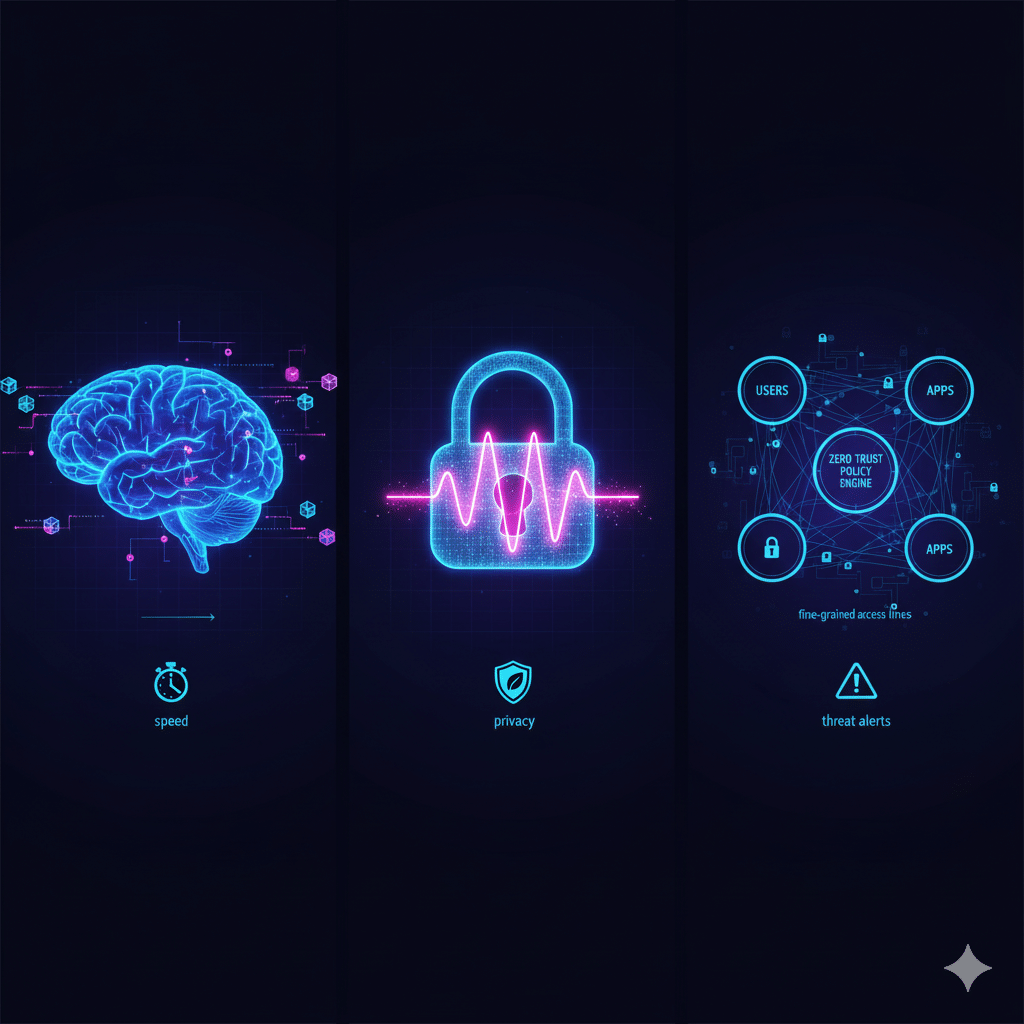

VPNs are no longer just about hiding an IP address. In 2025 the category is being reshaped by three converging forces: AI-driven threat detection and optimization, post-quantum (quantum-safe) cryptography, and the broad industry move toward Zero Trust Network Access (ZTNA)(VPN Future). Together these trends are changing how VPNs protect privacy, deliver performance, and resist future threats. Below we unpack each trend, show what vendors are doing, and explain what users and security teams should watch for.
1) AI: Smarter defense — and smarter attacks
AI is already transforming how VPN providers and enterprises detect and respond to threats. Large vendors and security teams are embedding machine learning models to flag anomalous connections, detect credential stuffing or account takeover patterns, and optimize routing decisions in real time. Cisco and other industry reports show widespread adoption of AI-based cyber tooling across organizations, accelerating detection and automating response workflows. For VPNs, that means smarter threat blocking (malicious endpoints or bot traffic), dynamic server selection for optimal latency, and automated load balancing based on predicted demand.
At the same time attackers are using AI to automate reconnaissance and craft more convincing social-engineering lures. This turns AI into both shield and sword — raising the stakes for continuous model tuning, adversarial-resistant ML design, and human oversight.
2) Quantum-safe encryption: preparing for tomorrow, today
Quantum computers threaten some widely used asymmetric algorithms (notably RSA and certain elliptic-curve schemes). To future-proof communications, several VPN vendors are already shipping post-quantum (PQC) or hybrid quantum-safe key exchanges — combining classical crypto with quantum-resistant algorithms so traffic remains secure even if harvested now and decrypted later. NordVPN, Windscribe and other providers have publicly rolled out PQE/quantum-resistant options for connections, and industry guidance (NIST standards, Europol recommendations) is pushing enterprises to inventory vulnerable crypto and plan migrations. For high-value data and regulated industries (finance, health), adopting quantum-resistant VPNs is moving from “optional” to “recommended.”
Practical note: post-quantum measures often use hybrid modes (classical + PQC) to preserve compatibility and performance while incrementally increasing cryptographic resilience. Vendors emphasize careful rollout and opt-in toggles so users can balance compatibility with long-term security.
3) Zero Trust (ZTNA): VPN as a feature, not the whole solution
The most strategic shift is architectural: enterprises are replacing broad, network-wide VPN tunnels with Zero Trust Network Access (ZTNA) models that grant least-privilege, per-app access based on identity and device posture. Zscaler and market analysts report strong momentum for Zero Trust, and forecasts show ZTNA market growth as organizations phase out conventional VPNs in favor of fine-grained access control and continuous verification. ZTNA reduces lateral movement risk, simplifies auditing, and often improves user experience by avoiding full network tunnels.
For many vendors, ZTNA isn’t an either/or choice — it’s becoming a complementary capability. Some VPNs now offer ZTNA overlays or integrate with identity providers so customers can migrate gradually (ZTNA over VPN as a transitional pattern).
How these trends intersect (and what that means)
AI + ZTNA: AI improves context-aware access decisions — for example, suspending access if anomalous behavior is detected, or dynamically tightening policies during high-risk windows.
Quantum + ZTNA: Even in a Zero Trust world, cryptographic protections remain essential. ZTNA solutions that support quantum-safe ciphers give long-lived assurance for sensitive sessions.
AI + Quantum: AI can help detect cryptographic misuse or configuration drift that might expose systems to quantum-era weaknesses — and automate remediation at scale.
Recommendations for security teams and users
Inventory crypto: Identify where long-lived secrets or archived traffic could be harvested for future decryption; prioritize PQC upgrades for high-risk assets.
Adopt ZTNA gradually: Start with critical applications and vendors that support per-app access and integrate with your identity stack. Use ZTNA over VPN patterns where needed during migration.
Use AI defensively — carefully: Deploy AI/ML features from reputable vendors, but monitor models for drift and adversarial manipulation; ensure human-in-the-loop controls.
Prefer hybrid quantum-safe modes: When available, choose providers offering hybrid PQC (classical + PQC) to balance compatibility and future security.
learn more than VPN Usage Declines in U.S. 2025
Conclusion
The VPN category is evolving from a single-purpose tunneling tool to a component of a richer, more resilient access stack. AI brings smarter detection and performance tuning, quantum-safe cryptography protects against future decryption risks, and ZTNA reshapes how access is granted and controlled. Organizations that plan for all three — adopting ZTNA patterns, enabling PQC where it matters, and responsibly applying AI — will be best positioned to offer secure, private, and high-performing remote access in the years ahead. Keep an eye on vendor roadmaps and independent audits as you evaluate providers: the next generation of VPN features is already here.