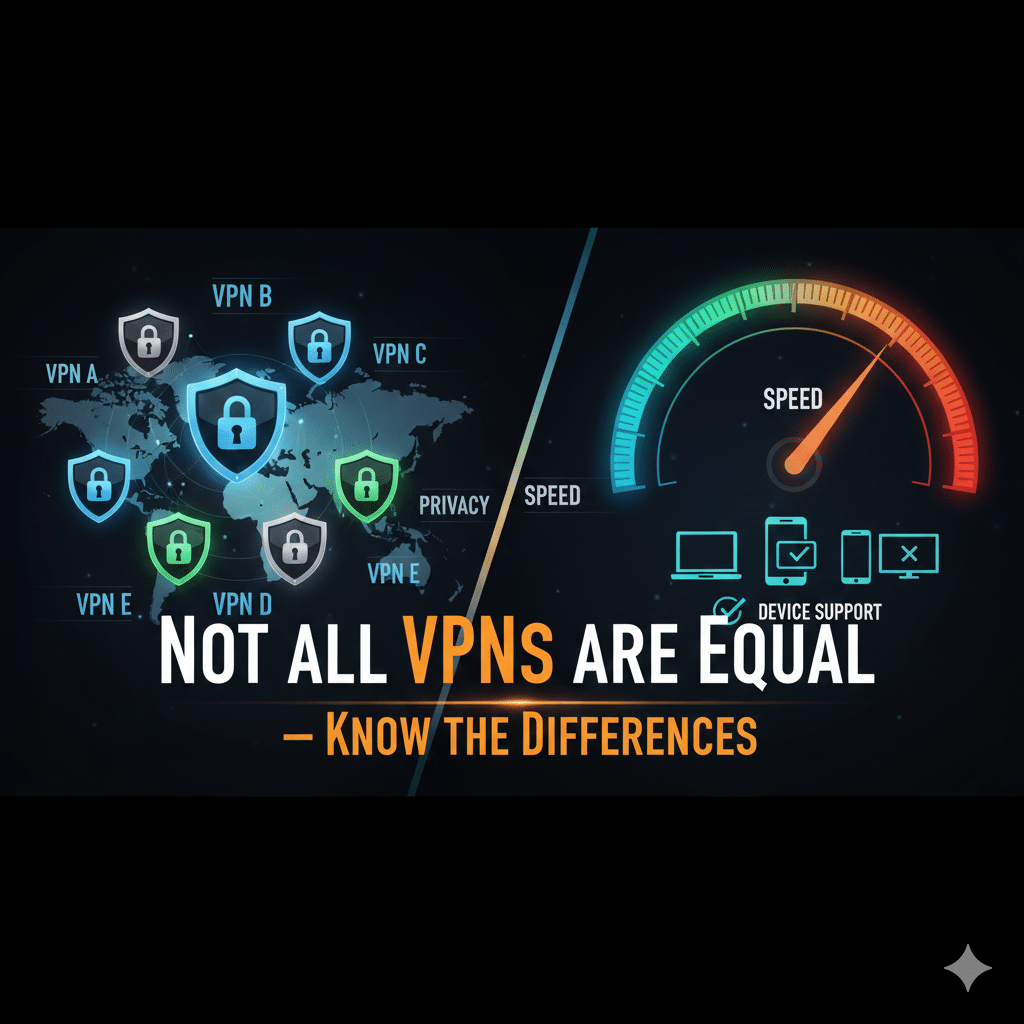

In 2025, as internet privacy concerns grow and VPN usage becomes mainstream for streaming, remote work, or bypassing geo‑restrictions, independent VPN reviews and tests reveal a crucial lesson: not all VPN services are equal. Performance, privacy, and compatibility vary widely — and depending on your priorities (speed, security, device support), the “best VPN” for someone else might be a bad fit for you (VPN testers). This article dives into recent comparative testing to show what matters when choosing a VPN, and why blanket claims like “fastest” or “most secure” should always be taken with caution.
Key factors where VPNs differ — and why they matter
🔄 Speed and performance — from blazing-fast to sluggish
Speed remains one of the most distinguishing factors among VPN providers. According to a recent 2025 testing report reviewing over 50 VPNs, some top-tier services suffer less than 5% download speed loss, while others introduce substantial lag.
For example:
NordVPN — often praised as “Best VPN for Security & Privacy” — reportedly showed very minor speed degradation (≈ <5%), even while using a large global server network spanning over 8,000+ servers across more than 120 countries.
On the other hand, some VPNs reviewed in 2025 presented speed losses of 15–20%, or inconsistent performance depending on server location or device, which can cause buffering in streaming, lag in gaming, or slow loading in remote‑work scenarios.
Speed matters not only for convenience; poor performance undermines the main benefits many seek from a VPN — privacy combined with usability.
Device coverage & app compatibility — what works where
A VPN’s usefulness also depends heavily on device support. Modern internet use spans multiple devices: laptops, phones, tablets, smart TVs, routers — not all VPNs perform equally across all platforms.
Top tier VPNs in 2025 tend to support a wide range of devices and operating systems.
For instance:
NordVPN, Surfshark, and ExpressVPN remain among the most compatible providers, covering Windows, macOS, Linux, Android, iOS, as well as streaming devices and smart TVs — a key advantage for users who switch between different devices regularly.
Some smaller or budget‑oriented VPNs (especially free or heavily discounted ones) may limit simultaneous device connections or lack optimized clients for smart TVs / streaming boxes, making them a poor choice if you plan to secure multiple devices.
So, if you value flexibility — streaming on a smart TV, browsing on a phone, secure work on a laptop — device support must be a key criterion when selecting a VPN.
Privacy policies, logging, and security — don’t ignore what’s under the hood
A fast and multi‑device VPN is useless if it compromises privacy. Recent expert testing underscores that formal privacy and security practices — such as no‑logs policies, secure server infrastructure, and encryption protocols — remain essential differentiators.
Many of the top‑rated VPNs in 2025 provide RAM‑only servers, meaning no user data persists after the server resets — reducing risk of data retention or seizure.
Strong encryption standards (e.g. AES‑256), automatic “kill switch” on connection drop, and leak protection (DNS, IPv6, WebRTC) are common among well‑reviewed VPNs.
Additionally, transparent logging policies and audits — and jurisdiction in privacy‑friendly countries — add another layer of credibility for users who want to minimize third‑party tracking or legal exposure.
In contrast, VPNs prioritizing low cost or free plans often skip independent audits, use shared or persistent servers, or have limited transparency — introducing risks to privacy that may nullify the very reason users install a VPN in the first place.
Trade‑offs: What you gain — and what you might lose — depending on your choice
Because VPN features vary widely, choosing one often involves trade‑offs:
What you wantWhat to prioritizeWhat you might compromiseMaximum speed & streamingFast server network + optimized protocolsSome advanced privacy features or fewer servers in niche countriesMaximum privacy & anonymityRAM‑only servers, audited no‑logs policy, strong encryptionLower speeds, fewer servers, possibly higher costMulti‑device coverage & convenienceBroad device support, user‑friendly appsSlight lag on some devices, more expensive planBudget / low costAffordable VPN with decent basic featuresFewer servers, slower speeds, weaker privacy guarantees
Thus, there’s no one-size-fits-all “best VPN” — only the right VPN for your individual needs.
Recent comparisons & standout findings from 2025
Recent 2025 rankings of top VPNs reinforce these distinctions:
NordVPN remains widely recommended as a top all‑rounder, with a large server network, high speed, strong privacy controls and broad compatibility.
Surfshark stands out for users on a budget or with many devices: it offers attractive pricing, unlimited simultaneous device connections, and a balance of speed, privacy, and usability.
ExpressVPN maintains robust performance across global servers and ease-of-use, especially for streaming and cross‑platform use.
Yet — and this is crucial — not every VPN in the “top 5” category will behave the same depending on server region, connection distance, or device type. Users testing long‑distance servers or streaming from mobile devices noted more variation than when using short-distance or desktop connections.
What to do before subscribing to a VPN — a user checklist
Based on extensive 2025 testing and expert reviews, here’s a recommended pre‑subscription checklist:
Check real‑world speed performance — look for independent tests showing minimal speed drop (ideally <10–15%) especially for your region.
Review device compatibility and simultaneous connections — ensure the VPN supports all your devices: PC, phone, smart TV, router, etc.
Read privacy policy carefully — prefer RAM‑only servers, audited no‑logs policies, and clear jurisdiction outside heavy surveillance alliances.
Verify protocol and encryption standards — modern VPNs should support protocols like WireGuard or proprietary secure protocols, with AES‑256 encryption, kill‑switch, and leak protection.
Consider use case: streaming vs privacy vs remote work — choose the VPN that balances speed, privacy, and convenience based on what matters most for you.
Conclusion
The 2025 wave of VPN reviews confirms what long‑time privacy advocates have warned: VPN services vary dramatically — and choices matter. Speed, device support, server infrastructure, privacy policies, and transparency distinguish the reliable from the mediocre.
For users, the takeaway is straightforward: don’t treat “VPN” as a monolith. Instead, evaluate providers based on your real needs — performance, privacy, ease-of-use — and choose accordingly. A good VPN can greatly enhance your online privacy and access; a subpar one may offer little benefit, or even introduce new risks.