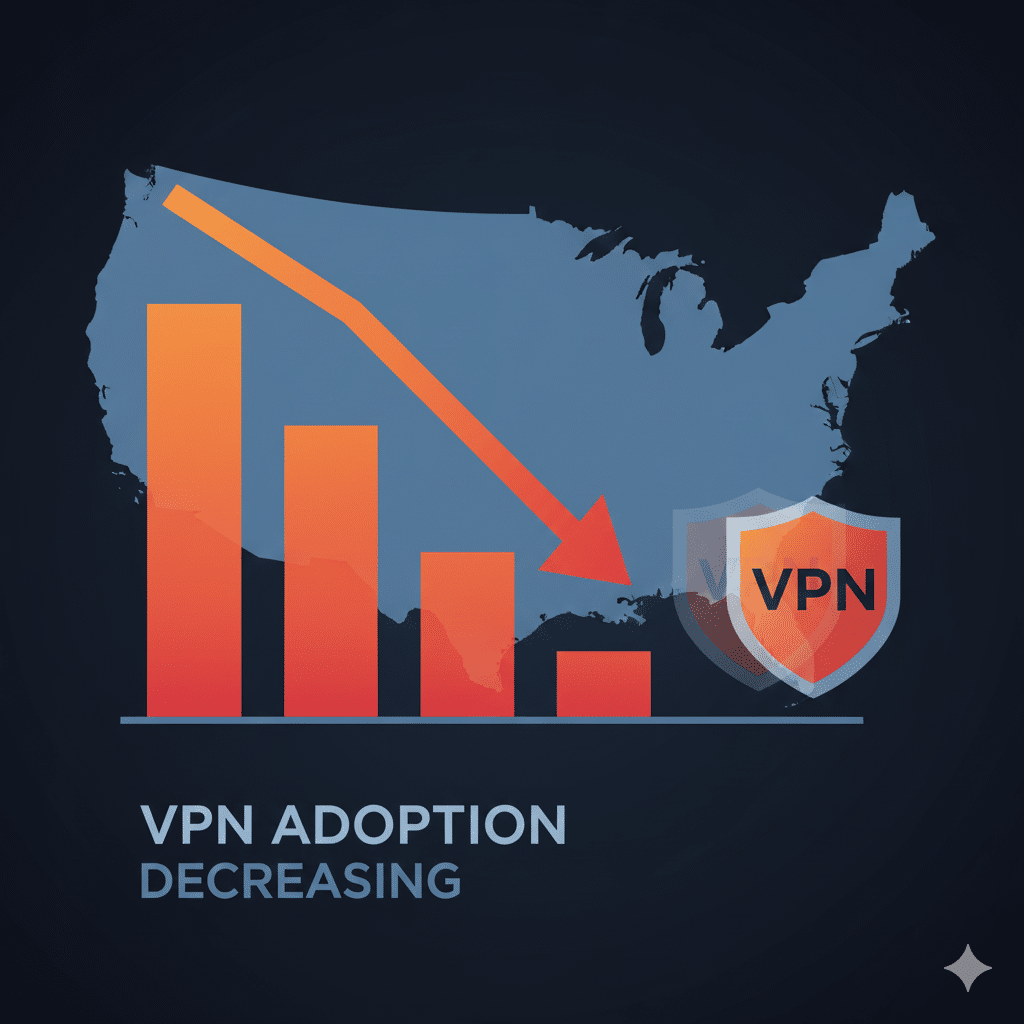

A surprising turn in the VPN market: according to the 2025 annual survey conducted by Security.org, only 32% of American adults now report using a VPN, down from 46% just a couple of years ago. This sharp decline in VPN usage isn’t necessarily a sign of shrinking interest in privacy — but rather indicates a maturing market, with use cases becoming more selective and specialized. Understanding the forces behind this shift is essential in a rapidly evolving digital-privacy landscape.
What’s Behind the Drop in U.S. VPN Users
Survey Data & Methodology
Security.org surveyed 1,009 U.S. adults in June 2025, producing what it describes as a nationally representative snapshot of VPN adoption.
According to their findings:
32% currently use a VPN, compared with 46% in 2023.
Business-only use of VPNs has dropped considerably: only 8% of adults say they use VPNs for work today, versus 13% in 2023.
Awareness remains high: even among non-users, many understand what a VPN does — but they may not feel they need one.
Why VPN Usage Is Declining — But That Doesn’t Mean the Market Is Collapsing
1. Shifting Motivations and Use Cases
For many, VPNs are no longer a “must-have” for basic privacy. The drop in usage suggests that early adopters and casual users who downloaded VPNs during peak privacy concerns or remote-work surges are now re-evaluating their need.
Personal vs. business use: The steepest decline is in business VPNs. Companies are increasingly replacing traditional VPNs with more modern, secure access technologies (like Zero Trust), reducing demand from remote workers.
Selective adoption: People who continue using VPNs tend to be the “privacy-first” segment — those deeply concerned about tracking, public Wi-Fi, or data leaks.
2. Misinformation or Misperception
Despite broad awareness, many non-users still cite a lack of understanding or perceived benefit as reasons for not using a VPN:
In the same survey, 30% said they “don’t need one,” and another 18% said they “don’t see the benefit.”
15% said they simply don’t know enough about VPNs to feel confident using one.
These barriers suggest education and awareness remain significant issues — even as privacy remains a hot topic.
3. Free vs Paid Options
Among the remaining users, not all are paying:
According to Security.org, 28% rely on free VPNs in 2025.
The remainder uses paid services, often because they value stronger security, faster speeds, or more trustworthy privacy policies.
4. Market Maturation
The decline from 46% to 32% may not indicate disinterest, but a more mature, segmented market:
Early VPN adopters may have already signed up, and future growth could depend on more niche use cases rather than mass adoption.
VPN providers may shift toward offering value-added features (security suites, integrated privacy tools) rather than purely anonymous tunneling.
What the Decline Means for VPN Providers & the Industry
Adapting to a New Landscape
VPN providers must evolve or risk stagnation. The drop in general usage suggests that providers need to:
Invest in value-add features: Beyond just encryption — think malware protection, threat detection, or privacy suites.
Focus on retention and loyalty: With fewer new users, keeping existing customers becomes crucial.
Target market segments: Tailor offerings for power users (privacy-focused), remote workers, streamers, and business customers.
Educate users: Help non-users understand VPN benefits in the modern context, especially in light of rising cyber threats.
Competitive Pressure from Alternative Technologies
The rise of Zero Trust and cloud-native access models is reducing the relevance of traditional VPNs in many organizations.
For personal use, integrated privacy tools (e.g., encrypted browsers, built-in OS protections) could substitute some VPN functionality.
What This Means for Users
If you’re a current or potential VPN user, here are some takeaways:
Assess your use case: Do you really need a VPN 24/7, or only occasionally (when traveling, or using public Wi-Fi)?
Choose wisely: With fewer “casual” users, premium and privacy-focused VPNs compete more on trust, speed, and features than price.
Stay informed: As VPNs evolve, things like data-logging policies, infrastructure (e.g., diskless servers), and security certifications matter more.
Be realistic about protection: A VPN is not a magic wand for all privacy concerns — combine it with good device hygiene, strong passwords, and threat awareness.
learn more about AI, Quantum & ZTNA: VPN Future Trends
Conclusion
The drop in U.S. VPN usage to 32% in 2025 marks more than just a dip in popularity. It highlights a market in transition — one that’s moving away from mass-market adoption toward a more nuanced, purpose-driven model. VPNs remain a critical tool for privacy-conscious users and professionals, but their role is being redefined. For providers, the challenge is clear: evolve, educate, and differentiate. For users, the opportunity is to choose more thoughtfully — not just whether to use a VPN, but how and why you use it.