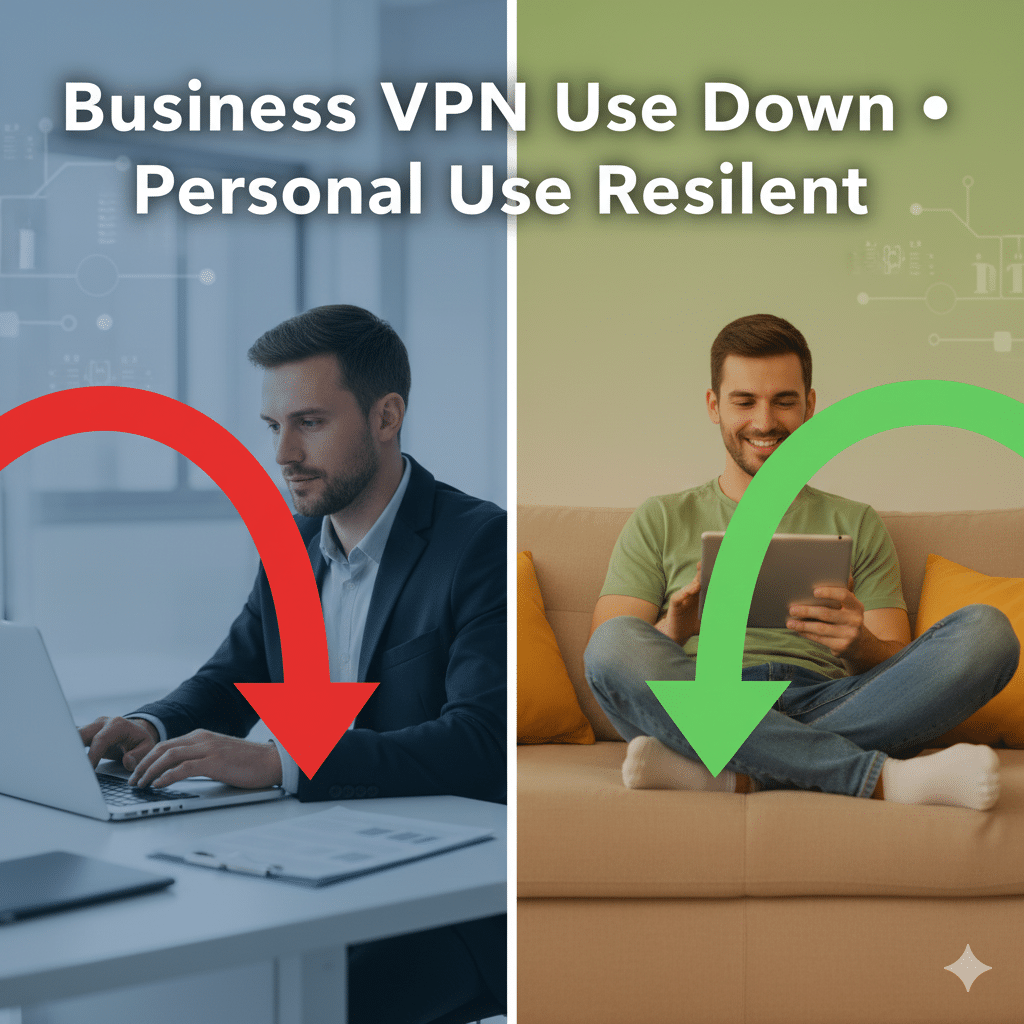

In 2025, a striking shift has taken place in how Americans use Virtual Private Networks (VPNs). According to a recent survey by Security.org, only 32% of U.S (VPN Usage for Work Declines). adults say they currently use a VPN — a sharp decline from 46% in 2023. Even more telling: business‑related VPN use has fallen to around 8%, signalling a major change in the remote‑access and enterprise connectivity landscape. In contrast, personal use remains relatively resilient, suggesting that the VPN market is evolving rather than collapsing.
What the data show
The June 2025 survey of 1,009 American adults reveals some key trends in VPN adoption.
Overall VPN usage dropped from 46% in 2023 to 32% in 2025.
The share of adults using a VPN for business purposes alone dropped to around 8%.
Meanwhile, the proportion of adults using a VPN exclusively for personal reasons is about 17% in that survey.
The report also noted that while 3 out of 4 Americans recognize what VPNs are, far fewer choose to use them — especially in a business context.
These numbers raise a number of questions: Why is business use falling so sharply? Why is personal use holding up? And what do these changes mean for VPN providers and users?
Why business usage is dropping
Several factors likely contribute to the decline in enterprise VPN usage:
1. Hybrid and cloud architectures
With more companies migrating to cloud‑first architectures, application‑based access and zero‑trust models are replacing traditional network‑VPN tunnels. VPNs that simply extend the corporate network to remote users may be seen as outdated or less secure.
2. Security and risk concerns
Legacy VPNs have come under scrutiny for being broad access points rather than narrow, application‑specific gateways. Security teams may be limiting VPN usage or phasing it out in favour of more modern alternatives such as ZTNA (Zero Trust Network Access) or SASE (Secure Access Service Edge).
3. Reduced remote‑only mandates
While remote work remains common, many companies are returning to hybrid models or in‑office expectations, reducing the dependence on full‑time VPN access for remote workers.
4. Cost and management overhead
Enterprises may find managing large numbers of VPN endpoints, certificates, and remote clients expensive and complex. The shift to simpler cloud‑native access tools can simplify administration and reduce cost.
Why personal use is holding up
On the consumer side, VPN usage remains more stable, supported by the following motives:
Privacy and security on public Wi‑Fi networks: According to the survey, 57% of VPN users say they use it for security reasons.
Streaming and geo‑unlocking content: VPNs continue to be used by consumers to access region‑locked media and streaming services.
General digital awareness: As data‑leak coverage increases, some individual users view VPNs as part of a personal cybersecurity toolkit.
Thus, while enterprise demand for traditional VPNs fades, consumer demand remains anchored in personal‑use cases.
Implications for VPN services and providers
These shifts carry important implications for the VPN industry:
Focus on consumer‑friendly features
VPN providers may lean into personal use cases — streaming, privacy, device protection — rather than primarily serving enterprise remote access. User experience, device support, speed, easy setup and transparency become key differentiators.
Adjust enterprise offerings
For enterprise clients, VPN vendors might need to pivot towards modern access models: ZTNA, application‑specific tunnels, identity‑centric access rather than broad network access. Otherwise, enterprise VPN could become commoditised or phased out.
Pricing and packaging changes
With consumer use stable and enterprise use declining, pricing models may adjust — perhaps offering simpler, affordable consumer plans while enterprise‑features become premium or specialist.
Marketing and trust‑building
As personal use remains the growth anchor, VPN brands will invest in trust signals: audited no‑logs policies, transparency reports, clear privacy‑articulation. Consumers are increasingly aware of privacy concerns and want assurance.
What users should do
For consumers:
Consider your use case: streaming, privacy, public Wi‑Fi protection — choose a VPN that aligns with your needs.
Opt for trusted providers with clear policies and independent audits.
Use strong authentication, keep VPN apps updated, and don’t treat a VPN as a silver‑bullet.
For organisations:
Evaluate whether your VPN still meets current security and architecture demands — especially in hybrid/cloud contexts.
Explore zero‑trust or application‑centric remote access models as alternatives or complements to VPN.
Monitor for remote access risks: credential theft, lateral movement and broad access via VPN tunnels.
Learn more than VPN Usage for Work Declines, Consumer Use Holds Up
Conclusion
The 2025 U.S. VPN usage survey reveals a clear bifurcation: business use of VPNs is declining sharply while personal use remains robust but no longer grows at previous rates. The drop to 32% overall usage, with only ~8% for business, signals that traditional VPN models are being challenged. For users and organisations alike, the takeaway is to rethink VPNs not as a one‑size‑fits‑all tool but as one element in a broader strategy for security and access. Providers must adapt, and users must stay informed.