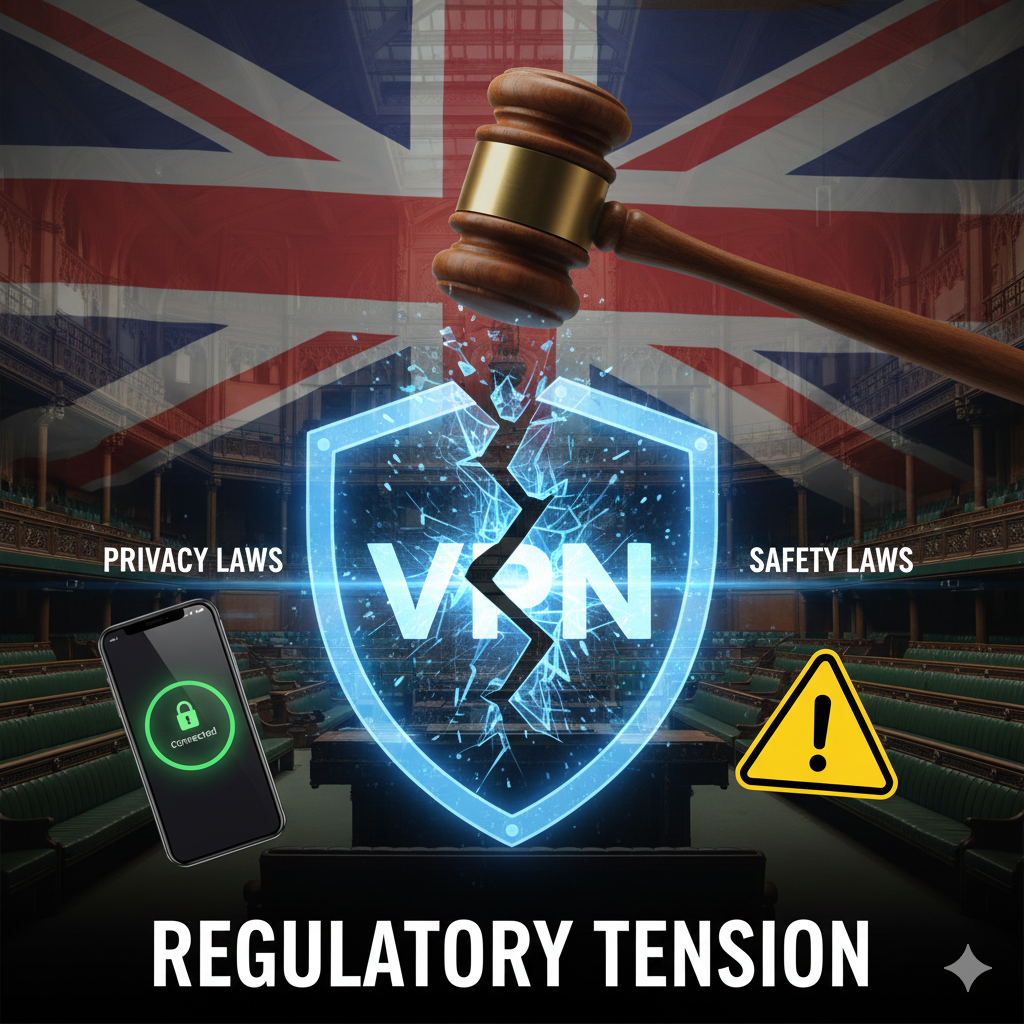

In late 2025, Members of Parliament in the United Kingdom turned the spotlight on virtual private networks (VPNs) during a contentious debate on the Online Safety Act (OSA) — a sweeping piece of legislation aimed at reducing online harm, especially to children(VPNs Under Online Safety). While the law’s primary focus has been age verification and content moderation on mainstream platforms, MPs expressed growing concern that ubiquitous VPN usage could undermine its enforcement. This has prompted discussions about potentially tightening compliance requirements for VPN providers and expanding regulatory oversight.
The debate reflects a broader struggle between lawmakers seeking to protect children and clamp down on harmful material, and digital rights advocates warning of an erosion of privacy and encryption protections. With VPNs increasingly in the crosshairs, the conversation now spans public safety, privacy rights, technological feasibilities, and legislative scope.
Why VPNs Are Under Parliamentary Scrutiny
The Online Safety Act, which came into force in 2025, imposes duties on online services to prevent illegal and harmful content and requires age verification for access to certain content types. However, critics argue that the legislation’s broad approach inadvertently created loopholes that users exploit via VPNs to mask their location and evade age checks.
Ofcom, the UK’s communications regulator, reported that VPN usage spiked after the OSA’s age verification rules were implemented. Daily active VPN users peaked at over 1.4 million in mid‑August before stabilizing around 900,000 daily users — still significantly higher than before the law’s rollout.
MPs such as Peter Fortune and Jim McMahon noted that VPNs could diminish the effectiveness of age verification systems, particularly for platforms hosting adult or harmful material. Some lawmakers have even suggested that VPN providers should be responsible for enforcing age verification or restricting usage by children.
Regulatory Responses and Government Position
During the Westminster Hall debate, officials reaffirmed their commitment to the Online Safety Act and acknowledged monitoring VPN usage trends to assess any regulatory gaps. The UK Minister for Digital Government and Data stated that the government and Ofcom are watching how VPN services are used to circumvent age checks, and that further measures could be considered if necessary.
This stance signals a willingness to explore tighter regulations — though outright bans on VPNs are not currently envisaged. Lawmakers are considering options such as age verification at the VPN service level, within app stores, or even at the device level — all controversial approaches that could fundamentally alter how VPNs operate and impact user privacy.
Industry and Privacy Advocate Concerns
Privacy advocates have widely criticized these regulatory trends. VPNs are traditionally designed to protect encryption, secure traffic, and safeguard user privacy. Any requirement for VPN providers to collect personal data — such as government‑issued ID for age verification — would conflict with basic privacy principles and many providers’ no‑logs policies.
Experts argue that compelling VPNs to log or verify user identities risks not only undermining privacy protections but also creating attractive targets for data breaches. Centralized verification systems with sensitive identity data could be exploited if poorly secured — raising cybersecurity concerns.
Digital rights groups also warn that broad enforcement could push users toward next‑generation VPN alternatives or decentralized privacy tools — technology that might be even harder to regulate. For example, blockchain‑ or peer‑to‑peer‑based “trustless VPNs” are emerging, partly as a response to increased regulatory attention.
The Balance Between Safety and Privacy
The core tension in the UK debate lies between protecting children and other vulnerable groups and safeguarding core digital freedoms. Proponents of stricter VPN regulation argue that encryption and anonymity shouldn’t enable users — especially minors — to easily bypass age verification designed to prevent exposure to harmful content.
Critics counter that VPNs are essential tools for online privacy, cybersecurity, and freedom of expression. The sharp increase in VPN usage following the OSA’s rollout reflects not only a loophole but a public backlash to perceived overreach, with search and sign‑up surges revealing resistance to intrusive verification rules.
Comparisons with other jurisdictions demonstrate the complexity of the issue. While the European Union’s Digital Services Act focuses on platform accountability with lesser emphasis on VPNs, countries with more authoritarian control — such as China and Russia — have severely restricted VPN use to suppress unmonitored access. The UK’s challenge is to chart a course that protects safety without unduly infringing on privacy and civil liberties.
learn more than Obscura VPN Passes Independent Security Audit: A Major Privacy Milestone
Conclusion
The UK government’s scrutiny of VPNs under the Online Safety Act marks a pivotal moment in digital policy, illustrating the delicate balance between safeguarding online environments for vulnerable populations and preserving individual privacy rights. As MPs continue to debate the regulatory scope and potential obligations for VPN providers, the outcome could have far‑reaching implications for digital freedoms and internet governance — not only in the UK but also as a reference point for other countries grappling with similar legislative challenges.
Public pressure, technological evolution, and ongoing legislative reviews will likely shape future policy directions. For now, the debate underscores a fundamental question: Can a regulatory framework effectively protect online users while respecting the privacy that VPNs were originally designed to ensure? Only time — and careful policymaking — will tell.