
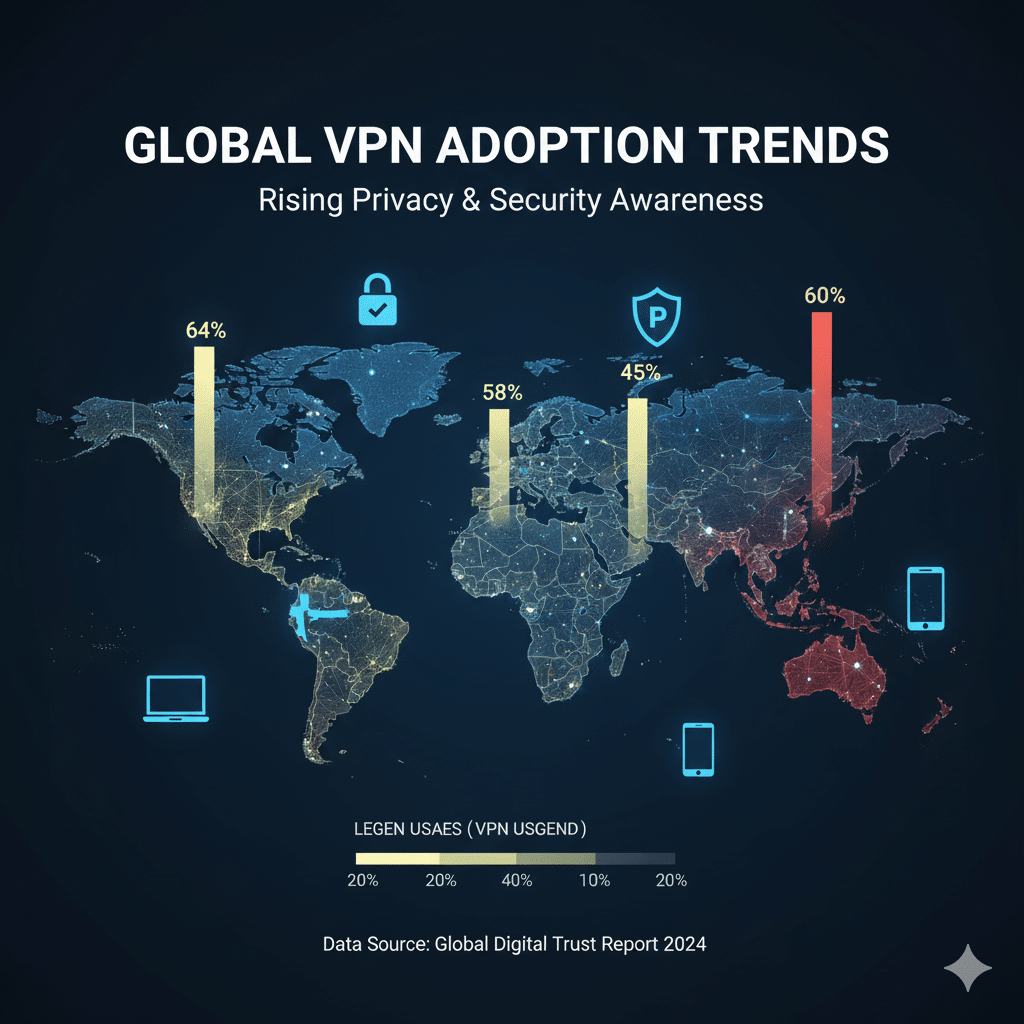

Virtual Private Networks (VPNs) have moved well beyond their early role as niche privacy tools for IT professionals or tech enthusiasts. Today, VPNs are mainstream digital utilities — used by individuals, mobile users, and businesses alike for privacy, performance, and unrestricted access to global internet content. Recent statistical estimates suggest that up to 1.75 billion people worldwide use VPN technology, or roughly one-third of all internet users, highlighting how integral VPN services have become in daily digital life. (Wider VPN)
Alongside growing adoption, regional differences in VPN usage and market rankings of popular services reveal broader trends in how, where, and why users are turning to VPNs — from combating censorship to protecting personal data on public networks.
Global Adoption Statistics: A VPN in Every Third Pocket
Market analysts estimate that there are currently roughly 1.75 billion active VPN users worldwide, a figure that marks significant growth from earlier years — particularly since the widespread shift to remote and hybrid work models.
Key points from the latest data include:
Global usage penetration: About one-third of all internet users now use a VPN at least occasionally.
Mobile dominance: More than 60 % of VPN usage now comes from mobile devices, indicating that everyday users are increasingly concerned about online privacy and security on the go.
Regional variation: The UAE has one of the highest VPN adoption rates globally at 65.78 %, driven by restrictions on VoIP services and strong demand for secure remote access.
These figures show that VPNs aren’t just specialized tools for enterprise remote access — they are widely deployed consumer technologies that people use daily for everything from private browsing and secure Wi-Fi connections to unrestricted media streaming.
Which Countries Lead in VPN Adoption?
VPN usage varies dramatically by region. For example:
United Arab Emirates: Around 65.78 % VPN adoption — one of the highest rates globally.
Qatar and Singapore: Both countries also show strong adoption rates, driven by a mix of local restrictions and privacy demand.
Middle East Overall: Middle Eastern countries dominate several top-VPN usage lists, often due to regional connectivity limitations or VoIP restrictions.
Africa: Many African countries have noticeably lower VPN adoption, with several not even making the top 50 in global rankings.
This geographic spread suggests that VPNs are particularly popular in regions where internet censorship or service blocks motivate users to seek secure, unrestricted access to global content while preserving personal privacy.
Trends in Search Demand and VPN Interest
Beyond raw usage numbers, search interest in VPNs has surged globally, indicating rising awareness and demand. Research from analytics firms shows that factors such as new online content access laws (for example, age-based verification requirements in the UK) have contributed to a dramatic increase in VPN search activity — in some regions jumping by thousands of percent as users seek ways to maintain privacy online.
This trend emphasizes that VPNs are not just security tools — they have become part of how users navigate and control their online experience in response to regulatory and platform changes.
Market Rankings: The Leading VPN Services in 2026
Several respected tech publishers release frequent rankings of VPN services based on performance, privacy, and overall value. A recent 2026 roundup identifies the following leaders:
NordVPN: Top overall VPN based on strong privacy features and global server coverage.
Surfshark: Best budget-friendly option with unlimited device support.
Proton VPN: Excellent for privacy-focused users and ethical practices.
ExpressVPN: Balanced performance and ease of use.
PrivadoVPN Free: Notable free tier with impressive streaming capability despite data limits.
Each of these services appeals to different user needs — from power users seeking privacy and speed to casual users prioritizing affordability or free access — reflecting a matured and competitive VPN market landscape.
Why VPN Adoption Continues to Grow
Experts point to several core drivers behind the expanding VPN market:
Digital privacy awareness: More people recognize the value of encrypting traffic and masking IP addresses on public or cellular networks.
Remote and hybrid work trends: Businesses and individuals rely on VPNs to securely access cloud applications from anywhere.
Regulatory responses: New laws requiring online identification or age verification are motivating users to seek privacy solutions.
Geographic content access: VPNs remain essential for users wanting access to streaming content or services restricted in their region.
These drivers suggest that reliance on VPNs will continue to expand as digital lifestyles evolve.
Conclusion: VPNs Becoming Everyday Connectivity Tools
VPN usage trends and market rankings for 2025–2026 paint a picture of a technology that has transcended its niche origins to become a mainstay in digital privacy, access, and security practices worldwide. With nearly two billion users and strong regional variations in adoption, VPNs now reflect how modern internet users interact with evolving online challenges — from privacy invasion and censorship to streaming and secure remote work.
As VPN usage becomes more commonplace and market competition intensifies, users can expect continued innovation, better performance, and increasingly tailored solutions designed to meet a broad spectrum of privacy and access needs.




It’s interesting to see how VPN adoption has shifted from being a niche tech choice to something tied closely to everyday connectivity, especially with the rise of hybrid work. The regional differences you highlighted also show how motivations vary—some users focus on bypassing censorship while others are more concerned about securing public-network usage. It’ll be worth watching whether this growth continues as more privacy regulations evolve globally.