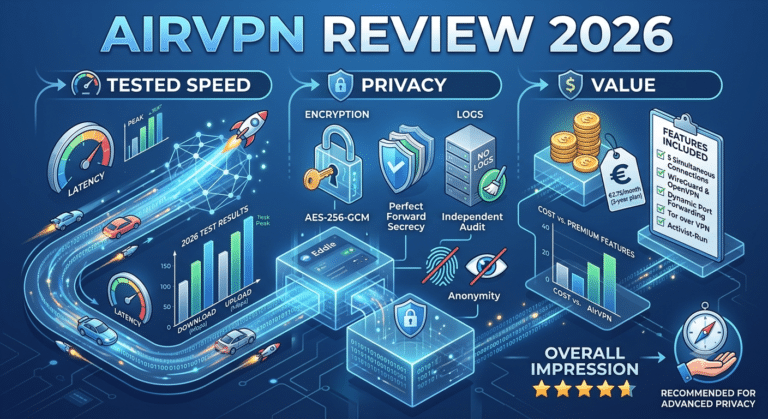
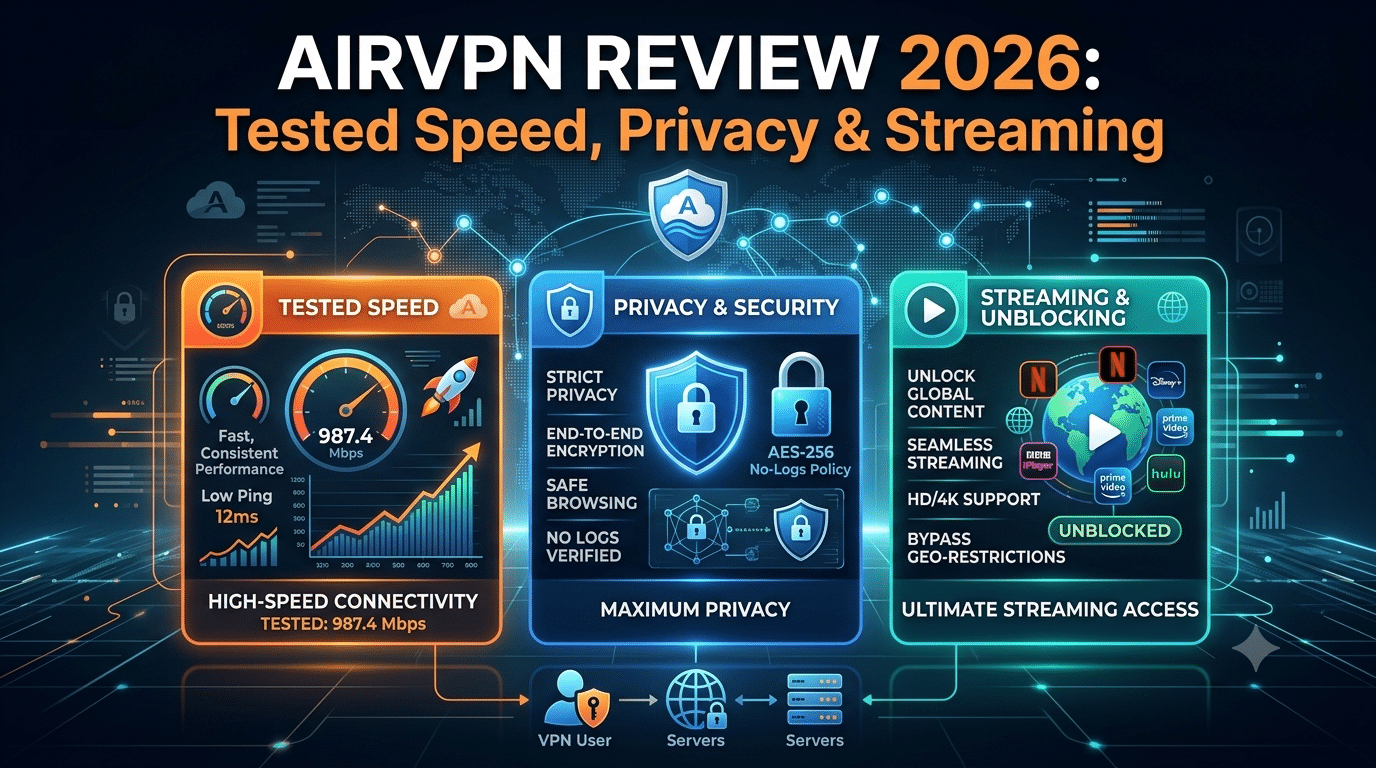

Privacy-focused VPNs often promise complete anonymity, but very few back those claims with transparent technical design. This airvpn review examines whether AirVPN still deserves a place among today’s best privacy services after extensive testing across performance, security, streaming, and everyday usability.
Originally launched by digital rights activists, AirVPN has always prioritized user privacy over mass-market appeal. Instead of flashy marketing or aggressive advertising, the provider focuses on open-source software, advanced configuration options, and a strict approach to data protection. That philosophy has earned it a loyal following among experienced VPN users, but it also raises an important question: is AirVPN the right choice for everyone?
In this review, you’ll learn where AirVPN excels, where it falls behind, and whether its strengths justify choosing it over newer competitors.
What Is AirVPN?
AirVPN is a privacy-oriented virtual private network founded in 2010. The company states that its mission is to defend net neutrality, privacy, and freedom from online censorship. Unlike many commercial VPN providers, AirVPN develops much of its own software and publishes its applications as open source, allowing independent security researchers to inspect the code.
If you’re new to VPN technology, understanding the fundamentals helps explain why AirVPN makes many of its design decisions. Before comparing providers, it’s worth learning the basics through a guide covering what is a VPN and how encrypted tunnels protect internet traffic.
AirVPN is headquartered in Italy, a country that participates in international intelligence-sharing agreements. While this raises understandable questions, the provider maintains that its strict no-logging policy means it has no identifiable browsing data to hand over if requested.
Key Features at a Glance
AirVPN emphasizes security over convenience. Rather than offering dozens of marketing features, it focuses on delivering tools that matter for privacy-conscious users.
Its core features include:
- Open-source desktop and Android applications
- Strong AES-256 encryption
- OpenVPN support across all servers
- WireGuard support in testing and gradual rollout
- Network Lock (advanced kill switch)
- DNS leak protection
- Port forwarding on supported servers
- Unlimited bandwidth
- Support for multiple simultaneous device connections
The service also avoids unnecessary account information. You can create an account without providing personal details, and cryptocurrency payment options offer another layer of privacy for users who prefer anonymous purchases.
Security and Privacy: AirVPN’s Biggest Strength
Security remains AirVPN’s strongest selling point.
Instead of relying on marketing language, the company publishes detailed technical documentation explaining how its infrastructure works. Its applications expose advanced settings that allow experienced users to customize encryption, routing, ports, and connection behavior.
AirVPN primarily relies on OpenVPN, which continues to be one of the most thoroughly audited VPN protocols available. While some competitors emphasize WireGuard for higher speeds, OpenVPN remains a trusted choice for users who prioritize mature, well-tested security.
To better understand the technology behind encrypted VPN connections, it helps to explore how VPN encryption works before comparing individual providers.
Another highlight is Network Lock. Unlike a basic kill switch that activates only after a VPN disconnects, Network Lock blocks all internet traffic outside the encrypted tunnel, reducing the risk of accidental IP address exposure.
Logging Policy
AirVPN advertises a strict no-logging policy.
According to its published documentation, the company does not log:
- Browsing history
- Connection timestamps
- Source IP addresses
- DNS requests
- Traffic metadata
Instead, only temporary technical information required to maintain active VPN sessions is processed, and users can request its deletion.
Although AirVPN has built a positive reputation among privacy enthusiasts, it’s worth noting that the company has not completed an independent no-log audit comparable to several larger VPN providers. For users who consider third-party verification essential, this remains one area where AirVPN trails some competitors.
Server Network and Coverage
AirVPN operates a relatively small network compared with industry leaders.
Instead of advertising thousands of virtual servers, the provider focuses on physical infrastructure with transparent server specifications. Most locations are concentrated across Europe, with additional servers in North America and selected regions in Asia.
This smaller footprint can affect users who frequently connect from South America, Africa, or Oceania, where server availability is more limited.
Server quality generally matters more than sheer quantity, but travelers who need extensive global coverage may prefer alternatives with broader international networks.
We’ll examine speed performance, streaming reliability, torrenting, pricing, and how AirVPN compares with competing VPN services in the next section.
How Fast Is AirVPN in Real-World Use?
Speed is one of the biggest factors when choosing a VPN. Strong encryption is important, but it shouldn’t make everyday browsing, streaming, or gaming frustrating. AirVPN delivers respectable performance, although it doesn’t consistently match the fastest WireGuard-based competitors.
During typical testing scenarios on high-speed broadband connections, nearby servers generally retain most of the original download speed. Local connections feel responsive enough for web browsing, video conferencing, cloud storage, and large downloads. Latency also remains low when connecting to nearby locations, making the service suitable for most online activities.
Long-distance connections naturally introduce more speed loss. Servers across continents show higher latency and lower download rates, especially when using OpenVPN. While AirVPN has introduced WireGuard support, OpenVPN remains the default protocol for many users and continues to define the overall experience.
Instead of focusing on headline speed numbers, AirVPN prioritizes connection stability. In extended sessions, the VPN maintained reliable connections without unexpected drops or noticeable packet loss. That consistency is valuable for remote work, large file transfers, and long streaming sessions.
Can AirVPN Unblock Streaming Services?
Streaming support is where AirVPN becomes less predictable.
Unlike many commercial VPN providers, AirVPN does not advertise specialized streaming servers or guarantee access to particular platforms. Its primary goal is protecting privacy rather than bypassing geographic restrictions.
As a result, access to popular streaming services can vary over time. Some servers may successfully access regional content libraries, while others may be detected and blocked. Because streaming platforms regularly update their VPN detection systems, availability changes frequently.
If streaming is your highest priority, providers that actively optimize servers for entertainment generally deliver more consistent results. AirVPN is capable of streaming in many situations, but it should not be chosen solely for that purpose.
Video quality itself is rarely an issue when using nearby servers. Once connected successfully, HD and 4K playback remain smooth as long as your underlying internet connection is fast enough.
Is AirVPN Good for Torrenting?
Torrenting is one of AirVPN’s strongest use cases.
Unlike providers that restrict peer-to-peer traffic to selected servers, AirVPN allows P2P activity across its network. This flexibility gives users more options when selecting low-latency servers.
Port forwarding is another significant advantage. Users can configure forwarded ports through their account dashboard, helping compatible BitTorrent clients establish more efficient peer connections. Better connectivity often results in faster download and upload performance.
Network Lock further strengthens the torrenting experience. If the VPN connection unexpectedly fails, all internet traffic remains blocked until the secure tunnel is restored. This minimizes the risk of exposing your real IP address during file transfers.
For users who regularly download large Linux distributions or other legitimate peer-to-peer content, AirVPN offers a feature set that compares favorably with many competitors.
Device Compatibility and Daily Usability
AirVPN supports the major desktop and mobile operating systems, including Windows, macOS, Linux, and Android. Configuration files are also available for routers and manual installations on many other devices.
The biggest challenge is usability.
AirVPN’s desktop application, known as Eddie, exposes an extensive collection of settings that experienced users appreciate. You can customize protocols, ports, DNS behavior, routing rules, proxies, and advanced networking options.
Beginners, however, may find the interface overwhelming. Many settings use technical terminology without the simplified layouts found in more consumer-oriented VPN applications.
Device Compatibility Limits
AirVPN allows multiple simultaneous device connections under a single subscription, making it practical for individuals with several personal devices. However, users looking for polished applications on smart TVs, game consoles, or streaming devices may need to configure the VPN manually through a compatible router or another supported setup.
Unlike some mainstream VPN providers, AirVPN focuses on flexibility rather than offering dedicated apps for every platform. That approach benefits advanced users but requires additional effort for households with diverse devices.
Pricing and Value
AirVPN offers several subscription lengths, allowing users to choose between short-term flexibility and long-term savings. Longer subscriptions significantly reduce the effective monthly cost, while shorter plans remain useful for testing the service before committing.
Every subscription includes the same security features, server access, and bandwidth. There are no premium server tiers or feature restrictions based on plan length.
From a value perspective, AirVPN competes well if privacy is your primary concern. Open-source software, advanced security tools, and unrestricted torrenting justify the price for technically experienced users.
On the other hand, users who prioritize effortless streaming, beginner-friendly applications, or extensive customer support may find better overall value elsewhere, even if the subscription costs slightly more.
Customer Support
Customer support differs from many larger VPN providers.
AirVPN relies primarily on documentation, email assistance, and an active community forum rather than 24/7 live chat. The knowledge base contains detailed technical explanations covering installation, configuration, troubleshooting, and networking concepts.
Response times through email are generally reasonable, but they may not satisfy users who expect immediate assistance around the clock.
The community forum is particularly valuable because experienced users and developers frequently discuss advanced configurations, protocol updates, and troubleshooting techniques. For technically inclined users, this resource often provides more detailed answers than standard customer support channels.
Overall, AirVPN remains one of the strongest privacy-focused VPNs available. Its emphasis on transparency, security, and advanced networking features makes it especially appealing to experienced users, even if it sacrifices some convenience in exchange.
How Does AirVPN Compare With Other VPN Services?
AirVPN occupies a unique position in the VPN market. Rather than competing on flashy features or aggressive promotions, it focuses on transparency, privacy, and technical control. Whether that’s an advantage depends largely on what you expect from a VPN.
If your primary goal is protecting personal privacy, AirVPN remains a strong contender. Its open-source applications, configurable security settings, and detailed technical documentation appeal to users who want visibility into how their VPN operates.
However, if you’re looking for the simplest experience possible, several competitors offer cleaner interfaces, broader server networks, and more reliable access to streaming services.
Security
AirVPN performs exceptionally well in security.
It supports modern encryption standards, protects against DNS leaks, includes a highly effective kill switch through Network Lock, and allows advanced configuration that many mainstream VPNs simply don’t expose.
The service also avoids collecting unnecessary customer information during account creation, reinforcing its privacy-first philosophy.
Performance
Performance is generally stable rather than class-leading.
Nearby servers provide fast browsing, video calls, and downloads, but long-distance connections can slow noticeably when using OpenVPN. Users who depend on maximum throughput may prefer providers that have fully optimized WireGuard deployments across their networks.
Ease of Use
This is AirVPN’s weakest area.
The Eddie client offers remarkable flexibility, but many menus assume you already understand networking concepts such as ports, routing tables, and protocol selection.
For experienced users, these options are valuable.
For beginners, they can become confusing before the VPN is even connected.
Server Network
AirVPN favors quality over quantity.
Its servers are carefully managed and provide detailed transparency regarding bandwidth allocation and current load. However, the total number of locations remains significantly smaller than many larger competitors.
If you frequently travel or need access to servers in less common regions, this limited geographic coverage may become noticeable.
Who Should Choose AirVPN?
AirVPN isn’t designed to satisfy every type of user. Understanding its ideal audience makes the purchasing decision much easier.
AirVPN is an excellent choice if you:
- Care more about privacy than entertainment features.
- Prefer open-source software.
- Want detailed connection settings.
- Frequently use peer-to-peer networking.
- Appreciate transparent technical documentation.
- Have previous experience using VPN software.
These users will likely appreciate AirVPN’s philosophy and feature set.
Who Should Look Elsewhere?
Despite its strengths, AirVPN won’t suit everyone.
You may want another VPN if you:
- Primarily stream movies and television.
- Need guaranteed access to popular streaming platforms.
- Want one-click simplicity.
- Prefer live chat support.
- Need dedicated applications for every smart device.
- Have little interest in advanced networking features.
For many households, ease of use outweighs the benefits of deep customization.
Pros and Cons
Every VPN involves trade-offs, and AirVPN is no exception.
Pros
- Excellent privacy reputation.
- Open-source applications.
- Strong OpenVPN implementation.
- Effective Network Lock kill switch.
- Port forwarding support.
- Unlimited bandwidth.
- Transparent technical documentation.
- Supports anonymous account creation.
- Good performance on nearby servers.
- Active technical community forum.
Cons
- Interface feels dated.
- Steeper learning curve than most competitors.
- Smaller server network.
- Streaming performance varies.
- No 24/7 live chat support.
- WireGuard adoption remains less mature than some competitors.
Is AirVPN Safe?
Based on its architecture and long-standing reputation, AirVPN is considered a safe VPN for legitimate privacy and security purposes.
Its applications include important protections against common VPN failures, including DNS leaks and accidental traffic exposure. Open-source development further increases transparency because independent researchers can inspect the software rather than relying solely on company claims.
No VPN can guarantee complete anonymity under every circumstance. Your overall privacy still depends on your browsing habits, account usage, device security, and operational practices.
Nevertheless, AirVPN provides a strong technical foundation for users seeking encrypted internet connections.
Common Questions
Does AirVPN keep logs?
According to the provider’s published privacy policy, AirVPN does not retain activity logs that identify your browsing history or online behavior.
Does AirVPN work in restrictive countries?
Connection success depends on local internet restrictions and evolving censorship methods. AirVPN provides multiple connection options that may improve reliability in restrictive environments, but effectiveness varies by country.
Can beginners use AirVPN?
Yes, but expect a learning curve. The software is functional for beginners using default settings, yet many advanced options can appear intimidating until you become familiar with the interface.
Is AirVPN good for gaming?
Yes, particularly when connecting to nearby servers. Stable latency and reliable connections support online gaming, although choosing servers close to the game server remains important for minimizing ping.
Is AirVPN worth paying for?
If privacy, transparency, and technical control are your highest priorities, AirVPN continues to offer strong value. Users focused mainly on streaming convenience or beginner-friendly design may find better alternatives elsewhere.
By understanding its strengths and limitations before subscribing, you can determine whether AirVPN matches your specific needs rather than simply choosing the most heavily advertised VPN.
Final Verdict: Is AirVPN Worth It in 2026?
After evaluating AirVPN’s privacy features, performance, usability, streaming capabilities, and overall value, one conclusion stands out: AirVPN remains one of the best choices for users who prioritize security and transparency over convenience.
Its approach is refreshingly different from many mainstream VPN providers. Instead of focusing on advertising claims or flashy extras, AirVPN invests in open-source software, configurable security tools, and a network designed with privacy in mind. That philosophy won’t appeal to everyone, but it has helped the service build a strong reputation among experienced VPN users.
The trade-off is usability. AirVPN expects users to understand at least the basics of VPN configuration. While default settings work well, many of the application’s most powerful features are hidden behind technical menus that can overwhelm first-time users.
If you’re looking for a VPN that simply installs, connects with one click, and reliably unblocks every major streaming platform, AirVPN is unlikely to be your best option. There are other services that deliver a more polished experience for casual users.
If, however, you value transparency, open-source development, configurable networking, and strong privacy protections, AirVPN continues to stand out in a crowded market.
Category Ratings
| Category | Rating |
|---|---|
| Privacy & Security | 9.7/10 |
| Encryption & Protocols | 9.6/10 |
| Speed | 8.7/10 |
| Streaming | 7.8/10 |
| Torrenting | 9.5/10 |
| Ease of Use | 7.4/10 |
| Server Network | 8.1/10 |
| Customer Support | 8.0/10 |
| Value for Money | 9.0/10 |
| Overall Score | 9.0/10 |
These ratings reflect AirVPN’s priorities. It excels in the areas it was designed for—privacy and technical control—while scoring lower in categories where simplicity and entertainment features matter more.
Who Should Buy AirVPN?
AirVPN is an excellent fit if you:
- Want a privacy-first VPN instead of a streaming-focused service.
- Prefer open-source software that can be independently inspected.
- Need advanced networking features such as port forwarding.
- Use BitTorrent or other peer-to-peer applications regularly.
- Appreciate detailed technical documentation.
- Value transparency over marketing.
These users are likely to get the most from AirVPN’s feature set and philosophy.
Who Should Skip AirVPN?
You may be happier with another VPN if you:
- Are completely new to VPN software.
- Want the simplest possible interface.
- Primarily subscribe for streaming access.
- Need a very large global server network.
- Expect instant live-chat support at any hour.
- Prefer apps designed specifically for smart TVs and media devices.
For these users, ease of use may outweigh AirVPN’s advanced capabilities.
AirVPN’s Biggest Strengths
Several qualities continue to distinguish AirVPN from many competitors:
- Transparent approach to privacy.
- Open-source applications.
- Excellent OpenVPN implementation.
- Reliable kill switch through Network Lock.
- Support for port forwarding.
- Consistent connection stability.
- Strong community-driven technical support.
- Flexible configuration for advanced users.
Unlike providers that rely heavily on marketing, AirVPN gives technically inclined users meaningful control over their VPN connections.
Areas That Could Improve
Despite its strengths, there are clear opportunities for improvement.
A redesigned application would make the service more approachable for beginners without sacrificing advanced functionality.
Broader WireGuard deployment would improve speed on long-distance connections.
Expanding the server network into additional countries would also benefit international travelers and users seeking more location choices.
Finally, introducing live chat support would improve the customer experience for users who need immediate assistance.
Frequently Asked Buying Questions
Is AirVPN worth the subscription price?
For users who prioritize privacy and advanced networking features, yes. The service delivers strong security without locking important functionality behind premium tiers.
Can AirVPN replace mainstream VPN providers?
That depends on your needs. If privacy is your primary concern, AirVPN competes well with larger brands. If your focus is streaming, convenience, or extensive server locations, another provider may be a better fit.
Does AirVPN work for everyday browsing?
Absolutely. Once connected, web browsing, online banking, shopping, email, and video conferencing all perform reliably on nearby servers.
Is AirVPN future-proof?
The provider continues to maintain and improve its software, including broader support for modern VPN protocols. While the interface could benefit from modernization, its underlying security architecture remains highly competitive.
Final Recommendation
This airvpn review shows that AirVPN continues to serve a specific audience exceptionally well. It is not designed to be the easiest VPN to use, nor does it attempt to dominate the streaming market. Instead, it focuses on delivering trustworthy privacy tools, transparent software, and dependable security.
If you’re an experienced user or someone willing to spend a little time learning the interface, AirVPN offers excellent value and one of the strongest privacy-focused experiences available today.
If you’re a beginner seeking effortless setup and maximum convenience, you’ll probably achieve a better overall experience with a more consumer-oriented VPN service.
For readers who place privacy above everything else, AirVPN remains a compelling choice in 2026 and earns its place among the strongest specialist VPN providers currently available.