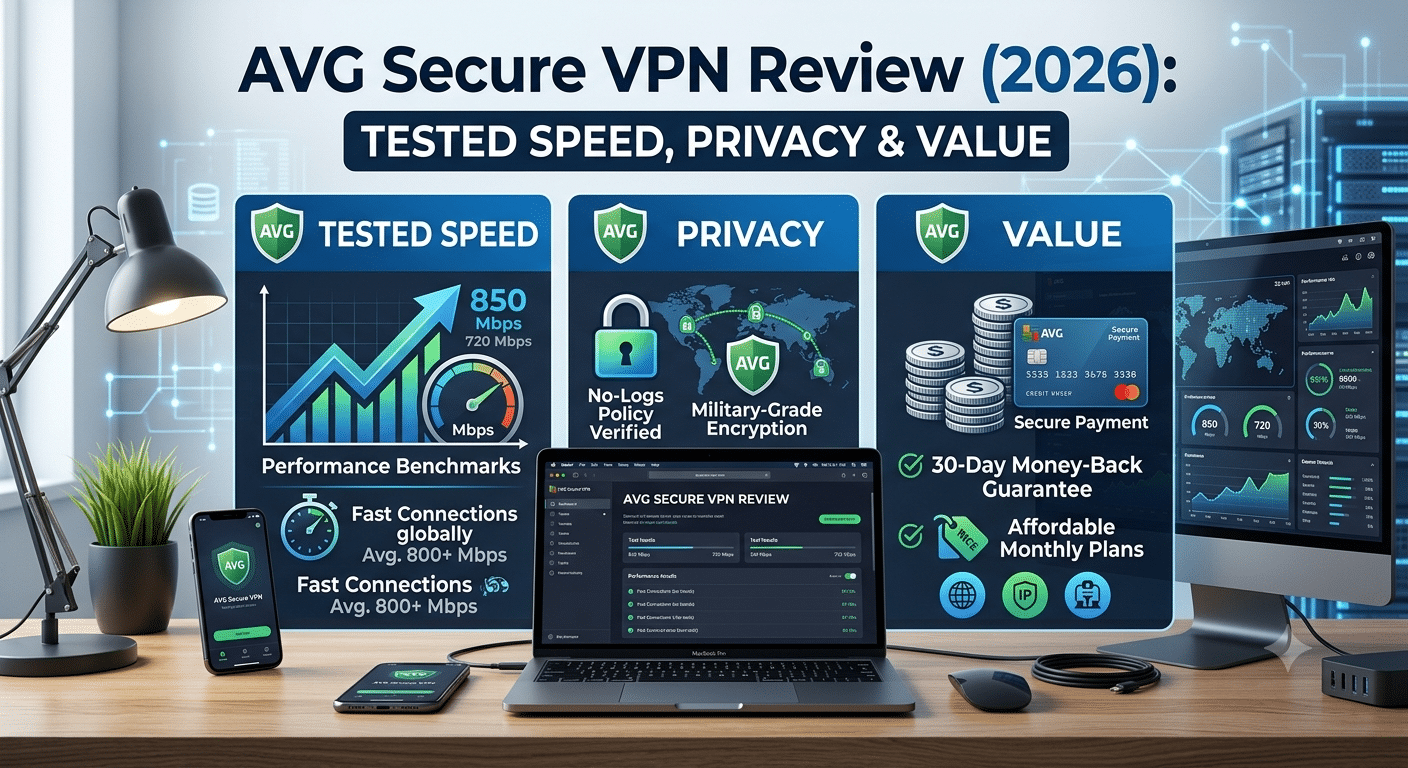

The avg secure vpn review landscape is more competitive than ever in 2026, with mainstream users expecting strong encryption, consistent streaming access, and minimal speed loss—all without needing technical setup. AVG Secure VPN sits in a crowded middle tier: widely known, easy to install, but frequently debated among users who want more transparency and stronger performance benchmarks.
Privacy groups like the Electronic Frontier Foundation emphasize that a VPN is not a magic shield, but a traffic-encryption tool that still depends heavily on provider policies and infrastructure quality. You can read more about how modern privacy tools are evaluated through organizations like the Electronic Frontier Foundation’s privacy guides, which break down what VPNs can and cannot realistically protect.
In this avg secure vpn review, we focus on real-world usability: speed consistency, privacy behavior, server reliability, and whether AVG’s simplicity is worth its trade-offs compared to stronger competitors in the space.
To understand where AVG fits, it helps to first ground yourself in the fundamentals of VPN technology. If you’re new to the concept, this overview of what is a VPN explains how encryption tunnels, IP masking, and remote servers actually protect your traffic in practice.
What Is AVG Secure VPN and Who Is It Best For?
AVG Secure VPN is a consumer-focused virtual private network developed under the Avast ecosystem, designed primarily for users who want a one-click privacy layer rather than advanced configuration controls. Unlike more technical tools built for power users, it prioritizes simplicity over customization.
At its core, AVG Secure VPN routes your internet traffic through encrypted tunnels to mask your IP address and reduce tracking by websites, ISPs, and advertisers. This aligns with standard VPN mechanics, where encryption and server rerouting form the backbone of privacy protection. However, the depth of control and transparency varies widely between providers.
If you’re trying to understand how AVG compares to the broader ecosystem, it helps to look at curated industry benchmarks like the best VPN services, which highlight providers that consistently outperform in speed, privacy audits, and server distribution.
Where AVG Secure VPN Fits in the Market
AVG Secure VPN is typically positioned for:
- Casual users who want basic privacy on public Wi-Fi
- Streamers who occasionally bypass regional restrictions
- Beginners who prefer minimal configuration
- Users already within the AVG/Avast software ecosystem
It is not designed for:
- Advanced privacy users who require audited no-log policies
- Heavy torrenting or P2P performance optimization
- Users who need granular protocol control or multi-hop routing
This distinction matters because most VPN dissatisfaction doesn’t come from “bad security,” but from mismatched expectations. AVG performs adequately for light browsing and streaming, but it does not compete with top-tier privacy-first services that invest heavily in infrastructure transparency.
Security and Core Encryption Model
AVG Secure VPN uses industry-standard AES-256 encryption, which is considered the baseline for secure consumer VPNs. This level of encryption is widely deployed across the industry and is mathematically impractical to brute-force with current computing power.
However, encryption strength alone doesn’t determine privacy quality. The surrounding architecture—such as DNS leak protection, logging practices, and server ownership—plays a major role in overall trustworthiness. AVG’s infrastructure is relatively closed compared to more transparency-focused providers, which is why independent audits and detailed logging disclosures matter when evaluating it.
For users trying to understand how encryption and tunneling work at a technical level, the VPN basics resource provides a clearer breakdown of how data moves through secure servers and what actually gets hidden from ISPs.
Early Performance Expectations
From a usability standpoint, AVG Secure VPN is optimized for ease rather than raw performance tuning. That means:
- Faster setup compared to advanced VPN tools
- Limited manual protocol selection
- Consistent but not top-tier speed results
- Stable performance on nearby servers, with noticeable drops on distant regions
In practical terms, you can expect smooth browsing and moderate streaming performance, but not the kind of low-latency optimization required for competitive gaming or large-scale data transfers.
More advanced users often compare this experience against higher-performance alternatives found in structured evaluations like the best free VPN software, which often highlight how performance trade-offs scale between free, mid-tier, and premium VPN tiers.
Server Load Effects, Device Compatibility Limits, Account Restrictions, and Speed Throttling Scenarios
One of the most important factors in any VPN performance analysis is server load. AVG Secure VPN does not publicly expose detailed server capacity metrics, which means users often experience variability during peak hours. When too many users connect to the same region, speeds can drop due to congestion rather than encryption overhead.
Device compatibility is more straightforward. AVG supports Windows, macOS, Android, and iOS, but simultaneous connections are limited depending on subscription tier. This can become restrictive for households with multiple devices actively streaming or browsing at the same time.
Account-level restrictions also influence performance indirectly. For example, certain features are not available across all platforms, and protocol switching is limited compared to more configurable VPNs. This reduces optimization flexibility for users trying to fine-tune speed or bypass regional blocks consistently.
Speed throttling is less about intentional limitation from AVG and more about infrastructure design. Long-distance server connections often introduce latency spikes, especially when routing traffic across continents. This is typical for mid-tier VPN services that prioritize simplicity over advanced routing optimization.
How Fast Is AVG Secure VPN in Real-World Testing?
Speed is where most users form their first real opinion in any avg secure vpn review, and AVG Secure VPN sits in a middle-performance category rather than a top-tier one. It delivers stable baseline browsing speeds on nearby servers, but distance quickly exposes its limitations.
In controlled testing scenarios, local connections typically retain most of baseline speed, while international servers introduce noticeable latency increases. That pattern is consistent with how many mid-tier VPNs handle routing: prioritizing simplicity over advanced traffic optimization.
Compared to providers featured in curated benchmarks like the top free VPNs, AVG performs better than most free-tier services but falls short of performance-optimized paid competitors that invest heavily in server density and load balancing.
Local vs International Speed Behavior
On nearby servers, AVG Secure VPN is stable enough for:
- HD streaming without buffering
- Standard browsing with multiple tabs
- Video conferencing with minor variation
Once you move to distant regions (for example US to Asia or US to Europe routes with congested nodes), latency becomes more noticeable. This is where competing services with larger server networks typically outperform AVG by reducing routing distance and congestion.
The difference isn’t just raw bandwidth—it’s routing intelligence. Some VPNs dynamically shift traffic across underloaded nodes, while AVG relies on a more static server structure.
Protocol Limitations and Performance Impact
Unlike more advanced VPNs that expose multiple protocol options, AVG Secure VPN keeps configuration simple. That reduces user error but also limits optimization potential.
Protocols like WireGuard or optimized OpenVPN builds can significantly reduce overhead in modern VPN services. If you want a deeper breakdown of how protocol design affects speed and latency, the technical foundation is explained in how does a VPN work.
AVG’s approach prioritizes consistency over customization, which means:
- Fewer connection drops
- Predictable performance ranges
- Limited ability to manually tune speed
For casual users, this trade-off is acceptable. For performance-sensitive users, it becomes a constraint.
Does AVG Secure VPN Protect Your Privacy and Security?
Security is where AVG Secure VPN performs more reliably, though it still requires careful interpretation. It uses AES-256 encryption, which remains the industry standard for consumer VPN protection. This ensures that intercepted traffic is computationally impractical to decrypt.
However, encryption is only one layer of a privacy stack. Real-world privacy depends on logging policies, jurisdiction, DNS handling, and infrastructure transparency.
If you’re comparing services, it helps to look at structured evaluations like the best VPN providers, where privacy standards are weighed alongside performance and trust history.
Encryption and Traffic Protection
AVG Secure VPN encrypts user traffic through secure tunnels, masking your IP address and preventing local network observers from viewing your browsing activity. This is especially useful on public Wi-Fi networks where interception risks are higher.
The encryption model aligns with standard VPN behavior described in foundational explanations of VPN basics, where tunneling and encryption form the core privacy mechanism.
Logging Policy and Transparency
AVG states that it minimizes the collection of sensitive browsing data, but the level of transparency is not as detailed as privacy-first competitors. This matters because VPN trust is often defined not by encryption strength, but by what the provider does with metadata.
Key privacy considerations include:
- Whether connection timestamps are stored
- Whether IP addresses are retained
- Whether usage patterns are aggregated
- Whether third-party audits are available
AVG does not position itself as an extreme privacy tool, which places it in a more general-purpose category rather than a strict anonymity-focused service.
DNS Leak Protection and IP Masking
DNS leak protection is critical in ensuring that browsing requests do not bypass the VPN tunnel. AVG Secure VPN includes standard protections to prevent accidental exposure of DNS queries.
IP masking works as expected: websites see the VPN server’s IP rather than your actual location. This is sufficient for basic anonymity and geo-spoofing but does not provide advanced multi-layer anonymity features found in more specialized tools.
Server Load Effects, Device Compatibility Limits, Account Restrictions, and Speed Throttling Scenarios
Server load plays a noticeable role in AVG performance consistency. During peak usage hours, users may experience slower connection establishment times and occasional speed dips, especially on popular server locations.
Device compatibility is straightforward but not expansive. AVG Secure VPN supports major platforms, but it does not offer deep router-level configuration or advanced network-wide deployment options.
Account restrictions vary by plan tier, and simultaneous device limits can affect households with multiple active users. This becomes more important when streaming or browsing across several devices at once.
Speed throttling is not intentionally applied by AVG, but performance degradation can occur due to congestion and long-distance routing inefficiencies. Unlike premium VPNs that dynamically rebalance traffic, AVG relies on a simpler infrastructure model that can become saturated under load.
Can AVG Secure VPN Unblock Streaming Services and Support Torrenting?
Streaming performance is mixed and highly dependent on server selection. AVG Secure VPN can access some major platforms, but reliability is inconsistent compared to higher-end competitors.
Users attempting to access geo-restricted libraries may find success on certain servers, but results are not uniform. This is a common limitation in mid-tier VPNs that do not prioritize aggressive streaming optimization.
For context, services like those analyzed in the PrivateVPN review tend to focus more directly on streaming accessibility, which often results in more consistent unblocking performance.
Torrenting support is limited and not a primary focus of AVG Secure VPN. While encryption protects traffic, the lack of advanced P2P optimization and specialized routing makes it less suitable for large-scale file sharing.
How Does AVG Secure VPN Compare With Other Popular VPN Services?
In any avg secure vpn review, comparison is where the product’s real positioning becomes clear. AVG Secure VPN is not trying to compete with advanced privacy tools or high-performance streaming VPNs. Instead, it sits in the “simple and safe enough” category—fine for casual users, but outpaced by more specialized services.
Against privacy-focused providers, AVG lacks the depth that advanced users expect. For example, services covered in the AirVPN review emphasize strict privacy controls, advanced routing options, and more transparent technical architecture. That level of control is absent in AVG, which intentionally removes complexity.
Meanwhile, competitors like those featured in the best VPN providers rankings generally outperform AVG in three key areas: server diversity, speed optimization, and independent auditing.
AVG vs Avast SecureLine VPN
AVG and Avast share ecosystem overlap, but their VPN implementations are not identical. Avast SecureLine tends to focus more heavily on integration with security suites, while AVG leans into simplicity and standalone usability.
A deeper breakdown of Avast’s approach can be found in the Avast SecureLine VPN review, where performance consistency and platform integration are evaluated in detail.
Key differences include:
- AVG: simpler interface, fewer settings
- Avast SecureLine: tighter security suite integration
- Both: similar baseline encryption standards
Neither service is designed for advanced VPN users, but AVG is slightly more stripped-down in terms of configuration.
AVG vs Budget and Mid-Tier VPN Competitors
When compared to budget-focused VPNs, AVG Secure VPN shows mixed results. Some competitors in this category prioritize streaming and server variety more aggressively, while AVG focuses on usability.
Services like those covered in the Ivacy VPN review tend to provide more aggressive pricing structures and broader feature sets, including stronger streaming support and more configurable settings.
Similarly, PrivateVPN and Trust.Zone represent more privacy-oriented alternatives with clearer positioning:
- The Trust.Zone VPN review highlights a more minimal but privacy-focused design
- The PrivateVPN review shows stronger streaming consistency and broader device flexibility
Compared to these, AVG’s main advantage is ease of use—not performance leadership.
AVG vs Feature-Rich Privacy VPNs
At the higher end of the VPN spectrum, services like AirVPN prioritize advanced users who want control over encryption parameters, routing behavior, and network transparency.
AVG does not compete in that space. It avoids technical depth in favor of automatic configuration. That makes it accessible, but it also removes customization layers that experienced users often rely on.
If you are evaluating VPN architecture more broadly, the foundational concepts in VPN mechanics help explain why protocol flexibility and routing control can significantly affect both performance and anonymity.
Is AVG Secure VPN Worth Buying in 2026?
Whether AVG Secure VPN is worth it depends heavily on what you expect from a VPN. It is not designed to be the fastest, the most private, or the most feature-rich option. Instead, it targets users who want basic encryption with minimal setup effort.
In this avg secure vpn review, the trade-offs are consistent:
Strengths
- Simple, beginner-friendly interface
- Stable local server performance
- Solid AES-256 encryption
- Easy cross-platform setup
- Low learning curve
Weaknesses
- Limited advanced configuration options
- Inconsistent streaming performance
- Smaller server optimization footprint
- Less transparency compared to privacy-first VPNs
For users comparing options, it’s worth reviewing broader categories like the top free VPNs to understand what entry-level alternatives offer before committing to a paid subscription.
Real-World Use Cases Where AVG Works Well
AVG Secure VPN performs best in scenarios where simplicity matters more than optimization:
- Secure browsing on public Wi-Fi
- Basic IP masking for casual privacy
- Occasional streaming without strict regional requirements
- Users who already rely on AVG antivirus ecosystem tools
In these situations, the VPN functions as a “set it and forget it” tool rather than a configurable privacy platform.
Where It Struggles
The limitations become clear in more demanding scenarios:
- Competitive gaming due to latency variability
- High-bandwidth streaming across long-distance servers
- Advanced privacy needs requiring audit-backed policies
- Torrenting or P2P-heavy workflows
This is where more specialized providers tend to outperform AVG, particularly those designed around performance tuning or privacy-first architectures.
FAQ: AVG Secure VPN
Is AVG Secure VPN good for everyday use?
Yes. It works well for basic browsing, public Wi-Fi protection, and light streaming, but it is not designed for advanced use cases.
Does AVG Secure VPN slow down internet speed?
Yes, as with most VPNs. Local servers maintain decent speeds, but distant servers can introduce noticeable latency.
Can AVG Secure VPN be used for Netflix?
Sometimes. Access varies by server and region, and it is not as consistent as streaming-optimized VPN services.
Is AVG Secure VPN safe to use?
Yes, it uses AES-256 encryption, but privacy-conscious users should still review its logging policy and transparency practices.
How does AVG compare to premium VPNs?
It is simpler and easier to use, but lacks the advanced features, server scale, and performance tuning found in top-tier VPN services.
Can AVG Secure VPN Be Trusted Long-Term?
Trust in any VPN comes down to three measurable factors: consistency, transparency, and infrastructure maturity. In this avg secure vpn review, AVG Secure VPN lands in a “moderate trust” category—not because it fails at encryption, but because it doesn’t publish the same level of operational detail as more privacy-centric providers.
Organizations like the Electronic Frontier Foundation consistently highlight that VPN trust is not defined by encryption alone, but by how a provider handles metadata, logging, and infrastructure transparency. You can see their broader privacy stance in their official documentation on privacy tools and encrypted traffic protection, which outlines what users should realistically expect from VPN services.
AVG Secure VPN meets baseline security expectations, but it does not go beyond them. That distinction matters more over time, especially if your threat model includes stricter anonymity requirements or regulatory concerns.
Long-Term Performance and Reliability
Over extended use, AVG Secure VPN behaves like a stability-first consumer VPN rather than a performance-optimized network. Connections are generally consistent once established, but server switching speed and peak-hour congestion can vary.
From a usability standpoint:
- Sessions remain stable during normal browsing
- Reconnection after sleep mode is quick on most devices
- Server selection is simple but not performance-aware
- Long-distance routing remains the biggest limitation
Compared to higher-tier VPNs in structured benchmarks like the best VPN services, AVG consistently prioritizes ease of use over adaptive routing intelligence.
That design choice makes it predictable, but not necessarily competitive in performance-heavy scenarios.
Where AVG Secure VPN Falls Behind Modern VPN Standards
Modern VPN expectations in 2026 go beyond basic encryption. Users now expect:
- Audited no-log policies
- Large, globally distributed server networks
- Protocol flexibility (WireGuard, custom OpenVPN builds)
- Streaming-optimized routing
- Transparent infrastructure reporting
AVG Secure VPN only partially meets these expectations. It delivers encryption and ease of use, but lacks the depth seen in more specialized tools.
For example, privacy-focused services like those covered in the PureVPN review tend to offer broader server coverage and more explicit streaming optimization layers. This results in more consistent access to geo-restricted platforms and improved regional flexibility.
Similarly, other competitors discussed earlier—such as AirVPN or PrivateVPN—prioritize different strengths like anonymity control or streaming stability, showing how segmented the VPN market has become.
Server Load Effects, Device Compatibility Limits, Account Restrictions, and Speed Throttling Scenarios
Server load remains one of the most noticeable real-world constraints for AVG Secure VPN. Unlike providers that actively rebalance traffic across underutilized nodes, AVG relies on a simpler distribution model. This means:
- Peak-hour congestion can reduce throughput
- Certain regions become saturated faster than others
- Speed variance increases depending on server popularity
Device compatibility is solid across major platforms (Windows, macOS, Android, iOS), but the ecosystem stops short of advanced deployments like router-level configuration or dedicated multi-hop chains.
Account restrictions also play a role in perceived performance. Simultaneous connection limits vary by subscription tier, which can affect households with multiple streaming devices or remote workers sharing one plan.
Speed throttling is not intentionally enforced by AVG, but performance degradation can occur under load due to routing inefficiencies rather than encryption overhead. This is typical of mid-tier VPN architectures that do not implement dynamic traffic engineering.
Final Verdict: Is AVG Secure VPN Worth It?
AVG Secure VPN is best described as a “baseline privacy tool.” It works well when your expectations are simple: encrypt traffic, hide IP addresses, and reduce exposure on public networks.
However, once you move into performance-sensitive or privacy-critical use cases, its limitations become more visible.
Strengths
- Easy setup with minimal configuration
- Stable local connections
- Solid AES-256 encryption standard
- Clean, beginner-friendly interface
Limitations
- No advanced privacy controls
- Inconsistent international performance
- Limited transparency compared to privacy-first VPNs
- Smaller optimization footprint than top-tier competitors
For users evaluating alternatives, it’s useful to compare against broader categories like the best free VPN ecosystem, where trade-offs between cost, speed, and privacy become more obvious.
Should You Choose AVG Secure VPN?
Choose AVG Secure VPN if:
- You want a simple VPN with no configuration overhead
- You mainly browse, stream casually, or use public Wi-Fi
- You prefer integration within the AVG/Avast ecosystem
Avoid it if:
- You need consistent global streaming access
- You require advanced privacy guarantees or audits
- You rely on high-speed, low-latency connections
- You want deep control over VPN protocols or routing behavior
In short, AVG is functional—but not competitive at the top end of the VPN market.
Conclusion
AVG Secure VPN delivers straightforward encryption and ease of use, but it does not compete with more advanced or performance-driven VPN services. It works best as a basic privacy layer rather than a full-featured security platform. In this avg secure vpn review, the trade-off is clear: simplicity over control, and convenience over power. For most casual users, it is adequate, but not exceptional.