
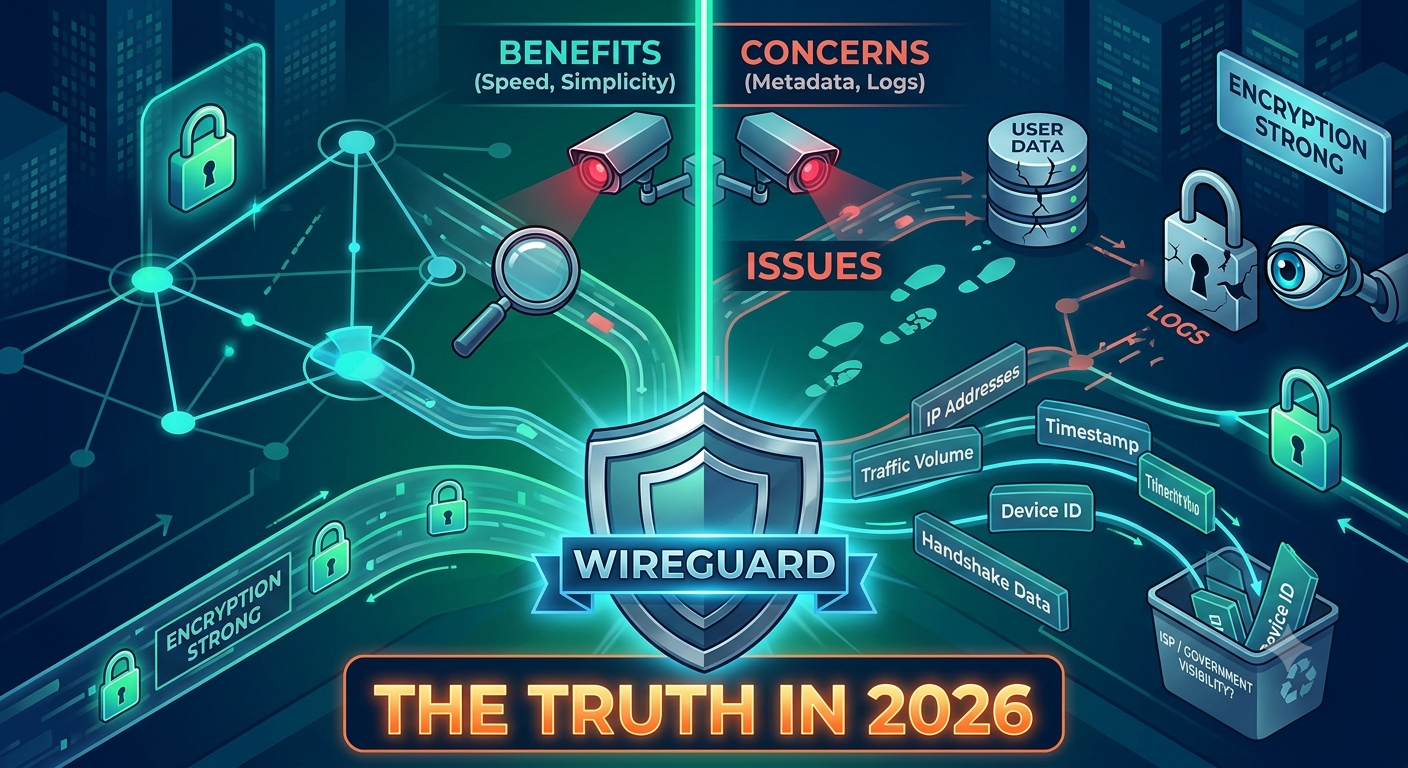

WireGuard privacy issues are one of the most misunderstood topics in the VPN industry. You’ll often see claims that WireGuard is either completely private or fundamentally flawed. Neither statement tells the full story.
The reality is simpler. WireGuard is one of the fastest and most secure VPN protocols available today, but its original design introduced privacy trade-offs that some providers had to solve through additional engineering.
If you’re comparing top-rated VPN services, understanding those trade-offs can help you separate legitimate concerns from outdated information.
Many users first encounter WireGuard while learning about understanding VPN technology. The protocol has become a major selling point because it delivers faster connection speeds, lower latency, and a much smaller codebase than older VPN protocols.
But speed alone doesn’t answer the privacy question.
To understand whether WireGuard presents a real risk, you need to examine how the protocol was designed, what privacy concerns researchers identified, and how modern VPN providers address those concerns.
According to the Electronic Frontier Foundation, privacy tools should minimize unnecessary data retention whenever possible. That principle sits at the center of most discussions surrounding WireGuard’s privacy architecture.
Does WireGuard Have Privacy Issues?
Yes—but not because of weak encryption.
This distinction matters.
When security researchers discuss WireGuard privacy issues, they are usually referring to how the protocol manages network identities and peer relationships rather than how it encrypts data.
WireGuard’s encryption remains highly respected throughout the cybersecurity community. It uses modern cryptographic primitives including:
- ChaCha20 for encryption
- Poly1305 for authentication
- Curve25519 for key exchange
- BLAKE2s for hashing
These components are widely trusted and have undergone extensive scrutiny.
The privacy debate comes from a different area of the protocol.
Unlike some traditional VPN systems, WireGuard was designed to keep a persistent association between a user’s public key and an assigned VPN address. This approach improves efficiency because the server knows exactly where traffic should be routed.
The result is exceptional performance.
The trade-off is that the server must maintain certain information to make that routing possible.
That design decision sparked years of discussion among privacy advocates.
Why Was WireGuard Designed This Way?
WireGuard’s creator, Jason Donenfeld, had different priorities than the developers behind older VPN protocols.
Instead of building a protocol with decades of backward compatibility requirements, WireGuard focused on:
- Simplicity
- Speed
- Security
- Minimal code complexity
For context, OpenVPN contains hundreds of thousands of lines of code. WireGuard’s codebase is dramatically smaller.
Smaller codebases are easier to audit and generally reduce the attack surface available to potential attackers.
However, achieving that simplicity required eliminating many of the dynamic mechanisms used by older VPN technologies.
This is one reason why many experts consider WireGuard easier to secure from a cryptographic perspective while simultaneously acknowledging its original privacy limitations.
If you’re unfamiliar with protocol design concepts, our guide covering VPN protocol fundamentals provides useful background before comparing WireGuard with alternatives.
Where Do The Privacy Concerns Come From?
The primary concern involves identity persistence.
When a WireGuard connection is established, the VPN server associates a public key with a specific internal VPN IP address.
In practical terms, the server needs to know:
- Which public key belongs to which user
- Which internal address should receive traffic
- Which peer configuration should be applied
Without this information, the protocol cannot route data efficiently.
Privacy-focused critics argued that persistent mappings could theoretically create a record linking a user to a specific VPN address over time.
That concern differs significantly from activity logging.
A VPN provider can avoid storing browsing histories while still maintaining temporary routing information required for WireGuard to function.
Unfortunately, many articles blur these concepts together.
As a result, readers often assume WireGuard keeps extensive logs.
That is not what researchers were warning about.
The debate focuses on metadata and network association rather than website histories or traffic contents.
Does WireGuard Keep Logs?
Not by default.
WireGuard itself is a protocol, not a logging system.
The protocol does not require providers to store:
- Browsing history
- DNS requests
- Download activity
- Website visits
However, WireGuard does maintain peer information necessary to establish and maintain connections.
This distinction is critical.
When people ask whether WireGuard keeps logs, they are often mixing together two different concepts:
Activity Logs
These record what you do online.
Examples include:
- Websites visited
- Search activity
- Download records
- Connection histories
Routing Information
This helps the VPN network function.
Examples include:
- Public keys
- Assigned internal VPN addresses
- Peer configurations
WireGuard requires routing information.
It does not require activity logs.
Understanding that difference eliminates much of the confusion surrounding WireGuard privacy issues.
Why Did Some VPN Providers Modify WireGuard?
Once providers began evaluating WireGuard for commercial VPN services, they quickly recognized the privacy concerns.
Many VPN companies serve users who expect strong anonymity protections.
Those expectations sometimes conflict with WireGuard’s original architecture.
Rather than abandoning the protocol, leading providers created privacy-enhancing modifications.
The most famous example is NordVPN’s NordLynx implementation.
Other privacy-focused providers developed their own systems for managing:
- Dynamic address assignment
- User separation
- Session handling
- Peer management
These solutions allow providers to preserve WireGuard’s speed advantages while reducing privacy concerns associated with persistent mappings.
We’ll examine these modifications in detail in the next section.
Before comparing those implementations, it’s useful to understand how VPN encryption works because many privacy misconceptions stem from confusing encryption, anonymity, and metadata management.
Why Does WireGuard Use Static IP Addresses?
The most frequently discussed aspect of WireGuard privacy issues is its use of persistent peer mappings. This is often simplified into the phrase “static IP addresses,” but the reality is more nuanced.
WireGuard was designed to operate differently from older VPN protocols. Instead of creating complex session management systems, it identifies peers through cryptographic public keys and associates those keys with specific internal VPN addresses.
This design offers a major advantage: speed.
Because the server already knows where traffic should be routed, WireGuard can establish connections almost instantly. Many users see faster connection times and lower latency compared with OpenVPN.
However, privacy researchers questioned whether persistent address assignments could create unnecessary user associations over time.
To understand why, it’s useful to examine how WireGuard handles routing.
What Is a Persistent Peer Mapping?
Every WireGuard connection relies on a relationship between:
- A public key
- A private key
- An internal VPN address
- Routing information
The VPN server uses these elements to determine where encrypted traffic should be delivered.
For example, imagine a VPN server managing thousands of users simultaneously.
Without some method of identifying peers, the server would not know which encrypted packets belong to which user.
WireGuard solves this by maintaining peer entries.
This approach dramatically reduces complexity, but it also means some user-related routing information exists while the connection is active.
Critics argued that privacy-focused VPN services should minimize these associations whenever possible.
Supporters countered that the information is necessary for network operation and does not expose browsing activity.
Both arguments contain elements of truth.
The key question becomes whether VPN providers implement additional privacy safeguards around those peer relationships.
Are Static IP Assignments a Real Privacy Risk?
For most users, the risk is smaller than many headlines suggest.
A persistent internal VPN address is not the same thing as exposing your real IP address.
These are two completely different concepts.
A WireGuard server may know that a specific public key is associated with an internal VPN address, but that does not automatically reveal:
- Browsing history
- Search activity
- Download records
- Website content
- Encrypted traffic contents
The concern is primarily about metadata.
Metadata describes information about a connection rather than the content of that connection.
Privacy-focused users often care about metadata because large datasets can sometimes reveal patterns even when the underlying traffic remains encrypted.
This is why WireGuard privacy issues are usually discussed within the broader context of anonymity rather than security.
Security vs Privacy vs Anonymity
One of the biggest weaknesses in competing articles is that they treat these terms as interchangeable.
They are not.
Security
Security protects your data from attackers.
Examples include:
- Encryption strength
- Authentication mechanisms
- Resistance to exploits
- Secure key exchange
WireGuard performs exceptionally well here.
Privacy
Privacy limits what information can be associated with you.
Examples include:
- Data retention policies
- Metadata collection
- Session management
- Logging practices
This is where most WireGuard privacy concerns originate.
Anonymity
Anonymity focuses on preventing identification.
Examples include:
- Shared IP systems
- Dynamic address allocation
- User separation techniques
- Identity obfuscation
A protocol can be secure while offering weaker anonymity protections.
Likewise, a system can improve anonymity without changing its encryption.
Understanding these distinctions makes it easier to evaluate WireGuard objectively.
How VPN Providers Solved WireGuard’s Original Privacy Problem
The good news is that the VPN industry recognized these concerns years ago.
Most major VPN providers no longer deploy WireGuard exactly as originally designed.
Instead, they add additional layers that reduce or eliminate the privacy limitations identified by researchers.
The most well-known example is NordLynx.
NordVPN introduced a double-NAT (Network Address Translation) architecture that separates user identity from assigned VPN addresses.
This approach allows users to retain WireGuard’s performance benefits while minimizing persistent user-to-IP associations.
Several other privacy-focused VPN providers have developed similar systems.
The result is that modern commercial WireGuard deployments often look very different from the protocol’s original implementation.
Why NordLynx Changed The Conversation
When WireGuard first gained popularity, critics frequently pointed to its static peer mappings as evidence that it wasn’t suitable for privacy-focused VPN services.
NordLynx challenged that assumption.
By introducing an additional network translation layer, NordVPN demonstrated that WireGuard’s speed and privacy could coexist.
Today, many discussions about WireGuard privacy issues fail to distinguish between:
- Original WireGuard architecture
- Modified commercial VPN implementations
That distinction matters because users rarely interact with raw WireGuard deployments.
Instead, they use VPN providers that have already built privacy enhancements around the protocol.
Is WireGuard More Private Than OpenVPN?
There is no universal answer.
The outcome depends heavily on implementation.
A poorly configured OpenVPN deployment can create more privacy risks than a well-designed WireGuard deployment.
Likewise, a provider that ignores WireGuard’s privacy considerations may offer weaker anonymity protections than a carefully configured OpenVPN service.
When comparing protocols, it’s helpful to review detailed analyses of WireGuard versus OpenVPN and IKEv2.
The comparison becomes even more interesting when examining real-world performance.
Studies consistently show that WireGuard delivers significantly faster speeds than many older protocols. Those performance gains explain why VPN providers invested heavily in solving its privacy limitations rather than abandoning the protocol altogether.
Readers interested in historical OpenVPN performance benchmarks can also review OpenVPN performance comparisons.
The important takeaway is that protocol choice alone does not determine privacy.
Provider implementation matters just as much.
Limitations & Performance Notes:
WireGuard’s speed advantages are real, but performance can still vary depending on:
- Server congestion
- Geographic distance
- ISP routing quality
- Device processing power
- VPN server load
Some VPN providers also reserve advanced WireGuard features for paid plans.
Free plans may limit:
- Server selection
- Simultaneous connections
- High-speed locations
- Specialty privacy features
These restrictions affect overall VPN performance more than the protocol itself.
In Part 3, we’ll examine recent fingerprinting research, evaluate whether users can actually be identified through WireGuard, and compare its privacy characteristics directly against IKEv2 and other modern VPN technologies.
What Did Recent WireGuard Fingerprinting Research Reveal?
One of the most important developments in the WireGuard privacy debate emerged from recent research into VPN exit-node fingerprinting.
The findings generated attention because they highlighted a privacy consideration that many earlier articles ignored.
However, some headlines overstated the practical risk.
The research did not reveal a catastrophic security flaw. It did not break WireGuard encryption. And it did not expose users’ browsing histories.
Instead, it focused on how certain traffic patterns might allow observers to distinguish between users under specific circumstances.
To understand the significance, you first need to understand what fingerprinting means.
What Is Fingerprinting?
Fingerprinting is the process of identifying or distinguishing users based on characteristics that remain consistent over time.
Examples can include:
- Browser configurations
- Device characteristics
- Network behavior
- Traffic timing patterns
- Connection metadata
Unlike traditional tracking methods, fingerprinting often works without cookies or account logins.
Privacy researchers pay close attention to fingerprinting because seemingly harmless pieces of information can sometimes be combined to identify users more accurately than expected.
The recent discussion surrounding WireGuard focused on whether certain implementation details could contribute to this type of identification.
Did Researchers Find a Way to Identify WireGuard Users?
Not in the way many people assumed.
The research highlighted scenarios where traffic characteristics might make users distinguishable from one another under specific network conditions.
This differs significantly from:
- Revealing a user’s real IP address
- Decrypting VPN traffic
- Accessing browsing histories
- Compromising encryption keys
The distinction is important.
Many online discussions transformed a nuanced privacy concern into claims that WireGuard users could be directly identified.
That is not what the research demonstrated.
The findings instead reinforced a broader privacy principle:
Minimizing persistent identifiers generally improves anonymity.
This principle has guided privacy-focused VPN providers for years.
Why The Research Matters Anyway
Even though the findings were limited, they provided valuable insight into modern privacy engineering.
Privacy is not simply about encrypting traffic.
A complete privacy strategy also considers:
- Metadata exposure
- Session persistence
- Network identifiers
- Traffic correlation
- User separation mechanisms
This is why leading VPN providers continue refining their WireGuard implementations even after solving the protocol’s original peer-mapping concerns.
Privacy is an ongoing process rather than a one-time feature.
Can WireGuard Actually Track Users?
The short answer is no.
WireGuard itself is not a tracking system.
However, this question highlights one of the most common misconceptions surrounding WireGuard privacy issues.
People often assume that because WireGuard associates public keys with peers, it somehow functions as a user-tracking mechanism.
That interpretation is inaccurate.
Every VPN protocol requires some method of identifying legitimate users and routing traffic correctly.
The question is not whether identification exists.
The question is:
How much information must be retained, for how long, and under what circumstances?
This is where provider implementation becomes critical.
A privacy-focused VPN provider may:
- Minimize metadata retention
- Rotate internal identifiers
- Use dynamic assignment systems
- Separate authentication from routing
- Reduce long-term associations
These measures can significantly strengthen privacy protections regardless of the underlying protocol.
How Does WireGuard Compare With IKEv2?
IKEv2 is frequently mentioned alongside WireGuard because both protocols emphasize speed and efficiency.
While their goals overlap, their architectures differ substantially.
Readers unfamiliar with the protocol can review a detailed explanation of how IKEv2 works.
From a privacy perspective, neither protocol automatically guarantees anonymity.
Instead, privacy depends on factors such as:
- Provider configuration
- Logging policies
- Session management
- Address assignment methods
- Infrastructure design
WireGuard typically delivers faster performance and a smaller codebase.
IKEv2 often receives praise for connection stability, especially on mobile devices that frequently switch between Wi-Fi and cellular networks.
For privacy-conscious users, the more important factor is usually the VPN provider rather than the protocol itself.
What About IPsec and SSL-Based VPN Technologies?
Another useful comparison involves IPsec- and SSL-based VPN architectures.
These technologies solve similar problems using different approaches.
If you’re evaluating enterprise VPN technologies, understanding IPsec and SSL VPN differences provides valuable context.
From a privacy perspective, no protocol automatically eliminates risk.
Instead, privacy outcomes depend on:
- Data retention practices
- Infrastructure design
- Jurisdiction
- Operational security
- Independent audits
This is one reason security professionals increasingly evaluate entire VPN ecosystems rather than focusing exclusively on protocol specifications.
A strong protocol cannot compensate for poor operational practices.
Likewise, excellent operational practices can often mitigate protocol limitations.
Is WireGuard Safe For Privacy-Conscious Users Today?
For most users, yes.
The modern WireGuard ecosystem looks very different from the environment that sparked the original privacy debate.
Today’s leading VPN providers have spent years refining their implementations.
Many now deploy:
- Dynamic IP systems
- Enhanced NAT architectures
- Privacy-focused routing designs
- Independent security audits
- Strict no-logs policies
As a result, the practical privacy risks facing most users are significantly lower than many older articles suggest.
That does not mean every provider offers the same protections.
It simply means evaluating a VPN requires looking beyond protocol names.
When choosing a VPN, consider:
- Independent audit history
- Logging policy transparency
- Jurisdiction
- Privacy engineering practices
- Security track record
These factors often have a greater impact on privacy than whether a provider uses WireGuard, OpenVPN, or IKEv2.
Why Protocol Choice Alone Is Not Enough
One of the biggest mistakes consumers make is treating VPN protocols like privacy scores.
A protocol is simply a tool.
How that tool is implemented matters just as much as its technical specifications.
For example:
- A poorly configured WireGuard deployment can weaken anonymity.
- A poorly configured OpenVPN deployment can weaken anonymity.
- A poorly configured IKEv2 deployment can weaken anonymity.
Conversely, a provider that invests heavily in privacy engineering can significantly reduce risks regardless of protocol choice.
This is why modern VPN evaluations increasingly focus on real-world privacy protections rather than protocol marketing.
In the final section, we’ll answer the most common questions about WireGuard privacy issues, discuss free VPN considerations, and provide a clear verdict on whether privacy-focused users should avoid WireGuard in 2026.
Should Privacy-Conscious Users Avoid WireGuard?
For most people, the answer is no.
The original WireGuard privacy concerns were legitimate technical discussions, but many articles and forum posts exaggerated their real-world impact.
Today’s VPN landscape is very different from the environment that existed when WireGuard first entered mainstream use.
Most reputable VPN providers have already addressed the protocol’s most commonly cited privacy limitations.
As a result, the practical question is no longer:
“Does WireGuard have privacy issues?”
Instead, the better question is:
“Has my VPN provider implemented WireGuard responsibly?”
That distinction changes everything.
A privacy-focused provider with strong operational practices can offer excellent privacy protections while using WireGuard as its primary protocol.
Meanwhile, a provider with weak privacy standards can expose users regardless of whether it uses WireGuard, OpenVPN, IKEv2, or another protocol.
What Should You Look For In A Privacy-Focused WireGuard VPN?
Protocol choice should be only one part of your evaluation.
When assessing VPN services, prioritize providers that offer:
Independent Security Audits
Third-party audits help verify privacy claims.
The strongest VPN providers regularly publish audit results that evaluate:
- No-logs policies
- Infrastructure security
- Application security
- Operational controls
Independent verification is far more valuable than marketing promises.
Transparent Privacy Policies
A provider should clearly explain:
- What data is collected
- Why it is collected
- How long it is retained
- When it is deleted
Ambiguous privacy policies are often a warning sign.
Modern WireGuard Implementations
Look for providers that discuss:
- Dynamic address management
- NAT-based privacy enhancements
- Metadata minimization
- Session isolation
These features directly address many of the concerns that originally fueled discussions about WireGuard privacy issues.
Proven Track Records
Past performance matters.
Providers with long histories of protecting customer privacy generally inspire more confidence than services with limited transparency or unverified claims.
Are Free VPNs A Good Choice For WireGuard Privacy?
This depends entirely on the provider.
Some users assume a free VPN automatically delivers less privacy than a paid VPN.
The reality is more complicated.
A poorly managed paid VPN can be worse than a well-operated free VPN.
That said, maintaining a global VPN network is expensive.
Providers must cover costs related to:
- Infrastructure
- Bandwidth
- Engineering
- Security operations
- Customer support
If a service is free, you should understand how those costs are funded.
Before choosing a free service, review trusted comparisons of reliable free VPN services and carefully evaluate the provider’s privacy practices.
The business model matters just as much as the protocol.
Common Myths About WireGuard Privacy
Several misconceptions continue appearing in discussions about WireGuard.
Let’s address them directly.
Myth #1: WireGuard Keeps Browsing Logs
False.
WireGuard is not a browsing-log system.
The protocol requires routing information, but it does not inherently store website histories, search activity, or download records.
Myth #2: WireGuard Reveals Your Real IP Address
False.
WireGuard’s privacy discussions focus on peer mappings and metadata management.
These concerns are entirely different from exposing a user’s public IP address.
Myth #3: OpenVPN Is Always More Private
False.
Privacy depends heavily on implementation.
A well-designed WireGuard deployment can provide stronger privacy protections than a poorly configured OpenVPN deployment.
Myth #4: WireGuard Is Unsafe
False.
WireGuard remains one of the most respected VPN protocols in the cybersecurity industry.
Its encryption design is widely trusted and has undergone extensive scrutiny.
Frequently Asked Questions
Does WireGuard Keep Logs?
WireGuard does not require activity logs. It maintains routing information necessary for operation, but browsing histories and traffic records depend on the VPN provider’s policies.
Is WireGuard Anonymous?
Not automatically.
Anonymity depends on how the VPN service implements the protocol, manages metadata, and handles user identification.
Why Did NordVPN Create NordLynx?
NordLynx was designed to preserve WireGuard’s speed advantages while addressing privacy concerns associated with persistent peer mappings.
Is WireGuard Better Than IKEv2?
Neither protocol is universally better.
WireGuard generally offers higher performance and a smaller codebase, while IKEv2 is often praised for connection stability on mobile networks.
Should I Use WireGuard In 2026?
For most users, yes.
When paired with a reputable VPN provider, WireGuard remains one of the strongest choices available.
Final Verdict
WireGuard privacy issues are real, but they are often misunderstood and frequently overstated.
The protocol’s original design created legitimate privacy questions surrounding persistent peer mappings and metadata management. However, those concerns were identified years ago, and most leading VPN providers have already implemented solutions that significantly reduce the associated risks.
For the vast majority of users, provider quality matters more than protocol selection. Independent audits, transparent privacy policies, strong operational security, and responsible WireGuard implementations have a greater impact on privacy than protocol branding alone.
If you’re comparing VPN services today, focus on providers with verified no-logs practices, transparent security standards, and proven privacy engineering. Based on current evidence and industry adoption, WireGuard remains one of the best combinations of speed, security, and privacy available in 2026.