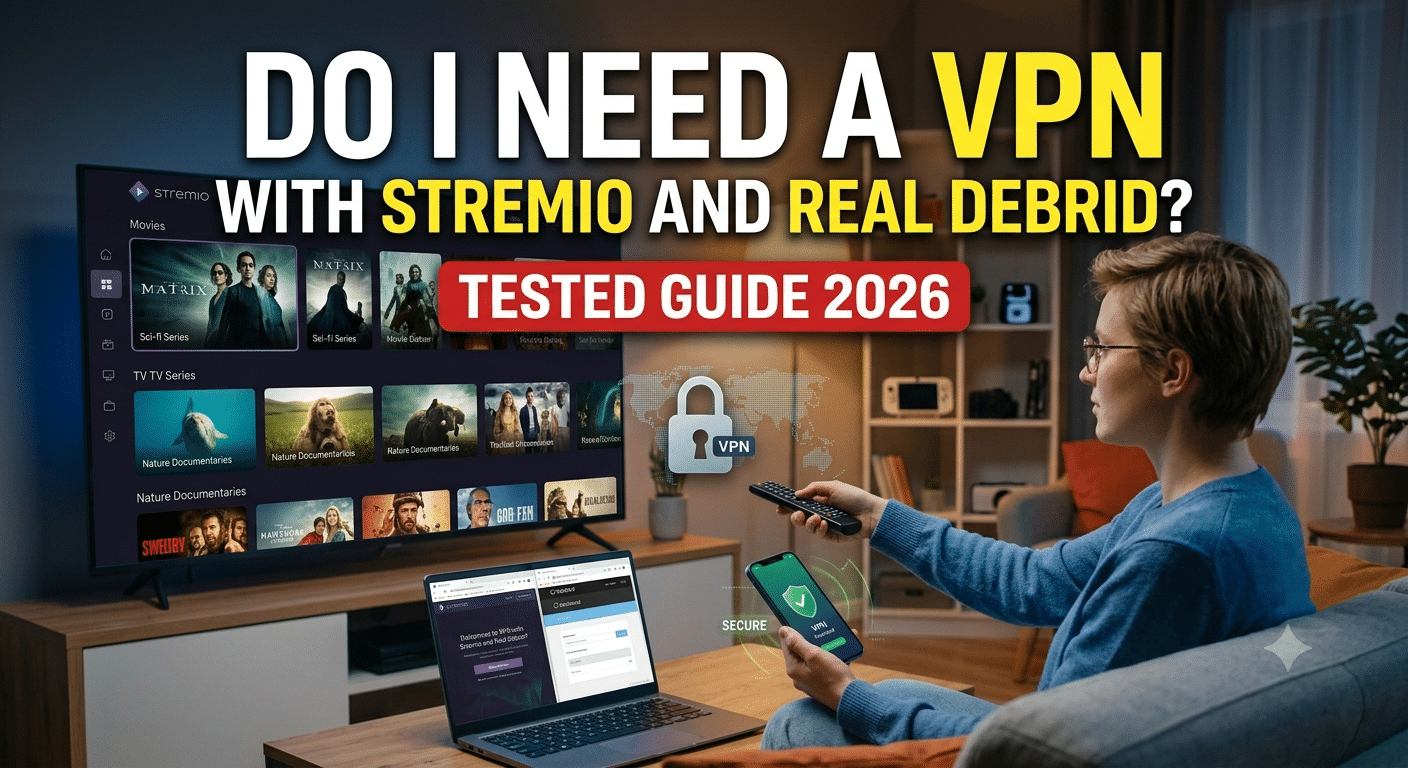

Many people assume that adding Real Debrid to Stremio eliminates the need for a VPN. That’s only partly true. While Real Debrid changes how content is delivered, it doesn’t provide the same privacy protections as a virtual private network. Whether you should use a VPN depends on your priorities: privacy, security, network restrictions, and streaming reliability.
If your primary goal is simply to improve streaming performance, Real Debrid may be enough for many situations. If you also want to reduce the amount of information your internet service provider (ISP) can see, protect your connection on public Wi-Fi, or mask your IP address, a VPN remains valuable.
This guide explains what each service does, where their functions overlap, and where they are fundamentally different.
What Does Real Debrid Actually Do?
Real Debrid is a premium multihost service. Instead of streaming directly from many public file hosts, compatible applications can retrieve content through Real Debrid’s servers, often providing higher-quality streams, faster downloads, and more reliable playback.
For many users, the biggest advantages include:
- More high-quality streaming sources
- Better buffering performance
- Support for larger 4K files
- Faster downloads from supported hosts
These benefits improve the streaming experience, but they are not primarily designed to enhance online privacy.
A common misconception is that Real Debrid functions like a VPN. It does not.
What Does a VPN Do Differently?
A VPN creates an encrypted tunnel between your device and a VPN server. Instead of your ISP seeing the destination of your internet traffic directly, it sees an encrypted connection to the VPN server.
A VPN typically provides benefits such as:
- Encrypting internet traffic
- Hiding your public IP address from the services you connect to
- Protecting data on public Wi-Fi
- Reducing ISP visibility into your browsing activity
- Helping bypass some local network restrictions
These functions are separate from what Real Debrid offers. The two services solve different problems.
Is a VPN Required With Stremio and Real Debrid?
For most users, the simple answer is no. Stremio and Real Debrid can work together without a VPN.
However, “not required” does not mean “never useful.”
A VPN becomes more valuable if you:
- Frequently use public Wi-Fi.
- Want to limit ISP visibility into your internet activity.
- Prefer masking your home IP address.
- Experience ISP traffic shaping or throttling.
- Want a consistent privacy layer across all online activities, not just streaming.
If none of these concerns apply to you, you may decide that Real Debrid alone meets your needs.
Can Your ISP Still See Your Activity?
This is one of the most common questions—and the answer requires some nuance.
Even when using Real Debrid, your ISP still knows that your device is communicating with Real Debrid’s servers. What it cannot necessarily inspect depends on how the connection is encrypted and how the service is being used.
A VPN changes this picture by encrypting traffic between your device and the VPN server, making it significantly harder for your ISP to determine the specific online services you’re accessing.
It’s important to distinguish between:
- Privacy — limiting who can observe your online activity.
- Security — protecting data from interception.
- Performance — improving streaming quality and reliability.
Real Debrid primarily focuses on performance, while a VPN focuses on privacy and secure networking.
Why Some Users Still Choose Both
Many experienced Stremio users run both services together because they address different needs.
Real Debrid improves stream availability and playback quality.
A VPN adds an extra privacy layer that extends beyond streaming. It protects web browsing, app traffic, and other internet activity through encrypted connections.
Using both services also creates consistency. You don’t have to think about when privacy matters—your VPN remains active regardless of which applications you’re using.
That doesn’t mean every user needs this setup. Someone who only streams at home on a trusted network may reasonably decide that the additional privacy provided by a VPN isn’t essential for their own situation.
In the next section, we’ll examine the real-world privacy benefits of using a VPN alongside Stremio and Real Debrid, including when it makes the biggest difference and when it may have little practical impact.
Here’s Part 2 of the original article.
When Does Using a VPN With Stremio and Real Debrid Make the Most Sense?
A VPN isn’t mandatory for every Stremio user, but there are situations where it provides meaningful advantages. Understanding these scenarios helps you decide whether it’s worth adding another service to your setup.
You’re Connected to Public Wi-Fi
Coffee shops, hotels, airports, and other public networks are convenient, but they also introduce additional security risks. Although many websites and apps already use HTTPS encryption, a VPN encrypts your device’s traffic before it leaves your network, adding another layer of protection against local eavesdropping and reducing the amount of information visible to the network operator.
If you regularly stream while traveling, this is one of the strongest arguments for keeping a VPN enabled.
You Want Greater Privacy From Your ISP
Your internet service provider carries your internet traffic. Depending on your location, your ISP may retain connection metadata or be required to comply with legal requests for customer information.
A VPN doesn’t make you anonymous, but it changes what your ISP can directly observe by encrypting the connection between your device and the VPN server. For users who value online privacy, this is often the primary reason to use one.
Your Network Restricts Certain Services
Some workplaces, schools, universities, or public Wi-Fi providers restrict access to particular websites or applications. In some cases, a VPN can help you access services that would otherwise be blocked on that local network.
Keep in mind that you should always comply with the rules and policies of the network you’re using and any applicable laws in your jurisdiction.
Situations Where a VPN May Not Be Necessary
Not everyone benefits equally from using a VPN.
If you primarily stream at home over a trusted internet connection, don’t have privacy concerns beyond standard web encryption, and aren’t experiencing ISP throttling or network restrictions, you may find that Real Debrid alone provides the performance improvements you’re looking for.
In that case, adding a VPN becomes a personal privacy decision rather than a technical requirement.
Does a VPN Slow Down Streaming?
One of the biggest concerns among streamers is performance.
Every VPN introduces some overhead because your traffic is encrypted and routed through an additional server. The impact, however, varies considerably depending on the provider, server location, and protocol.
Modern VPN protocols such as WireGuard are designed for efficiency and often maintain excellent speeds. On a fast broadband connection, many users notice little difference during HD or even 4K streaming when connected to a nearby server.
Larger slowdowns are more likely when:
- Connecting to servers on another continent.
- Using overloaded or congested VPN servers.
- Choosing older VPN protocols.
- Using free VPN services with limited bandwidth.
The quality of your VPN matters far more than the simple fact that you’re using one.
Speed Throttling Scenarios
Some users report smoother streaming after enabling a VPN because their ISP was previously managing or prioritizing certain types of traffic during periods of network congestion. While this isn’t universal, encrypting your connection can sometimes prevent traffic from being classified in the same way.
It’s important to recognize that buffering can also result from overloaded streaming sources, home Wi-Fi problems, or limited internet speeds. A VPN isn’t a universal solution for every playback issue.
Choosing the Right VPN Features
If you decide that a VPN fits your needs, focus on features that improve privacy and performance rather than marketing claims.
Look for:
- A clearly documented no-logs policy.
- Support for modern protocols such as WireGuard.
- DNS leak protection.
- A kill switch that helps prevent accidental exposure if the VPN disconnects.
- Fast servers located near your region.
- Apps for all of your streaming devices.
Unlimited bandwidth and consistent speeds are also important if you regularly stream high-bitrate 4K content.
Avoid choosing a VPN based solely on the number of servers it advertises. Server quality, network capacity, and overall reliability typically have a greater impact on real-world performance than raw server counts.
The next section explores common misconceptions about Real Debrid and VPNs, explains what each service can—and cannot—protect, and answers several frequently asked questions that influence whether running both services is worthwhile.
Common Myths About VPNs, Stremio, and Real Debrid
Confusion about how these services work has led to several persistent myths. Understanding the differences helps you make better decisions about your streaming setup.
Myth 1: Real Debrid Replaces a VPN
This is the most common misconception.
Real Debrid is designed to improve access to supported file hosts and deliver faster, more reliable streams. It is not a privacy service. While your connection to its servers is encrypted using standard web security protocols, Real Debrid does not hide your public IP address from every service you use or provide the broader network privacy that a VPN offers.
If your goal is to improve streaming quality, Real Debrid can be enough. If your goal also includes protecting your IP address and encrypting your internet traffic across applications, a VPN serves a different purpose.
Myth 2: A VPN Makes You Completely Anonymous
No VPN can guarantee complete anonymity online.
A reputable VPN can significantly improve privacy by encrypting your connection and masking your IP address from the websites and services you access. However, your online activity can still be associated with information such as account logins, browser fingerprinting, cookies, or data you voluntarily provide.
Think of a VPN as one important layer in a broader privacy strategy rather than a complete solution.
Myth 3: Every VPN Is Good for Streaming
VPN quality varies dramatically.
Some providers operate high-capacity networks with modern protocols and regularly updated infrastructure. Others rely on overcrowded servers, impose bandwidth limits, or offer inconsistent performance.
When streaming large 1080p or 4K files, stability often matters more than having hundreds of server locations. A reliable nearby server typically delivers better results than a distant, overloaded one.
Potential Trade-Offs of Using a VPN
Although a VPN offers valuable privacy benefits, it also introduces a few considerations.
Slightly Higher Latency
Because your traffic passes through an additional server, response times usually increase slightly. For video streaming, this difference is rarely noticeable after playback begins, but online gaming or real-time communication may be more sensitive to added latency.
Additional Cost
Real Debrid and a premium VPN are separate subscription services. If you’re paying for both, consider whether the extra privacy features match your personal priorities and budget.
For users who primarily stream on a secure home network and have few privacy concerns, the additional subscription may provide limited practical value.
Initial Setup
Most modern VPN applications are straightforward to install, but you’ll still need to select a server, configure basic settings if desired, and ensure the VPN is active before streaming.
Fortunately, many VPN clients remember your preferred server and reconnect automatically when your device starts.
Which Users Benefit Most From a VPN?
The answer depends less on Stremio itself and more on how and where you use the internet.
A VPN is likely to provide the greatest value if you:
- Frequently connect to public Wi-Fi networks.
- Prefer minimizing the amount of information visible to your ISP.
- Travel regularly and stream from different locations.
- Want one consistent privacy solution for browsing, streaming, and other online activities.
- Value encrypting internet traffic across all compatible applications.
On the other hand, users who stream exclusively at home over a trusted network may decide that the additional privacy is helpful but not essential.
Practical Tips for Better Streaming Performance
Whether or not you choose to use a VPN, several best practices can improve your overall streaming experience.
Use a stable, high-speed internet connection whenever possible. If you’re watching high-bitrate content, a wired Ethernet connection generally provides more consistent performance than Wi-Fi.
Keep Stremio and its add-ons updated to reduce compatibility issues and improve stability. Outdated software can cause buffering or playback errors that have nothing to do with your internet connection.
If you use a VPN, connect to a server that is geographically close to your location unless you have a specific reason to choose another region. Shorter routing paths often translate into lower latency and better speeds.
Finally, restart your router periodically and avoid running large downloads in the background while streaming. Local network congestion is a common cause of playback interruptions.
In the final part, we’ll bring everything together with clear recommendations for different types of users, answer frequently asked questions, and summarize when using both Stremio and Real Debrid with a VPN is the right choice.
Final Recommendations: Should You Use a VPN With Stremio and Real Debrid?
There isn’t a single answer that fits everyone. The right choice depends on what you value most: streaming performance, online privacy, or a combination of both.
If Your Priority Is Better Streaming Quality
Real Debrid can significantly improve the availability and reliability of compatible streaming sources. If you stream exclusively on a trusted home network and your main concern is reducing buffering or accessing higher-quality streams, you may find that Real Debrid alone meets your needs.
If Your Priority Is Privacy
A VPN provides protections that Real Debrid does not. It encrypts your internet connection, masks your public IP address from the websites and services you access, and reduces the amount of information your ISP can directly observe.
For users who regularly use public Wi-Fi, travel frequently, or simply prefer stronger online privacy, a reputable VPN remains a worthwhile addition.
If You Want the Most Balanced Setup
Many experienced users choose to combine both services because they complement one another rather than compete.
- Real Debrid focuses on stream quality, source availability, and download performance.
- A VPN focuses on connection privacy, encrypted traffic, and IP address protection.
Used together, they address different aspects of the streaming experience.
Frequently Asked Questions
Does Real Debrid encrypt my connection?
Connections to Real Debrid typically use HTTPS, which encrypts data in transit between your device and its servers. However, this is not the same as using a VPN, which encrypts your internet connection more broadly and routes it through a VPN server.
Will every VPN work well with streaming?
Not necessarily.
Performance depends on the provider’s infrastructure, server load, available bandwidth, and the protocol being used. Premium VPNs generally offer more consistent speeds and better reliability than free alternatives.
Can a VPN eliminate buffering?
No.
Buffering can result from many factors, including internet speed, Wi-Fi quality, server congestion, device performance, or the availability of streaming sources. A VPN may improve performance in certain situations—such as when ISP traffic management is involved—but it is not a universal fix.
Is It Safe to Leave a VPN Connected All the Time?
For most users, yes.
Many VPN applications are designed to remain connected continuously with minimal impact on everyday browsing and streaming. Automatic reconnection, kill switches, and protocol selection help maintain both convenience and privacy.
As always, choose a reputable provider with a transparent privacy policy and a history of independent security audits.
Key Takeaways
If you’re asking, “Do I need a VPN with Stremio and Real Debrid?”, the practical answer is that it depends on your goals.
You do not need a VPN simply to make Stremio and Real Debrid function together. The services are fully capable of working without one in many home-network scenarios.
However, if protecting your IP address, reducing ISP visibility, securing public Wi-Fi connections, or maintaining a higher level of online privacy matters to you, a VPN offers meaningful benefits that Real Debrid does not replace.
Neither service is a substitute for the other. One improves access to supported streaming sources and playback quality, while the other focuses on protecting your internet connection.
Before deciding, consider these questions:
- Do you regularly use public or shared Wi-Fi?
- Are you concerned about online privacy beyond streaming?
- Have you experienced ISP traffic management or network restrictions?
- Do you want a consistent privacy solution across all of your internet activity?
If you answered “yes” to one or more of these questions, adding a reputable VPN is likely to enhance your overall experience.
Bottom Line
For most home users, Real Debrid delivers the streaming improvements they’re looking for. A VPN is an optional—but often valuable—layer that enhances privacy rather than streaming functionality itself.
Choosing to use both isn’t about making Stremio work better in every situation; it’s about deciding how much importance you place on protecting your connection while enjoying your media.