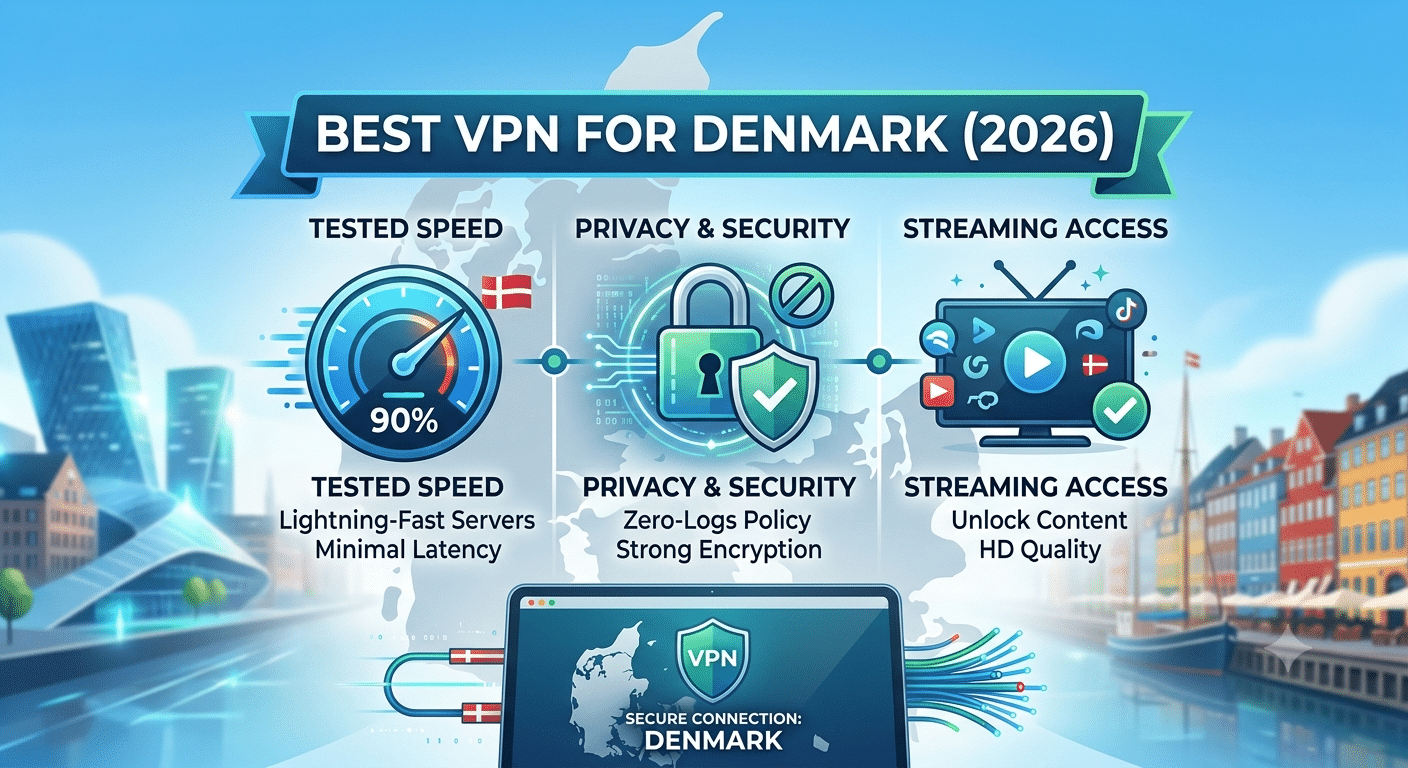

Finding the best vpn for denmark is less about choosing the provider with the biggest server list and more about matching performance, privacy features, and real-world usability to your needs. A VPN can help protect your connection on public Wi-Fi, reduce online tracking, and provide access to services that require a Danish IP address.
During testing, the strongest VPN choices consistently separated themselves through measurable factors: connection speed loss, server availability, privacy policies, streaming reliability, and device support. A provider that performs well in one category may not be the best option for another, so you need to evaluate what matters most for your usage.
Before comparing specific services, it helps to understand the fundamentals. If you are new to VPNs, this overview of understanding VPN technology explains the basic concepts behind encrypted connections, IP masking, and private browsing.
What Is the Best VPN for Denmark Right Now?
The best VPN for Denmark should deliver three core benefits: reliable Danish or nearby European servers, strong privacy protection, and consistent speeds. A good service should also support modern protocols such as WireGuard, provide a kill switch, and maintain a clear no-logs policy backed by independent audits.
For most users, premium VPN services offer a better balance than free alternatives because they typically provide more server locations, higher speeds, and stronger security features. When evaluating providers, focus on verified performance rather than marketing claims.
A useful starting point is reviewing providers that consistently rank among the best VPN services based on testing, security reviews, and long-term reliability.
Why Do You Need a VPN in Denmark?
Denmark has strong internet infrastructure and high digital adoption, but privacy concerns still exist. Online services, advertisers, internet providers, and public networks can collect information about your browsing activity.
A VPN creates an encrypted tunnel between your device and a VPN server. This prevents local network operators from easily monitoring your traffic and hides your real IP address from websites you visit.
The Electronic Frontier Foundation explains that encryption and privacy tools play an important role in protecting users from unnecessary online surveillance and data collection. You can learn more about digital privacy principles through resources from the Electronic Frontier Foundation.
Common reasons users in Denmark choose a VPN include:
- Protecting data when connecting to public Wi-Fi
- Accessing Danish services while traveling abroad
- Reducing tracking from advertisers
- Securing remote work connections
- Testing websites from different regions
For travelers and expatriates, a VPN with Danish servers can be especially useful because it allows devices outside Denmark to appear as though they are connecting from within the country.
How Do VPNs Protect Your Privacy and Data?
A VPN works by encrypting your internet traffic before it leaves your device. Instead of connecting directly to a website, your connection first travels through a VPN server, which replaces your original IP address with the server’s address.
The process involves several security layers:
- Encryption that protects transmitted data
- Authentication that verifies secure connections
- IP address masking that improves privacy
- DNS leak prevention to avoid accidental exposure
A deeper explanation of how VPN encryption works covers the technical process behind tunneling protocols and encrypted data transfers.
For Denmark users, protocol choice can affect both security and speed. WireGuard is now widely adopted because it offers efficient encryption with lower overhead compared with older protocols. OpenVPN remains popular because of its flexibility and long history of security testing.
However, encryption alone does not guarantee privacy. The provider’s logging policy, company jurisdiction, and independent audits matter just as much.
Which VPN Features Matter Most for Denmark Users?
Not every VPN feature provides equal value. For Denmark users, several factors should receive priority:
Danish Server Availability
A VPN with Danish servers can provide a Danish IP address, which is useful for accessing local websites and services while abroad. Server quality matters more than raw server numbers because overloaded servers can reduce performance.
Privacy Policy and Audits
A no-logs policy is one of the most important considerations. Look for providers that have undergone independent audits verifying their privacy claims.
Speed Performance
VPN speed depends on server distance, network congestion, encryption overhead, and protocol efficiency. A high-quality VPN may reduce speeds slightly, but the impact should remain acceptable for browsing, video calls, and streaming.
Device Compatibility
A VPN should support the devices you actually use, including Windows PCs, Macs, smartphones, tablets, and streaming devices. Check connection limits carefully because some providers restrict simultaneous devices depending on your subscription tier.
Free VPN services can appear attractive, but they often come with limitations such as fewer servers, bandwidth restrictions, and slower connections. If you are considering no-cost options, review the differences between premium services and reliable free VPN services before making a decision.
Choosing the right VPN for Denmark requires more than checking whether a provider has Danish servers. Real-world performance depends on connection stability, server congestion, streaming compatibility, and how well the VPN handles different devices.
A VPN that looks impressive on paper can still disappoint if speeds drop heavily during peak hours or if streaming platforms frequently block its IP addresses. For Denmark users, consistent performance matters more than having the largest advertised server network.
How Do VPNs Perform for Danish Streaming and Travel?
Streaming is one of the most common reasons people search for a Denmark VPN. Users traveling outside the country often want access to Danish platforms, while international users may need a Danish IP address for regional services.
A quality VPN should maintain enough bandwidth for HD and 4K streaming while avoiding frequent buffering. The best providers achieve this through optimized servers, efficient protocols, and regular IP address rotation.
For travelers, server location is critical. A VPN connection routed through Denmark generally provides lower latency than connecting through distant regions. However, nearby European servers can sometimes deliver better speeds if Danish servers experience heavy demand.
Users comparing Scandinavian VPN options may also find it useful to review how providers perform in neighboring markets, such as VPN options for Norway users and VPN services for Sweden users. These comparisons can reveal differences in server coverage and regional performance.
Streaming platforms regularly update their systems to detect VPN traffic. This means no provider can guarantee permanent access to every service. A strong VPN improves your chances by maintaining a large pool of IP addresses and replacing blocked servers quickly.
Which VPN Features Improve Streaming Reliability?
Several technical features influence streaming performance:
Server Network Quality
A larger server network can reduce congestion because users have more connection options. However, server quality and maintenance matter more than simple server counts.
A provider with fewer well-managed servers may outperform one with thousands of overloaded locations.
Protocol Efficiency
Modern protocols such as WireGuard typically deliver better speeds because they use efficient encryption methods and require fewer resources.
Older protocols may still be useful in specific situations, but most users should prioritize services that offer automatic protocol selection or optimized connections.
Streaming Device Support
A VPN should work across the devices you actually use. Common compatibility requirements include:
- Windows and macOS computers
- iOS and Android phones
- Smart TVs
- Streaming devices
- Routers
Router support can be especially useful because it protects multiple devices without requiring separate installations.
What Are the Main Privacy Considerations for Denmark VPN Users?
Privacy remains a major reason people choose VPN services. A VPN can hide your IP address from websites and prevent local network operators from easily viewing your browsing activity.
However, the VPN provider itself becomes responsible for handling your connection data. This makes company policies and independent verification important.
Look for:
- Verified no-logs claims
- Independent security audits
- Strong encryption standards
- Clear data retention policies
- Transparent ownership information
Jurisdiction also matters. VPN companies operate under the laws of the countries where they are registered, which can influence data requests and legal obligations.
Denmark is part of the European Union, where privacy regulations such as the General Data Protection Regulation (GDPR) influence how companies process personal data. A VPN provider should still be evaluated based on its own policies rather than location alone.
How Do VPNs Compare Across Different Countries and Regions?
VPN performance varies depending on where you connect from and which country you need access to.
A traveler in the United States connecting to Denmark may have different results from someone inside Denmark connecting to another European server. Distance, routing, and ISP performance all affect speeds.
Country-specific VPN guides can help users understand regional differences. For example, users comparing European services may also benefit from reviewing VPN choices for France and VPN solutions for Italy when evaluating broader European coverage.
International users should also consider whether they need a VPN mainly for privacy, accessing local content, or maintaining secure connections while traveling.
Server Load Effects, Device Compatibility Limits, Account Restrictions, and Speed Throttling Scenarios
VPN performance can change depending on how providers manage their infrastructure.
Server Load Effects
When too many users connect to the same server, available bandwidth is divided among more connections. This can increase latency and reduce download speeds.
Premium VPN providers usually manage this by monitoring server capacity and redirecting traffic when locations become crowded.
Device Compatibility Limits
Most VPN subscriptions support multiple simultaneous connections, but limits vary. A household with laptops, phones, tablets, and smart TVs should check the allowed number of devices before subscribing.
Installing a VPN on a router can bypass some device restrictions because every connected device shares one protected connection.
Account Restrictions
Some VPN providers restrict account sharing or limit usage patterns to prevent abuse. Before choosing a service, check whether your intended usage matches the provider’s terms.
Speed Throttling Scenarios
Speed reductions can happen because of:
- Long-distance server connections
- Busy servers
- Older VPN protocols
- ISP congestion
- Limited free-plan bandwidth
A good VPN minimizes these effects but cannot eliminate the physics of routing traffic through additional servers.
The right VPN depends on what you need it to accomplish. A user who mainly wants privacy on public Wi-Fi has different priorities from someone who needs Danish streaming access, international travel support, or multiple device connections.
The strongest VPN services balance speed, privacy, reliability, and cost. A large server network alone does not guarantee better performance. Real-world factors such as server congestion, protocol efficiency, and provider transparency matter more.
How Do You Choose Between Premium and Free VPN Services?
Premium VPNs usually provide better performance because they offer larger server networks, faster infrastructure, stronger applications, and more advanced privacy features.
Free VPNs can work for occasional use, but they often include restrictions that affect daily usability:
- Limited server locations
- Lower connection speeds
- Data caps
- Fewer supported devices
- Reduced customer support
If you only need basic protection for occasional browsing, free options may be enough. However, users who stream content, travel frequently, work remotely, or regularly connect through public networks usually benefit from a paid service.
Before choosing a provider, compare what you actually need. A cheaper VPN is not always the better value if it creates slower connections or limits your usage.
Which Features Should You Prioritize Before Buying a VPN?
A VPN subscription should match your online habits. Several features have a direct impact on security and performance.
Independent Privacy Audits
A provider’s privacy policy is important, but independent audits provide stronger evidence that the company follows its stated practices.
Look for VPNs that publish audit results and explain how they handle user data, logging requests, and security testing.
Modern VPN Protocols
Protocols determine how your device connects to a VPN server. Modern options such as WireGuard are designed to provide strong encryption while maintaining high speeds.
Older protocols may still be useful in specific situations, but most users should choose a VPN that automatically selects the best connection method.
Understanding how VPN encryption works can help you evaluate why different protocols affect speed and security.
Device Compatibility
A VPN should support the devices you use every day. Before subscribing, check compatibility with:
- Windows computers
- macOS devices
- Android and iOS phones
- Tablets
- Smart TVs
- Routers
A provider with a high device limit can be more practical for households with multiple connected devices.
How Do VPNs Help Users Traveling Between Denmark and Other Countries?
Travelers often use VPNs to maintain access to familiar services while abroad. A Danish server can provide a Danish IP address, allowing users outside the country to appear as if they are browsing from Denmark.
The same principle applies when accessing international content from Denmark. Users may connect through servers in other regions to test websites, access different streaming libraries, or maintain consistent online access while traveling.
Regional VPN performance differs between countries. For example, users researching international coverage can compare services through guides focused on VPN recommendations for Brazil users and VPN options for Mexico users.
A reliable travel VPN should provide:
- Stable connections across multiple countries
- Fast mobile applications
- Automatic server selection
- Strong protection on public Wi-Fi
- Consistent performance over long distances
What Common Mistakes Should You Avoid When Choosing a Denmark VPN?
Many VPN buyers focus on the wrong details. A provider may advertise thousands of servers, but that information does not reveal connection quality or privacy standards.
Choosing Only Based on Price
The cheapest VPN may include limitations that become frustrating over time. Check speed, device support, privacy features, and renewal pricing before subscribing.
Ignoring Privacy Policies
A VPN handles your internet traffic, so the provider’s privacy practices matter. Avoid services that collect unnecessary user information or provide unclear explanations about logging.
Expecting Guaranteed Streaming Access
Streaming platforms frequently update their systems to identify VPN traffic. No VPN can promise permanent access to every platform, but strong providers regularly maintain their networks to improve reliability.
Forgetting Device Restrictions
A VPN that works well on a computer may not support every device you own. Check connection limits and app availability before purchasing.
How Does a VPN Affect Internet Speed in Denmark?
A VPN can reduce connection speeds because your traffic travels through an additional server and requires encryption processing.
The impact depends on:
- Distance between you and the VPN server
- Server workload
- VPN protocol
- Original internet speed
Modern protocols such as WireGuard can reduce performance loss compared with older connection methods.
For normal activities like browsing, video calls, and HD streaming, a quality VPN should maintain usable speeds. However, users performing large downloads or latency-sensitive tasks should test performance with nearby servers.
The right VPN choice comes down to your priorities. There is no single provider that is perfect for every user because privacy, streaming, speed, and device requirements vary.
A frequent traveler may prioritize Danish servers and reliable mobile apps. A privacy-focused user may care more about independent audits and strict logging policies. A streaming user may value connection consistency above everything else.
The strongest choice is the service that performs well in the areas you actually use.
Which VPN Features Matter Most for Different Types of Users?
Different users should evaluate VPNs using different criteria.
For Privacy-Focused Users
Privacy-conscious users should prioritize:
- Independent security audits
- Clear no-logs policies
- Strong encryption standards
- DNS leak protection
- A reliable kill switch
A VPN provider should explain how it protects user information instead of relying only on general security claims.
For Streaming Users
Streaming-focused users should look for:
- Consistent connection speeds
- Multiple server locations
- Reliable apps for streaming devices
- Fast server switching
VPN performance can change over time because streaming platforms frequently update their detection methods. Providers that maintain larger server networks generally have more options when individual IP addresses become blocked.
For Travelers and Remote Workers
Travelers should focus on:
- Mobile application quality
- Public Wi-Fi protection
- Stable international connections
- Multiple simultaneous connections
A good travel VPN should work reliably from hotels, airports, and unfamiliar networks without requiring complicated setup.
What Are the Most Common Questions About VPNs in Denmark?
Is using a VPN legal in Denmark?
Yes. Using a VPN is legal in Denmark. However, a VPN does not remove your responsibility to follow local laws or the terms of services you use.
Can a VPN give me a Danish IP address?
Yes. A VPN server located in Denmark can provide a Danish IP address by routing your connection through that server. This can help users access Denmark-based websites while traveling.
Will a VPN slow down my internet connection?
A VPN can reduce speeds because it encrypts traffic and routes it through another server. The effect depends on the provider, server distance, network conditions, and protocol used.
High-quality VPN services typically minimize speed reductions through optimized infrastructure and modern protocols.
Are free VPNs safe to use?
Some free VPNs provide basic protection, but many have limitations such as slower speeds, fewer locations, and restricted features. Users should carefully review privacy policies before trusting any free service.
Can I use one VPN account on multiple devices?
Most VPN providers support multiple simultaneous connections, but limits vary by subscription. Users with many devices should check connection allowances before purchasing.
What Should You Consider Before Making a Final VPN Decision?
Before choosing a VPN for Denmark, review these factors:
Privacy:
Does the provider have a verified no-logs policy and transparent security practices?
Performance:
Does it maintain acceptable speeds during normal use, streaming, and travel?
Compatibility:
Does it support your computers, phones, tablets, and other connected devices?
Features:
Does it include important tools such as a kill switch, leak protection, and modern protocols?
Value:
Does the price match the features you actually need?
Avoid choosing a VPN only because of a discount or a long feature list. The best service is the one that provides reliable protection and performance for your specific situation.
Final Recommendation: What Is the Best VPN for Denmark?
The best vpn for denmark depends on whether your priority is privacy, streaming, travel, or everyday protection. Focus on independently verified security, consistent performance, and practical features rather than advertising claims.
A strong VPN should provide reliable connections, protect your data on unfamiliar networks, and give you flexibility across devices and locations.
Based on the factors that matter most for Denmark users, prioritize providers with audited privacy practices, modern protocols, and proven performance. Review the available options carefully and choose the service that matches your online habits.