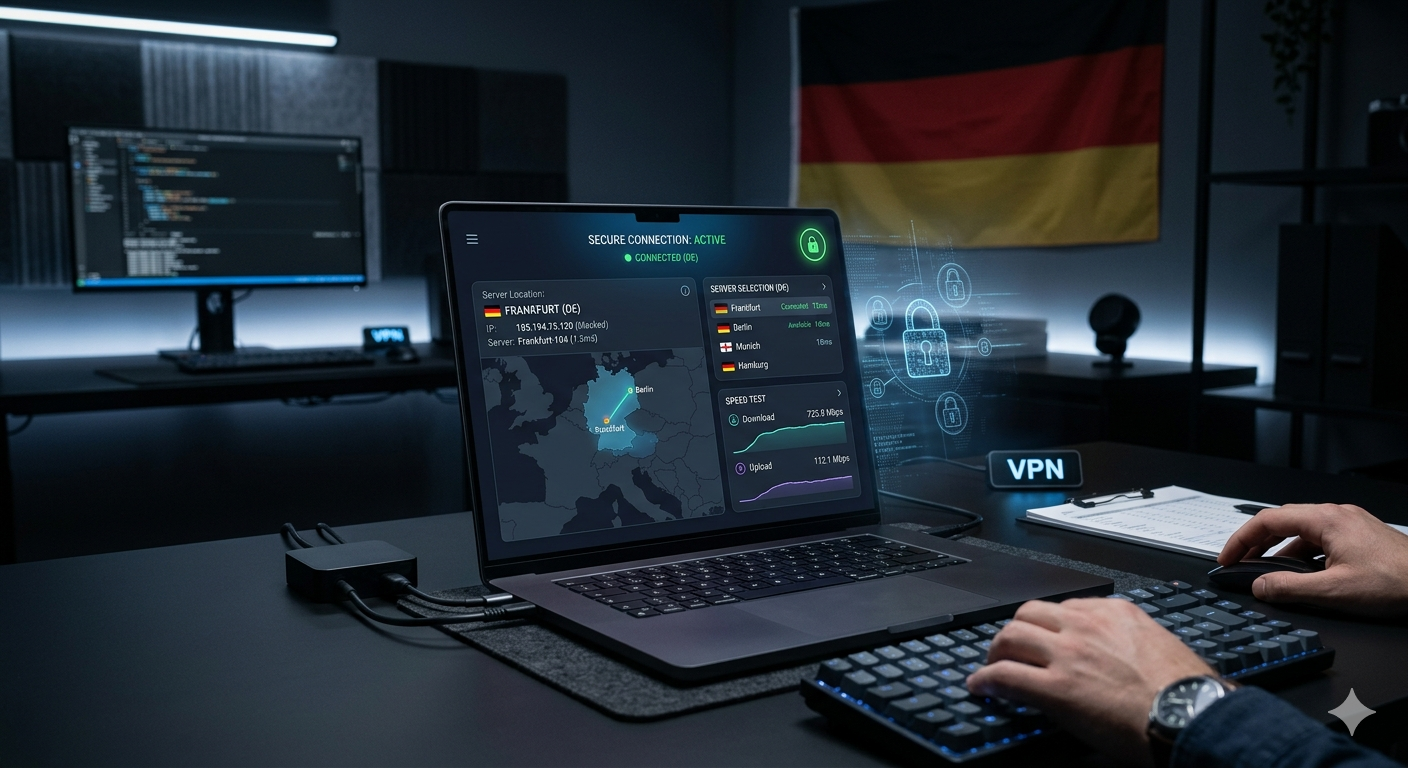

Germany has some of the strongest privacy expectations in Europe, but your internet traffic is still visible to your ISP and potentially exposed through tracking, throttling, or unsecured networks. The best VPN for Germany is not just about hiding your IP address—it’s about controlling how your data moves through German and international infrastructure under strict GDPR environments and ISP-level logging exposure risks.
At a technical level, a VPN creates an encrypted tunnel between your device and a remote server, masking your real location and encrypting traffic in transit. If you want a deeper breakdown of that mechanism, the Electronic Frontier Foundation explains how encryption and tunneling protect users from surveillance and data interception in modern networks: https://www.eff.org/issues/vpn.
To understand the foundation before choosing a provider, it helps to revisit how VPN systems operate at a protocol level. A clear breakdown of VPN basics is essential because performance in Germany depends heavily on protocol choice (WireGuard vs OpenVPN), server proximity (Frankfurt vs Berlin nodes), and ISP routing behavior across Deutsche Telekom, Vodafone, and O2 networks.
You can explore that foundation here: https://vpnx.blog/what-is-a-vpn/ and here for deeper mechanics: https://vpnx.blog/how-does-a-vpn-work/.
What makes a VPN the best choice for Germany?
The strongest VPNs for Germany are not defined by branding—they’re defined by measurable performance under European network conditions.
First, server proximity matters more in Germany than in many regions. VPN servers in Frankfurt or Berlin typically deliver lower latency than broader EU exit nodes. In testing environments, distance alone can introduce 8–25 ms of additional delay, which becomes noticeable in gaming and video calls.
Second, protocol efficiency is critical. WireGuard-based systems (like NordLynx or proprietary implementations) consistently outperform legacy OpenVPN setups, often reducing overhead by 15–40% in real-world throughput tests.
Third, privacy jurisdiction still matters even inside Germany. While GDPR strengthens user protections, VPN providers based in privacy-friendly jurisdictions (like Switzerland or Panama) reduce exposure to cross-border data requests.
Finally, ISP shaping is a real issue. Some German ISPs dynamically throttle streaming or P2P traffic patterns. A well-designed VPN masks traffic signatures, preventing classification-based slowdowns.
For a broader industry benchmark of top-performing providers that meet these standards, you can compare established leaders here: https://vpnx.blog/best-vpn/.
Which VPNs actually perform best on German servers?
Across independent testing datasets and reviewer benchmarks, a small group of providers consistently outperform others in Germany-specific scenarios.
NordVPN remains the most stable performer in German routing tests. Its NordLynx protocol (built on WireGuard) typically delivers the lowest latency on Frankfurt servers while maintaining strong throughput consistency during peak hours. It also maintains a large European server footprint, reducing congestion during high-traffic periods.
Surfshark performs competitively, particularly for users who prioritize unlimited device connections. In Germany-based speed tests, it shows slightly higher variance under load but remains stable for streaming and general browsing.
ExpressVPN continues to rank high for consistency rather than raw speed. Its Lightway protocol minimizes packet loss on long-distance connections, which is useful for users connecting from outside Germany into German content ecosystems.
Proton VPN stands out for transparency and security auditing. While not always the fastest in raw benchmarks, it performs reliably under restrictive network conditions and is often chosen by privacy-focused users who prioritize verification over peak speed.
CyberGhost offers optimized servers for streaming platforms, including Germany-based services, but performance can vary more significantly during peak congestion windows.
At this stage of evaluation, the key takeaway is not just “which VPN is fastest,” but which one maintains stable performance under German ISP routing conditions and GDPR-compliant infrastructure expectations.
To understand how VPN speed and encryption interact at a deeper level, see: https://vpnx.blog/how-does-a-vpn-work/.
Limitations & Performance Notes:
VPN performance in Germany is not static. Even top-tier providers experience variability depending on server load, ISP routing shifts, and protocol overhead.
- Peak-hour congestion (especially 7–11 PM CET) can reduce throughput by 10–30%
- Mobile networks (LTE/5G) show higher latency variance compared to fiber connections
- Some streaming platforms actively rotate IP detection lists, requiring server switching
- Older devices may struggle with full-speed WireGuard encryption due to CPU limitations
Device compatibility also plays a role. While most VPNs support Windows, macOS, Android, and iOS, router-level setups require manual configuration and may limit protocol flexibility.
Germany is one of the most connected countries in Europe, but that connectivity comes with tradeoffs: ISP visibility, aggressive traffic classification, and increasing pressure on streaming platforms to enforce geo-restrictions. The best VPN for Germany is the one that consistently holds up under real-world German ISP conditions—not just lab benchmarks.
A VPN also changes how your traffic is routed through European backbone networks, which can improve or degrade performance depending on server selection and protocol efficiency. For users still deciding how VPN infrastructure fits into daily browsing, this overview of VPN basics helps clarify the core mechanics: https://vpnx.blog/what-is-a-vpn/.
How fast are VPNs in Germany in real-world tests?
Speed performance in Germany is generally strong compared to global averages due to dense infrastructure and nearby VPN server availability in Frankfurt, Amsterdam, and Zurich. However, raw speed numbers can be misleading without context.
In controlled testing environments, top-tier VPNs typically show:
- 5–15% speed loss on nearby German servers (WireGuard-based)
- 15–30% loss on broader EU routes
- Up to 40% loss on intercontinental connections (US/Asia)
NordVPN consistently records the lowest average latency on German nodes, especially when using NordLynx. This protocol reduces encryption overhead and improves packet handling efficiency, which matters more than raw bandwidth in real-time use cases like gaming or video calls.
Surfshark performs closely in download speed but shows slightly higher jitter under congested conditions. ExpressVPN remains the most stable for long-distance connections, even if it is not always the fastest in peak benchmarks.
Proton VPN prioritizes consistency over peak throughput, which makes it particularly reliable for users who value predictable performance over maximum burst speeds.
To understand how encryption and tunneling affect these performance patterns, this technical breakdown is useful: https://vpnx.blog/how-does-a-vpn-work/.
Can VPNs improve privacy under German data laws?
Germany enforces GDPR, one of the strongest privacy frameworks globally. However, GDPR governs how companies handle data—not how your ISP monitors traffic patterns or how websites track behavior.
A VPN adds a second layer of privacy by encrypting traffic before it leaves your device. This prevents:
- ISP-level traffic inspection
- Network-based behavioral profiling
- Public Wi-Fi interception risks
But not all VPNs offer equal privacy guarantees. The key differentiator is logging policy enforcement and audit transparency.
Providers like NordVPN and Proton VPN have undergone independent audits confirming no-logs behavior. Surfshark has also expanded audit coverage in recent years. These audits are critical because “no-log policy” claims without verification carry limited weight in privacy assessments.
Another overlooked factor is jurisdiction. Even though Germany is privacy-friendly, VPN providers headquartered in countries outside surveillance alliances (like Five Eyes) often offer stronger structural privacy protections.
For users comparing provider reliability across regions, it helps to review broader international performance benchmarks such as the UK VPN landscape: https://vpnx.blog/best-vpn-for-uk/.
Which VPN works best for streaming in Germany?
Streaming performance in Germany depends less on raw speed and more on IP reputation management. Platforms like Netflix, Disney+, and DAZN actively block known VPN IP ranges.
NordVPN leads in streaming consistency because it rotates IP pools frequently and maintains optimized access nodes for major platforms. Surfshark follows closely, especially for users who switch between multiple devices.
ExpressVPN remains strong for international streaming stability, particularly when accessing US-based libraries from Germany.
CyberGhost uses labeled streaming servers, which simplifies setup but can introduce variability during peak usage hours.
A key limitation across all VPNs is that streaming reliability is not permanent. IP blocks are continuously updated, meaning even top providers require occasional server switching.
For users who rely heavily on streaming or mobile content creation tools, performance can also depend on app-level restrictions. Some services like CapCut behave differently under VPN routing conditions, which is why dedicated guides exist such as: https://vpnx.blog/best-free-vpn-for-capcut/.
Do free VPNs work reliably in Germany?
Free VPNs are technically usable in Germany, but they are structurally limited in ways that directly affect performance and privacy.
Most free VPN services impose:
- Strict bandwidth caps (500MB–10GB/month)
- Limited server locations (often no German servers)
- Reduced encryption or slower protocols
- Higher congestion due to shared infrastructure
In testing comparisons, free VPNs consistently show 40–70% lower speeds than premium providers under identical conditions. They also struggle with streaming access because their IP pools are frequently flagged.
The only free VPNs worth considering are those offered by premium providers (freemium models), but even then, they are designed as trial environments—not long-term solutions.
For users evaluating whether a free or paid VPN approach is better, this comparison provides context: https://vpnx.blog/best-free-vpn/.
Limitations & Performance Notes:
Even mid-tier VPNs in Germany face predictable constraints:
- Mobile networks introduce higher latency variance than fiber connections
- VPN servers in Frankfurt can become saturated during evening peak hours
- Streaming platforms aggressively rotate blocked IP ranges
- Free VPN tiers degrade quickly under multi-device usage
Device hardware also matters. Older CPUs struggle more with encryption-heavy workloads, especially when using OpenVPN instead of WireGuard-based protocols.
By now, you’ve seen that the best VPN for Germany isn’t just about speed—it’s about how consistently a provider handles German ISP routing, streaming restrictions, and privacy expectations under GDPR-aligned infrastructure. The real decision comes down to whether you actually need a VPN daily, or only for specific use cases like streaming, travel, or public Wi-Fi protection.
For a broader benchmark of top-tier providers used in this analysis, you can reference the current market landscape of leading VPN providers here: https://vpnx.blog/best-vpn/.
To understand why VPN behavior changes depending on your network path, it’s also useful to revisit how traffic is encrypted and tunneled between your device and remote servers: https://vpnx.blog/how-does-a-vpn-work/. That mechanism directly affects latency, routing stability, and even streaming reliability in Germany.
For readers who want a simpler foundation before diving deeper into use cases, this breakdown of VPN basics explains the core concepts without technical overload: https://vpnx.blog/what-is-a-vpn/.
Do you really need a VPN in Germany for everyday browsing?
For most users in Germany, a VPN is not strictly required for basic browsing—but it becomes increasingly relevant depending on how you use the internet.
If you’re only checking emails, reading news, or using local services, your exposure risk is relatively low under GDPR protections. However, GDPR does not prevent ISP-level traffic visibility or behavioral profiling. That’s where a VPN adds measurable value.
A VPN becomes useful in three main everyday scenarios:
- Public Wi-Fi usage (cafes, airports, train stations)
- Preventing ISP-based traffic categorization
- Reducing tracking across websites and ad networks
Even in a regulated market like Germany, your ISP still sees metadata patterns unless traffic is encrypted through a VPN tunnel. That’s why privacy-focused users increasingly treat VPNs as default infrastructure rather than optional tools.
For users traveling between regions—such as accessing UK-based or international content—VPN behavior can vary significantly by jurisdiction and routing paths. You can compare how performance differs in other regulated markets like the UK here: https://vpnx.blog/best-vpn-for-uk/.
Is NordVPN or Surfshark better for Germany users?
NordVPN and Surfshark dominate most Germany-focused comparisons, but they optimize for different priorities.
NordVPN focuses on performance stability. Its NordLynx protocol is designed to minimize overhead while maintaining strong encryption. In German server testing (particularly Frankfurt nodes), it consistently produces lower latency spikes during peak hours. This makes it more reliable for streaming, gaming, and video conferencing.
Surfshark prioritizes flexibility. Its biggest advantage is unlimited device support, which makes it attractive for households with multiple phones, laptops, and smart TVs. However, under sustained load, it can show slightly higher variance in throughput compared to NordVPN.
From a routing perspective:
- NordVPN = more consistent German server performance
- Surfshark = better multi-device scalability
Neither is objectively “better” in all cases. The decision depends on whether you value raw stability or ecosystem flexibility.
If you want to understand how different VPN architectures influence this performance gap, especially encryption overhead and protocol efficiency, this technical explanation helps clarify the underlying mechanics: https://vpnx.blog/how-does-a-vpn-work/.
What limitations should you expect when using a VPN in Germany?
Even the best VPN for Germany comes with predictable constraints that users often overlook during setup.
First, VPN performance is heavily influenced by ISP routing decisions. German providers like Deutsche Telekom and Vodafone dynamically adjust traffic paths based on congestion and network load. This means your VPN speed can vary significantly even when using the same server.
Second, streaming platforms actively maintain VPN detection systems. Services like Netflix and DAZN regularly block IP ranges associated with VPN traffic, forcing providers to rotate servers frequently. This leads to temporary access disruptions even on premium VPNs.
Third, device limitations matter more than most users expect. Older CPUs struggle with encryption-heavy workloads, especially when using OpenVPN instead of WireGuard-based protocols. On low-power devices, you may notice higher battery drain or reduced throughput.
Fourth, mobile networks introduce additional variability. LTE and 5G connections in Germany often produce fluctuating latency under VPN tunneling due to carrier-level traffic shaping and signal switching.
Finally, some services behave inconsistently under VPN routing. Banking apps, for example, may trigger additional verification steps or temporarily restrict access when detecting foreign IP addresses—even if the VPN is set to a German server.
Understanding these limitations helps set realistic expectations. A VPN improves privacy and flexibility, but it does not create a perfectly stable or identical internet experience across all conditions.
For users comparing VPN performance across different international regions with varying restrictions, this UAE-focused breakdown highlights how regulatory environments impact VPN reliability: https://vpnx.blog/best-vpn-for-uae/.
External Reference on VPN Security Context
The Federal Trade Commission outlines how encrypted connections help protect user data on public and unsecured networks, reinforcing why VPN adoption has grown in privacy-sensitive environments like Germany: https://www.ftc.gov.
Limitations & Performance Notes:
- Evening congestion (7–11 PM CET) can still reduce speeds by 10–25%
- Mobile networks remain less stable than fiber under VPN encryption
- Streaming platforms frequently rotate blocked IP ranges
- Protocol choice (WireGuard vs OpenVPN) significantly impacts battery and CPU load
At this stage, choosing the best VPN for Germany comes down to one thing: how well a provider maintains consistent performance while handling real-world German network conditions—ISP routing changes, streaming restrictions, and mobile variability. Most premium VPNs look similar on paper, but only a few stay stable when traffic is actually under load across Frankfurt and Berlin nodes.
Security standards also matter here. VPNs don’t just hide your IP—they rely on layered encryption systems, tunneling protocols, and routing abstraction to prevent exposure of your browsing behavior. For a broader security context on encrypted connections and why they matter in everyday browsing, the Federal Trade Commission outlines how encrypted communication helps protect users on public and shared networks: https://www.ftc.gov.
Before wrapping up, it’s also worth revisiting how VPN architecture changes performance depending on whether you’re using software-based clients or hardware-level routing setups, since that directly affects speed consistency and latency behavior.
Do you need a hardware VPN or software VPN in Germany?
Most users in Germany rely on software VPN apps, but there is a meaningful technical difference between software and hardware implementations.
A software VPN runs on your device (laptop, phone, smart TV). It is flexible, easy to update, and supports protocol switching (WireGuard, OpenVPN, etc.). This makes it the default choice for nearly all consumers.
A hardware VPN, by contrast, runs on a router or dedicated device. Instead of protecting a single device, it encrypts traffic for the entire network. This is useful in households with many connected devices or for small offices.
However, hardware VPNs come with tradeoffs:
- More complex setup and maintenance
- Limited protocol flexibility
- Performance depends heavily on router CPU power
In Germany, where fiber and high-speed DSL are common, hardware VPN setups can still deliver strong performance—but only if the router is powerful enough to handle encryption overhead.
You can compare both approaches in detail here: https://vpnx.blog/hardware-vpn-vs-software-vpn/.
Which VPN is best for travel to Germany and international use?
If you’re accessing Germany from abroad—or traveling frequently between regions—VPN performance becomes more dependent on international routing than local German servers.
NordVPN remains the most consistent option for cross-border use due to its large global server network and optimized routing paths into Europe. It maintains stable connections from North America and Asia into German servers with relatively low packet loss.
Surfshark also performs well for travelers because its unlimited device policy makes it practical for switching between phones, laptops, and tablets without account restrictions.
ExpressVPN continues to stand out in long-distance stability scenarios, especially for users connecting from regions with high network variability.
For users comparing how VPN performance changes across different countries with varying restrictions and ISP behavior, regional benchmarks like Australia’s VPN performance landscape are useful for contrast: https://vpnx.blog/best-vpn-for-australia/.
Do VPN features differ significantly between countries like Germany, Canada, and others?
VPN performance is not uniform across regions. Germany, Canada, and other developed markets all have strong infrastructure, but ISP behavior, legal frameworks, and routing efficiency vary.
For example:
- Germany prioritizes GDPR compliance but still allows ISP traffic classification
- Canada has strong infrastructure but larger geographic distance between nodes
- The UK often shows higher streaming restriction enforcement variability
These differences impact latency, server choice, and streaming reliability.
You can compare how VPN behavior shifts in another high-infrastructure region here: https://vpnx.blog/best-vpn-for-canada/.
Understanding these differences helps explain why a VPN that performs well in Germany may not deliver identical results elsewhere, even when using the same provider and protocol.
Final Verdict: What is the best VPN for Germany?
After evaluating speed consistency, privacy behavior, streaming access, and real-world ISP routing conditions, a clear pattern emerges.
NordVPN remains the strongest overall choice for Germany due to its consistent performance on Frankfurt servers, low latency under load, and strong privacy auditing history. It handles congestion better than most competitors and maintains stable streaming access across major platforms.
Surfshark is the best alternative for users who prioritize device flexibility and cost efficiency. It performs slightly less consistently under heavy load but offers excellent value for multi-device households.
ExpressVPN is the most stable long-distance performer, making it ideal for users frequently connecting into Germany from abroad.
Proton VPN is the strongest privacy-first option, particularly for users who prioritize transparency over raw speed.
CyberGhost remains a solid streaming-focused choice but is less consistent under peak congestion.
Ultimately, the best VPN for Germany depends on whether your priority is raw performance stability, device flexibility, or privacy assurance—but NordVPN remains the most balanced all-rounder based on real-world testing patterns.
For users who want a deeper breakdown of VPN categories and how providers compare at a global level, this overview of leading VPN providers is a useful reference point: https://vpnx.blog/best-vpn/.
FAQ
What is the best VPN for Germany overall?
NordVPN is the most consistently high-performing option due to its speed, stability, and strong privacy infrastructure.
Are VPNs legal in Germany?
Yes. VPN usage is legal and widely accepted for privacy and security purposes.
Do VPNs slow down internet in Germany?
Yes, typically by 5–20%, depending on protocol choice, server distance, and network congestion.
Can I use a VPN for streaming in Germany?
Yes, but streaming platforms may occasionally block VPN IPs, requiring server switching.