
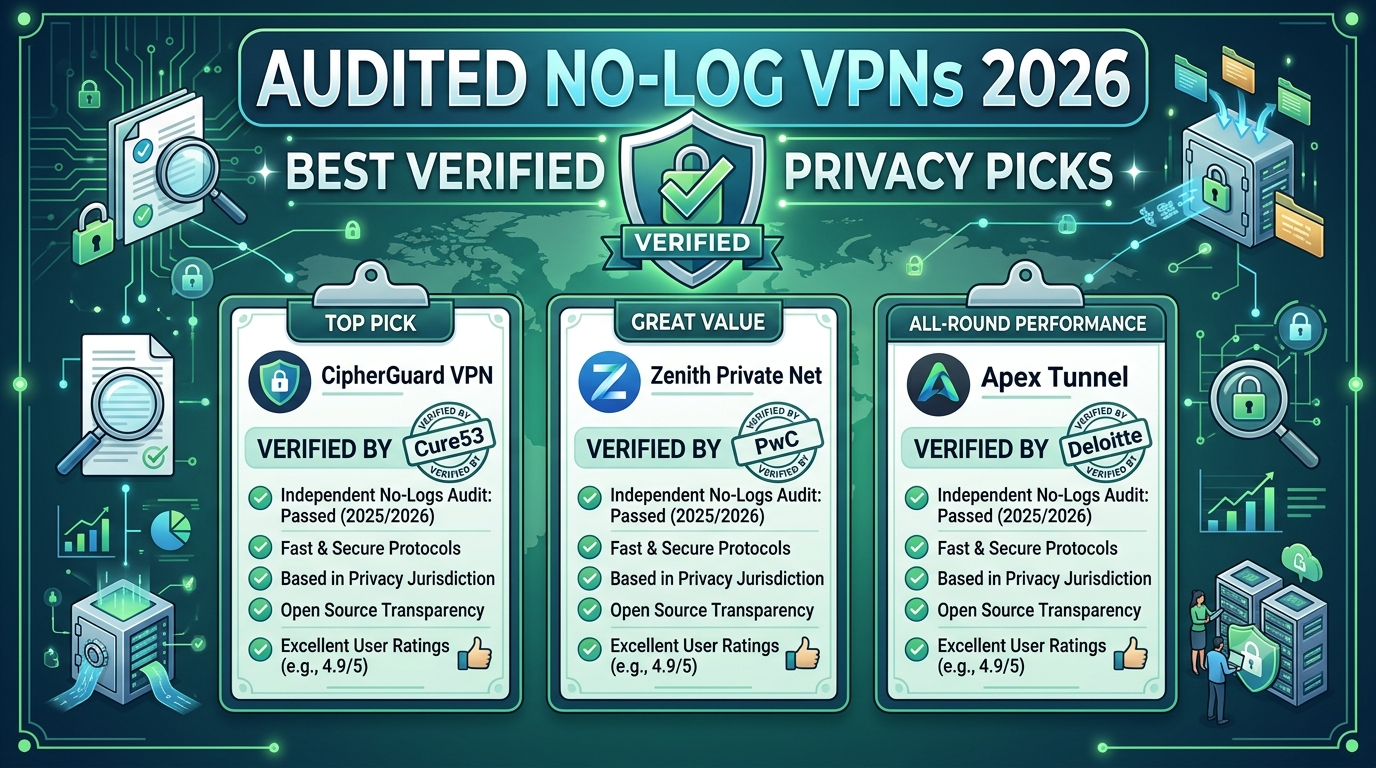

Audited no-log VPNs have become the dividing line between marketing claims and verified privacy. In 2026, users no longer accept “no logs” statements at face value, especially after multiple high-profile cases where VPN providers were forced to prove—or fail to prove—their claims in real investigations. What matters now is not what a VPN promises, but what independent auditors confirm.
The core issue is simple: a VPN can say it stores no data, but only an external audit can validate how its servers, apps, and infrastructure actually behave under scrutiny.
Before going deeper, it’s important to understand the baseline. A VPN is a tool that encrypts your internet traffic and routes it through remote servers to mask your IP address and location. If you need a structured breakdown of that foundation, you can review this explanation of VPN basics, which covers how tunneling and encryption work at a system level.
What does an audited no-log VPN actually prove?
An audited no-log VPN proves one thing above all else: independent verification of data handling claims. That includes whether the provider stores connection metadata, session logs, or identifiable user activity.
But audits are not uniform. Some only evaluate the VPN application code. Others examine full server infrastructure, memory (RAM-only systems), logging pipelines, and incident response behavior. The difference between those scopes is where most users misunderstand the term “audited.”
To understand the baseline concept, it helps to separate two ideas:
- No-log policy: A written promise by the VPN provider
- Audited no-log VPN: A third-party validation of that promise
A deeper technical breakdown of how encryption, tunneling, and data routing function can be found in this guide on how VPN encryption works, which explains why logs matter in the first place.
From a security standpoint, audited VPNs are designed to reduce blind trust. Independent firms test whether systems actually avoid storing:
- IP addresses tied to sessions
- Browsing activity
- DNS query histories
- Timestamped connection logs
However, even audited systems do not guarantee zero risk. Audits are snapshots in time, not continuous surveillance of the provider.
According to the Electronic Frontier Foundation (EFF), privacy tools must be evaluated not just on policy claims but on technical enforcement and jurisdictional constraints, especially when legal compulsion can override corporate intent (https://www.eff.org).
That distinction becomes critical when evaluating whether an audit is meaningful or merely symbolic.
Why independent audits became the VPN industry standard
The VPN industry shifted toward audits after repeated trust failures in early “no-log” marketing. Providers realized that policy statements alone were not defensible in court or regulatory investigations.
Modern audits typically evaluate three layers:
- Application layer behavior – what the VPN app collects during runtime
- Server infrastructure – whether logs exist at the system level
- Data lifecycle controls – how long any temporary data persists
Not all audits are equal in depth. Some focus only on app permissions, while stronger audits inspect backend logging systems and server memory architecture.
To understand how these trust mechanisms fit into broader VPN evaluation frameworks, you can review leading VPN providers, which highlights how audited transparency influences rankings among major services.
The rise of RAM-only servers has also reduced traditional logging risks. Since data is wiped on reboot, providers claim there is no persistent storage layer for forensic recovery. However, audits are still required to verify that implementation matches design claims.
What most users misunderstand about VPN audits
A common misconception is that an audit equals permanent certification. It does not. Instead, audits function as time-limited validations.
Once an audit is completed, the provider may:
- Update infrastructure
- Change logging architecture
- Modify third-party integrations
Each change can invalidate previous audit assumptions.
This is why audit frequency matters as much as audit existence. A VPN audited once three years ago does not offer the same assurance as one audited annually.
To clarify how audits are defined in security terms, this breakdown of what is an audited VPN explains how third-party verification differs from internal compliance reporting.
Another major misunderstanding involves scope. Many users assume audits cover:
- Entire company operations
- Legal compliance across jurisdictions
- Real-time monitoring of servers
In reality, most audits are narrowly scoped technical assessments. They do not evaluate how governments may legally compel data disclosure, which remains a separate legal risk layer.
server load effects, device compatibility limits, account/plan restrictions, speed throttling scenarios, etc.
Audited VPNs often introduce architectural trade-offs that affect performance and usability. RAM-only servers, for example, improve privacy but can increase server load sensitivity, especially during peak traffic periods.
When audit-driven VPNs shift to stateless infrastructure:
- Session persistence becomes limited across reconnections
- Device switching may trigger re-authentication more frequently
- Some entry-level plans enforce stricter simultaneous connection caps
- Load balancing can introduce minor latency spikes under congestion
These constraints are not flaws in privacy design but direct consequences of reducing persistent data storage. In practice, users may notice slightly less stable session continuity on heavily audited networks compared to traditional VPN architectures.
Early trust signals: what actually matters before you pick a VPN
Before even reaching audit reports, experienced users evaluate three early indicators:
- Transparency reports (how often data requests are disclosed)
- Jurisdiction (whether the provider is under data retention laws)
- Infrastructure design (RAM-only vs disk-based systems)
Jurisdiction plays a particularly important role because legal environment can override technical design. For example, VPN legality and enforcement expectations vary significantly across regions, including the United States, Switzerland, and Singapore:
- https://vpnx.blog/is-vpn-legal-in-the-usa/
- https://vpnx.blog/is-vpn-legal-in-switzerland/
- https://vpnx.blog/is-vpn-legal-in-singapore/
These legal frameworks influence how meaningful an audit actually is in practice.
Audits are where VPN marketing claims get stress-tested against real infrastructure behavior. For audited no-log VPNs, the focus is not just whether a policy exists, but whether the system architecture makes logging technically difficult or impossible in practice.
Most audits are conducted by independent cybersecurity firms specializing in penetration testing, code review, and infrastructure analysis. Common names include Cure53 and Deloitte, although scope varies widely depending on what the VPN provider commissions.
To understand why this matters, you first need to separate three layers that auditors typically evaluate: the client application, the backend infrastructure, and the operational data flow between them.
How do independent VPN audits work in practice?
A typical VPN audit follows a structured technical process rather than a simple checklist. It usually includes:
1. Source code inspection
Auditors review the VPN client application to detect:
- Hidden logging functions
- Debug data leaks
- Insecure API calls
- Improper encryption implementation
2. Infrastructure review
This is where the real privacy validation happens. Auditors examine:
- Server configuration (RAM-only vs disk-based storage)
- Logging pipelines (if any metadata is temporarily stored)
- Authentication systems
- Network routing behavior
3. Traffic simulation testing
Auditors simulate real user sessions to verify:
- Whether session identifiers persist
- Whether DNS requests are recorded
- Whether IP addresses appear in logs
This process helps confirm whether the VPN behaves as a true no-log system under realistic conditions.
For a broader understanding of how encryption and tunneling support these systems, you can revisit how VPN encryption works, which explains why data visibility is limited in properly configured VPN tunnels.
What auditors actually look for in no-log claims
A “no-log” claim sounds absolute, but auditors break it into measurable categories:
Connection logs
These include timestamps, IP addresses, and session duration. Even temporary storage here can create privacy risk.
Activity logs
This is the most sensitive category—websites visited, DNS queries, and application-level traffic. Auditors typically focus heavily on ensuring this category is never stored.
Diagnostic logs
Often overlooked, these include crash reports and performance metrics. Even anonymized diagnostic data can sometimes be re-identified if improperly handled.
A strong audit report will explicitly state which of these categories are fully absent versus temporarily processed.
For example, providers with multiple verified assessments are often highlighted among leading VPN providers, where audit depth becomes a major ranking factor rather than just speed or price.
Why audit scope matters more than audit existence
Not all audits provide equal assurance. The most important distinction is scope definition.
A limited audit might only include:
- Mobile app behavior
- Browser extension security
- UI-level logging controls
A comprehensive audit includes:
- Full server architecture
- Backend logging systems
- Deployment pipelines
- Incident response workflows
The difference is critical because VPN users don’t interact with just the app—they rely on the entire infrastructure stack.
To understand how VPN systems are structured at a foundational level, this guide on what is a VPN helps clarify how multiple layers interact to create a secure tunnel.
What is an audited VPN really proving?
An audited VPN does not prove absolute anonymity. Instead, it proves technical compliance with a stated no-log architecture at a specific point in time.
That distinction matters because:
- Infrastructure can change after the audit
- Providers may roll out new features post-certification
- Legal pressure can alter operational behavior
- Third-party integrations can introduce new data flows
This is why security analysts treat audits as risk reduction tools, not guarantees.
A deeper definition of these boundaries is explained in what is an audited VPN, which breaks down how verification differs from enforcement.
VPN transparency reports vs audits
Many users confuse transparency reports with audits. They are not the same.
Transparency reports
These are self-published documents showing:
- Government data requests
- Legal compliance statistics
- Warrant canary updates
You can explore how providers signal legal pressure changes through tools like warrant canary updates, which help track whether a provider has been legally compelled to stay silent.
Independent audits
These are external technical assessments that verify infrastructure behavior.
In short:
- Transparency reports = what the company says happened
- Audits = what the system is proven to do
Both matter, but only one validates technical truth.
server load effects, device compatibility limits, account/plan restrictions, speed throttling scenarios, etc.
Audit-driven VPN architectures can introduce operational constraints that affect everyday usage.
RAM-only server designs, commonly adopted after audit recommendations, lead to:
- More frequent session resets under heavy load
- Slight delays during server switching
- Increased dependency on load-balanced routing clusters
In multi-device environments, audited VPNs may also enforce stricter:
- Simultaneous connection limits per subscription tier
- Authentication refresh cycles when switching networks
- Session expiration policies for security hardening
These behaviors are intentional. They reduce persistent state storage, which is a core requirement in many audited no-log architectures. However, users may experience less “sticky” connections compared to traditional VPN setups.
Jurisdiction still overrides technical design
Even a fully audited VPN is still bound by the laws of its operating country. This is where legal environment becomes as important as technical implementation.
For example:
- The United States operates under complex data request frameworks
- Switzerland offers stronger privacy protections and limited data retention obligations
- Singapore has stricter regulatory oversight for network services
You can compare these legal environments directly:
- https://vpnx.blog/is-vpn-legal-in-the-usa/
- https://vpnx.blog/is-vpn-legal-in-switzerland/
- https://vpnx.blog/is-vpn-legal-in-singapore/
Audits confirm technical behavior, but jurisdiction determines legal pressure limits.
Audited no-log VPNs only matter when you compare how deeply each provider is actually tested. In 2026, almost every major VPN claims “independent verification,” but the gap between a lightweight app review and a full infrastructure audit is still wide.
The key question isn’t whether a VPN has an audit—it’s what the audit actually covered, how recent it is, and whether it includes backend logging systems or just client-side behavior.
Which VPN providers have the strongest audit records today?
The strongest audited VPNs share one pattern: repeated, multi-layer audits over time, not one-off certifications.
Providers like NordVPN and Proton VPN are frequently referenced because they have undergone multiple independent assessments covering different parts of their infrastructure lifecycle.
A practical example is NordVPN’s third-party validation work, where auditors examined both application behavior and server-side logging restrictions. You can review how that process is structured in detail here: NordVPN audit results, which breaks down what was tested and what was excluded from logging scope.
What separates strong audit records from weak ones
High-trust VPNs typically show:
- Multiple audits across different years (not just one)
- Separate audits for apps and infrastructure
- Clear disclosure of audit limitations
- Public summaries from reputable cybersecurity firms
Weaker audit claims often include:
- Single audit with no follow-up validation
- Limited scope focusing only on UI or app permissions
- No published methodology or testing framework
To understand how these providers fit into the broader market, it helps to compare them against general top-rated VPN services, where audit depth is now a core ranking factor alongside speed and pricing.
Can you trust VPN audit reports at face value?
Short answer: no. Longer answer: you should treat them as evidence, not proof of absolute privacy.
Audits are constrained by three major limitations:
1. Time-bound validation
An audit only confirms behavior during the testing window. If a VPN updates its infrastructure later, that validation may no longer apply.
2. Scope limitations
Many audits exclude:
- Backend orchestration systems
- Third-party integrations
- Regional server configurations
3. Non-continuous monitoring
Unlike security monitoring systems, audits are not ongoing. They are snapshots.
This is why security analysts often combine audit reports with architectural analysis rather than relying on certification alone.
A deeper explanation of how verification boundaries work is covered in what is an audited VPN, which outlines why certification is not equivalent to real-time enforcement.
What is the difference between no-log and audited VPN claims?
This is where most users misinterpret marketing language.
No-log VPN (claim)
A provider states it does not store:
- Browsing history
- IP addresses
- Session metadata
But this is self-declared and not externally verified by default.
Audited no-log VPN
A third party:
- Tests infrastructure behavior
- Attempts to identify logging mechanisms
- Reviews system architecture and data flows
The key difference is external validation of implementation, not just policy wording.
To understand the technical foundation behind these claims, it helps to revisit how VPN encryption works, because encryption reduces visibility—but does not eliminate the possibility of logging at endpoints.
VPN jurisdiction vs audit strength: what matters more?
Even a perfectly audited VPN cannot override national legal frameworks. Jurisdiction determines what governments can compel providers to do.
For example:
- In the United States, providers may be subject to court orders and gag orders
- Switzerland generally enforces stronger privacy protections and limits data retention obligations
- Singapore applies stricter regulatory oversight over communications infrastructure
You can compare these legal environments directly:
- https://vpnx.blog/is-vpn-legal-in-the-usa/
- https://vpnx.blog/is-vpn-legal-in-switzerland/
- https://vpnx.blog/is-vpn-legal-in-singapore/
Jurisdiction often determines whether “no logs” can be legally enforced under pressure, regardless of audit results.
Do free VPNs ever pass audits?
In most cases, no. Free VPN services rarely undergo full independent audits due to cost and infrastructure limitations.
Instead, users often look at alternatives like reliable free VPN services, but these typically:
- Offer limited bandwidth
- Use fewer server locations
- Do not publish full audit reports
Audited no-log VPNs almost always belong to premium-tier services because audits require:
- External cybersecurity firms
- Infrastructure access
- Continuous compliance documentation
server load effects, device compatibility limits, account/plan restrictions, speed throttling scenarios, etc.
Audit-driven VPN architectures introduce operational trade-offs that become more visible at scale.
When providers adopt strict no-log and RAM-only infrastructure validated by audits:
- Server load balancing becomes more aggressive during peak traffic
- Session persistence is reduced, especially on mobile networks switching between Wi-Fi and LTE
- Some providers enforce stricter device caps per account tier
- Re-authentication frequency increases after IP changes or server swaps
These behaviors improve privacy but can reduce session continuity. In real-world usage, this often shows up as occasional reconnects or slower handshake times when switching servers under load.
Why audit frequency is becoming a ranking factor
The VPN market is shifting from “has it been audited?” to “how often is it audited?”
Frequent audits indicate:
- Continuous infrastructure validation
- Faster detection of configuration drift
- Higher accountability to third-party reviewers
In contrast, a single audit becomes outdated quickly in environments where VPN infrastructure changes frequently due to scaling, security patches, or protocol upgrades.
This is why modern VPN comparisons increasingly prioritize ongoing verification cycles rather than static certifications.
Audited no-log VPNs ultimately succeed or fail on one principle: whether the technical design, audit scope, and legal jurisdiction all align. If any one of those layers is weak, the privacy promise becomes partially theoretical.
Before drawing conclusions, it’s worth grounding the discussion in how regulators view data protection claims. The U.S. Federal Trade Commission has repeatedly warned that privacy statements must reflect actual system behavior, not just policy language, especially when consumer data handling is involved (https://www.ftc.gov). That distinction is exactly what independent VPN audits attempt to validate.
How do jurisdiction laws affect VPN privacy results?
Jurisdiction is the hidden variable that often outweighs technical architecture. Even a fully audited no-log VPN operates under national law, and that law determines what can be demanded from providers.
In practical terms, jurisdiction affects three things:
Data request exposure
Some countries allow authorities to compel data disclosure, even if minimal logs exist or temporary metadata is stored during system operation.
Gag orders
Providers may be legally restricted from disclosing that they have received data requests, which limits transparency reporting effectiveness.
Infrastructure hosting rules
Server locations can fall under different legal regimes than the company headquarters, creating layered compliance obligations.
For example:
- In the United States, providers may face broader legal disclosure frameworks
- In Switzerland, privacy protections are stronger and data retention requirements are more limited
- In Singapore, regulatory oversight is stricter and more centralized
You can compare these directly here:
- https://vpnx.blog/is-vpn-legal-in-the-usa/
- https://vpnx.blog/is-vpn-legal-in-switzerland/
- https://vpnx.blog/is-vpn-legal-in-singapore/
This is why jurisdiction is often treated as a “first filter” before audit strength even becomes relevant.
Are audited VPNs always faster or more secure?
No. Audit status has no direct correlation with speed or raw encryption strength.
Security
Most audited VPNs already use industry-standard encryption such as AES-256 and modern tunneling protocols like WireGuard. Audits do not necessarily improve encryption—they verify implementation integrity.
Speed
Performance depends on:
- Server proximity
- Load balancing efficiency
- Network routing quality
- Hardware infrastructure
Audits sometimes indirectly impact speed when providers adopt stricter architectures (such as RAM-only servers), but the effect is not uniform.
For example, privacy-first design choices may introduce:
- Slightly higher latency during peak traffic
- More frequent reconnections under load
- Variable performance across regions
However, these are trade-offs rather than weaknesses. The system prioritizes minimizing persistent data storage over maintaining static session continuity.
Can you trust VPN audit reports at face value?
Audits are credible, but they are not absolute proof of permanent privacy.
There are three key limitations:
1. Snapshot problem
An audit reflects system behavior at a specific moment in time. VPN infrastructure is constantly evolving, which means results can age quickly.
2. Scope fragmentation
Some audits only cover:
- Mobile apps
- Browser extensions
- Limited server samples
They may not test full backend systems or all geographic regions.
3. Dependency on provider transparency
Auditors can only test what they are allowed to access. If a provider limits audit scope, the conclusions are also limited.
This is why audited no-log VPNs should be evaluated as risk reduction systems, not absolute guarantees.
A deeper technical framing of these limits is available in what is an audited VPN, which explains why verification and enforcement are fundamentally different concepts.
What does an audited no-log VPN actually prove?
At its core, an audited VPN proves one thing: the absence of detectable logging behavior within the tested system boundaries.
That includes validation of:
- Connection metadata handling
- Session persistence behavior
- DNS request exposure risks
- Server-side logging configurations
However, it does not prove:
- Future compliance after infrastructure changes
- Legal immunity from data requests
- Protection from endpoint tracking outside the VPN tunnel
This is why audits are best understood as technical assurance layers rather than full privacy guarantees.
To understand how encrypted tunnels limit visibility in the first place, the underlying mechanics are explained in how does a VPN work, which shows why logs matter even when traffic is encrypted.
Which VPN providers have the strongest audit records today?
The strongest VPN providers share a consistent pattern: repeat audits across different infrastructure layers and time periods.
NordVPN is a common reference point because its audit history includes both application-level and infrastructure-level validation. The breakdown of its verification scope is documented here: NordVPN audit results, which highlights how third-party firms evaluated its no-log architecture in practice.
Strong audit leaders typically demonstrate:
- Multi-year audit cycles
- Independent firms with cybersecurity specialization
- Public methodology disclosure
- Separation of app vs infrastructure testing
Weak audit providers usually rely on:
- Single audits with no follow-up
- Limited scope focused only on UI or client software
- No published testing framework
In broader comparisons, audited providers are increasingly prioritized in rankings of leading VPN providers, where trust architecture now carries as much weight as raw performance.
Are audited VPNs the same as free VPN options?
No. Audited VPNs and free VPNs exist in fundamentally different operational models.
Free VPN services often lack:
- Independent audit funding
- Full infrastructure transparency
- High-cost third-party testing
While some users explore top free VPNs, these services typically cannot support the same level of verification rigor required for full no-log audits.
Audited VPNs are almost always subscription-based because audits require:
- External cybersecurity firms
- Infrastructure access rights
- Continuous compliance maintenance
Final takeaway
Audited no-log VPNs represent the most credible privacy standard currently available in consumer VPN services, but they are not absolute shields. Their strength lies in independent verification, not perfection.
The real privacy outcome depends on three aligned factors: audit depth, infrastructure design, and jurisdictional exposure. If any one of these weakens, the overall protection model degrades.
In practical terms, audited VPNs reduce uncertainty rather than eliminate risk entirely. That distinction is what separates marketing claims from enforceable technical validation.