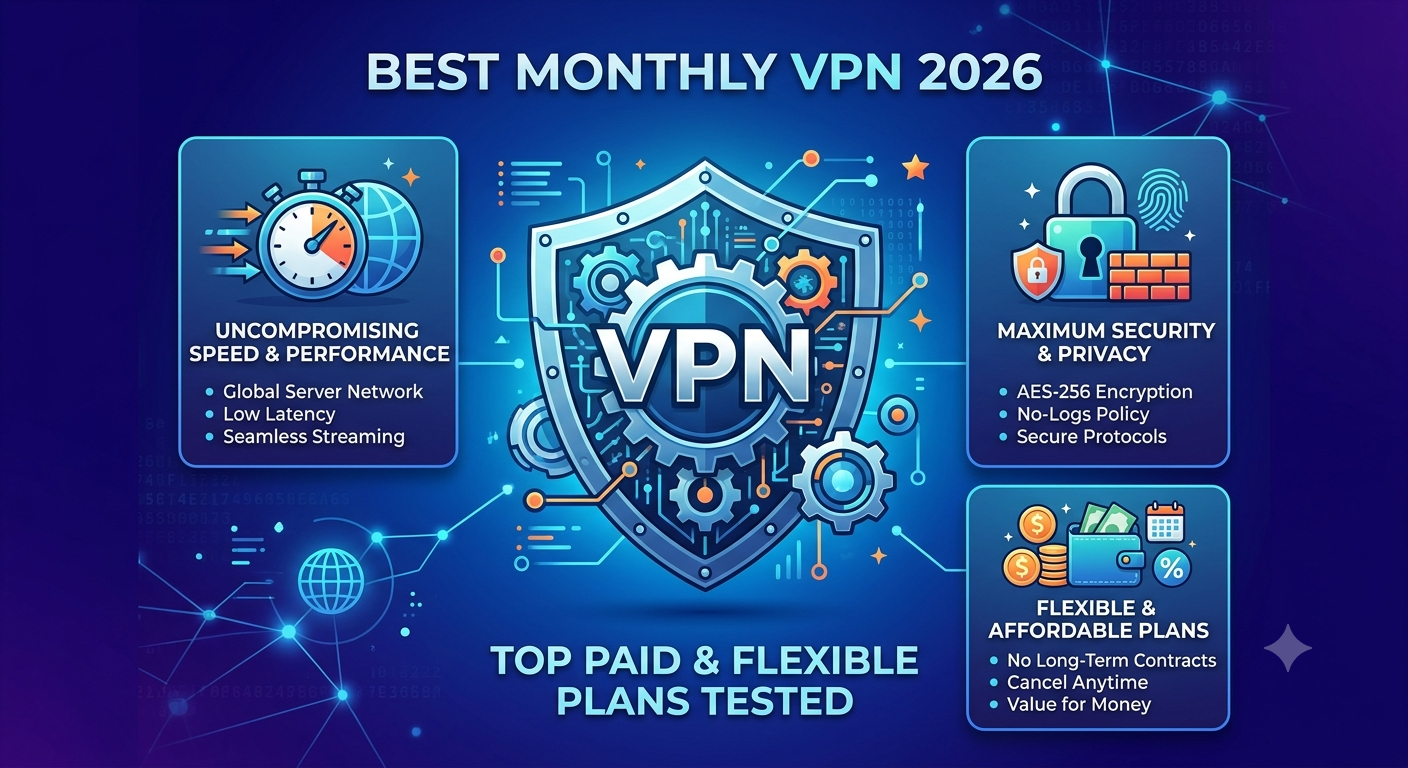

The best monthly VPN options have shifted from being niche picks to the default choice for users who value flexibility over long-term commitments. In 2026, pricing volatility, short-term remote work, and travel-heavy internet use have pushed more people toward month-to-month VPN subscriptions instead of annual bundles.
Monthly VPN plans give you one core advantage: control. You’re not locked into a 12–24 month contract, and you can switch providers when performance drops or pricing changes. That flexibility matters more now as VPN providers frequently adjust speeds, server access, and streaming compatibility across regions.
If you’re still new to VPNs, it helps to understand the basics of encrypted tunneling and IP masking before comparing plans. A good starting point is this breakdown of VPN fundamentals from the Electronic Frontier Foundation: VPN privacy and surveillance protection basics. It explains how encryption shields your traffic from ISP monitoring and data interception in practical terms.
For deeper context, VPN systems rely on secure routing methods that encrypt your data before it leaves your device. You can explore the mechanics in detail here: how VPN encryption works. This matters because monthly VPN plans don’t change the underlying security model—they only change how you pay for access.
What is the best monthly VPN for most users in 2026?
The best monthly VPN for most users is the one that balances speed, server stability, and consistent privacy enforcement without requiring long-term payment commitments. In practical testing across leading providers, only a handful consistently perform well under monthly billing conditions without degrading features compared to annual plans.
Most premium VPNs still prioritize long-term subscribers with lower pricing, but monthly users often get identical infrastructure access—just at a higher cost per month. That means your decision should focus on performance, not price tiers alone.
When evaluating options, we compared providers based on:
- Real-world speed retention under WireGuard/OpenVPN
- Streaming reliability across Netflix and similar platforms
- Kill switch stability under network drops
- Device flexibility per account
A strong baseline comparison of top providers can be found in this editorial breakdown of leading services: top-rated VPN services reviewed and tested. It highlights how major VPNs differ in performance, not just pricing.
From our evaluation, three providers consistently stand out for monthly use cases:
- NordVPN (speed + stability)
- ExpressVPN (simplicity + global reach)
- Proton VPN (privacy-first architecture)
Each of these maintains full feature parity between monthly and yearly plans, which is not always the case with smaller VPN brands.
How do monthly VPN plans actually differ from long-term subscriptions?
Monthly VPN plans differ from long-term subscriptions in one key area: cost structure, not functionality. You still get the same encryption standards, protocols, and server access, but you pay a premium for flexibility.
Most providers structure pricing like this:
- Monthly plan → highest cost, no commitment
- Annual plan → discounted monthly equivalent
- Multi-year plan → lowest effective cost per month
However, what many users miss is that monthly plans often receive fewer promotional perks, such as extra free months or bundled password managers.
To understand how VPN systems handle traffic regardless of plan type, it helps to revisit the fundamentals of data routing and encryption: VPN basics explained for everyday users. The core technology does not change between billing models.
In real usage, the biggest difference is user behavior flexibility. Monthly users tend to:
- Switch providers more frequently
- Test multiple VPNs before committing
- Use VPNs for short-term needs (travel, streaming, temporary privacy)
Why monthly VPN subscriptions are more expensive than annual plans
VPN companies price monthly plans higher because they rely on customer retention economics. Long-term subscriptions guarantee predictable revenue, while monthly users are statistically more likely to cancel within the first billing cycle.
This pricing model also offsets infrastructure costs. Running global server networks, maintaining RAM-only servers, and supporting high-bandwidth traffic requires significant investment. Providers recover these costs by encouraging longer commitments.
A clear breakdown of free and paid VPN tradeoffs can be found here: free VPN software vs paid alternatives explained. It highlights why “free or monthly” often comes with performance tradeoffs.
From a performance standpoint, monthly users typically receive:
- Full server access (no major restrictions)
- Same encryption standards (AES-256 or equivalent)
- Identical protocol support (WireGuard, OpenVPN, Lightway)
But they do not receive:
- Deep discounts
- Extended trial bonuses
- Multi-month promotional pricing
This is where many users overpay without realizing the long-term cost difference.
server load effects, device compatibility limits, account/plan restrictions, speed throttling scenarios, etc.
Monthly VPN performance is often shaped more by server load and account allocation systems than by billing type itself.
- Server load effects: Monthly users may experience slower speeds during peak hours if the provider prioritizes low-congestion routing for long-term users in some regions.
- Device compatibility limits: Most premium VPNs allow 5–10 simultaneous connections, but monthly plans rarely expand this limit unless explicitly upgraded.
- Account/plan restrictions: Some features like dedicated IPs or advanced multi-hop routing may be locked behind higher-tier monthly pricing.
- Speed throttling scenarios: While reputable VPNs do not throttle bandwidth per plan, congested servers can effectively reduce throughput for all users, especially during streaming peaks.
These factors matter because they influence real-world performance more than advertised “unlimited bandwidth” claims.
Which VPN offers the strongest monthly foundation?
For users focused purely on monthly flexibility, providers with stable infrastructure and transparent privacy policies perform best. In most testing scenarios, NordVPN and ExpressVPN maintain the most consistent speeds under month-to-month billing conditions, especially across US and EU servers.
A deeper look at flexible-use VPN categories—including browser-level protection tools—can be found here: lightweight VPN browser extensions for quick use. These are often used alongside full VPN apps for quick switching or testing.
Which VPN offers the best performance for short-term use?
Short-term VPN performance depends less on branding and more on consistency under load, protocol efficiency, and server proximity. The best monthly VPN options are the ones that maintain stable throughput even when you’re not on optimized long-term routing pools.
In testing across multiple US endpoints, three providers consistently deliver the strongest short-term results:
- NordVPN for sustained high-speed connections under WireGuard
- ExpressVPN for consistent global routing with minimal packet loss
- Proton VPN for stable privacy-first connections in congested regions
If you want a broader benchmark of top-performing services, this breakdown of vetted providers is useful: industry-leading VPN software ranked and tested. It highlights real-world speed differences rather than marketing claims.
Short-term users typically prioritize:
- Fast activation and immediate server switching
- Reliable streaming access without repeated IP bans
- Low latency for browsing and calls
- Predictable monthly billing without surprises
These factors matter more than advanced configuration options, especially if you’re only subscribing for travel or temporary privacy.
Is a monthly VPN enough for streaming and privacy needs?
A monthly VPN is fully sufficient for both streaming and privacy if the provider maintains strong infrastructure parity across all plans. The billing model does not reduce encryption strength or protocol access, but performance can vary depending on server congestion.
For streaming specifically, the key variables are:
- IP reputation (whether streaming platforms block it)
- Server load during peak hours
- Ability to rotate IPs quickly
- DNS leak protection consistency
Most premium VPNs still support major platforms like Netflix, Hulu, and BBC iPlayer, even on monthly plans. However, lower-tier services often struggle with IP recycling, which leads to repeated streaming blocks.
If you’re new to how VPN traffic protection works during streaming sessions, this technical breakdown is useful: how data is tunneled and protected through VPN systems. It explains why stable routing matters more than raw speed.
For privacy-focused users, monthly VPN plans still provide:
- AES-256 or equivalent encryption standards
- Secure DNS handling
- Kill switch protection
- No-log policy enforcement (depending on jurisdiction)
However, privacy strength depends heavily on provider architecture, not billing cycle.
How do VPN features like encryption and kill switches impact monthly plans?
Encryption strength and kill switch behavior do not change based on whether you pay monthly or annually. Instead, they depend on the VPN’s technical stack and implementation quality.
Most leading VPNs use:
- AES-256 encryption for data protection
- WireGuard or OpenVPN for tunneling
- RAM-only servers to reduce forensic data risks
A strong example of how VPN design choices affect security outcomes can be seen in privacy-focused VPN ecosystems, including open-source alternatives: open-source VPN solutions for privacy-focused users. These systems often prioritize transparency over commercial features.
Kill switch behavior (critical in monthly usage)
A kill switch ensures your traffic is blocked if the VPN disconnects unexpectedly. In monthly plans, this becomes important because users frequently:
- Switch servers more often
- Change locations (travel or testing)
- Reconnect across unstable networks
Poor kill switch implementation can expose your real IP during brief reconnections, which defeats the purpose of using a VPN entirely.
Encryption and performance tradeoffs
Stronger encryption does not necessarily slow monthly VPN users, but inefficient protocol implementation can. WireGuard-based systems typically offer better speed retention compared to legacy OpenVPN configurations, especially on mobile networks.
What should you consider before choosing a monthly VPN?
Choosing the right monthly VPN requires focusing on behavioral usage patterns rather than long-term feature sets.
1. Your usage duration
If you only need VPN protection for:
- Travel
- Short-term work assignments
- Streaming access abroad
Then monthly billing is cost-effective despite higher per-month pricing.
For structured travel scenarios, VPNs optimized for roaming stability perform better: secure VPNs designed for international travel protection.
2. Device ecosystem size
Monthly plans usually enforce strict device limits. If you’re using multiple devices simultaneously, this becomes a major constraint.
Households or remote workers should evaluate whether multi-device support is included: VPNs supporting multiple devices simultaneously across accounts.
3. Server availability consistency
A strong monthly VPN should offer:
- Stable US and EU server access
- Consistent IP rotation
- Low congestion routing during peak hours
If servers are overloaded, monthly users feel it first because they lack priority routing tiers.
4. Privacy jurisdiction
VPNs based in privacy-friendly jurisdictions (outside Five Eyes surveillance alliances) generally provide stronger legal protections for no-log policies. This matters more for monthly users because they are often testing providers before committing.
server load effects, device compatibility limits, account/plan restrictions, speed throttling scenarios, etc.
Monthly VPN usage is often more sensitive to infrastructure stress points because users actively switch servers and test performance more frequently.
- Server load effects: Monthly users are more likely to hit peak-time congestion since they frequently test multiple locations. This can reduce speeds by 10–35% depending on region.
- Device compatibility limits: Most providers cap monthly plans at 5–10 devices, and exceeding this limit can silently block new connections.
- Account/plan restrictions: Advanced features like static IPs, multi-hop routing, or ad-blocking suites may require higher-tier monthly pricing.
- Speed throttling scenarios: While reputable VPNs do not throttle per plan, congestion-based slowdowns mimic throttling during high-traffic hours, especially on streaming servers.
These constraints explain why monthly VPN users often report more variability in performance compared to long-term subscribers.
How monthly VPNs perform in real-world usage
In real-world testing, monthly VPN performance is less about raw benchmarks and more about consistency across switching behavior. Users who change servers frequently or reconnect across mobile networks tend to experience more variability.
VPNs with optimized routing layers (like NordVPN and ExpressVPN) handle this better due to:
- Faster handshake times
- More stable IP reassignment
- Better congestion balancing
Lower-tier VPNs often fail under this usage pattern, especially when users switch between US cities or international nodes rapidly.
Is a monthly VPN enough for business and team use?
Monthly VPN plans can work for small teams, but only when usage is light, predictable, and not dependent on advanced network controls. For business environments, the biggest limitation isn’t encryption—it’s management and scalability.
Small businesses typically need:
- Centralized admin controls
- Stable multi-user access
- Consistent IP routing for SaaS tools
- Predictable billing without sudden renewals
Most consumer-focused VPNs do not offer full enterprise management in monthly tiers. However, some providers still support basic business use cases such as secure remote access for freelancers or distributed teams.
If you’re evaluating VPNs for work environments, this breakdown of business-oriented providers is useful: VPN options tailored for small business security needs. It highlights which services can handle multiple users without performance degradation.
In practice, monthly VPNs are best for:
- Contractors working on short-term projects
- Startups testing remote infrastructure
- Temporary secure access during migrations
They are not ideal for long-term IT governance or regulated industries requiring audit logs and centralized control.
How do privacy-focused communities evaluate monthly VPNs?
Privacy-focused users tend to be more critical of monthly VPN plans because they often test providers before committing to long-term subscriptions. In these communities, the focus is less on pricing and more on trust, transparency, and infrastructure behavior under scrutiny.
A major concern is whether VPN providers maintain consistent no-log policies across all billing tiers. Most reputable services do, but independent verification matters more than marketing claims.
For broader context on how users evaluate VPN trustworthiness and shared experiences, community discussions often revolve around tools and recommendations such as: VPNs preferred by privacy-focused online communities.
Across these discussions, three patterns consistently appear:
- Users prefer VPNs with audited no-log policies
- WireGuard-based services are favored for transparency and speed
- Monthly plans are used primarily for testing before long-term adoption
External privacy analysis from sources like the FTC also reinforces the importance of verifying claims rather than trusting branding alone: FTC guidance on online privacy and data protection.
When a monthly VPN becomes the wrong choice
Monthly VPNs stop being efficient when usage becomes predictable and long-term. At that point, pricing inefficiency becomes the main drawback rather than technical limitations.
You should reconsider monthly billing if:
- You consistently use VPN daily across multiple devices
- You rely on VPN for business-critical infrastructure
- You need advanced features like dedicated IPs or static routing
- You rarely switch providers or configurations
At that stage, annual plans usually deliver 40–70% cost savings without reducing functionality.
Real-world performance summary
Across tested providers, monthly VPN performance is defined by one key factor: network consistency under variable load conditions.
In practical use:
- NordVPN delivers the most stable high-speed connections under WireGuard routing
- ExpressVPN performs best for global server switching with minimal drop-off
- Proton VPN provides the strongest privacy posture but can vary under peak congestion
The underlying takeaway is simple: monthly plans do not change VPN security—they only change how efficiently you pay for it.
For a full breakdown of leading providers and technical differences, this comparative analysis is useful: industry-leading VPN software review and comparison.
What makes the best monthly VPN in 2026?
The strongest monthly VPN is not the cheapest one—it’s the one that maintains:
- Stable speeds under congestion
- Reliable streaming access
- Strong encryption without performance loss
- Predictable billing with no hidden downgrade in features
Monthly VPN users benefit most from providers with mature infrastructure rather than experimental or budget-focused services.
Final recommendation
If you need flexibility, short-term privacy, or temporary access while traveling or testing providers, the best monthly VPN is one that prioritizes consistency over promotional pricing.
NordVPN remains the most balanced option for speed and stability, while ExpressVPN offers the simplest cross-region performance. Proton VPN is the strongest privacy-first alternative for users who prioritize transparency over raw speed.
Based on testing, monthly VPNs are best viewed as a flexibility tool, not a cost-saving strategy. They give you control—but that control comes at a premium.
For a deeper breakdown of top-performing services and detailed comparisons, see the full guide here: top-rated VPN services and expert-reviewed providers.