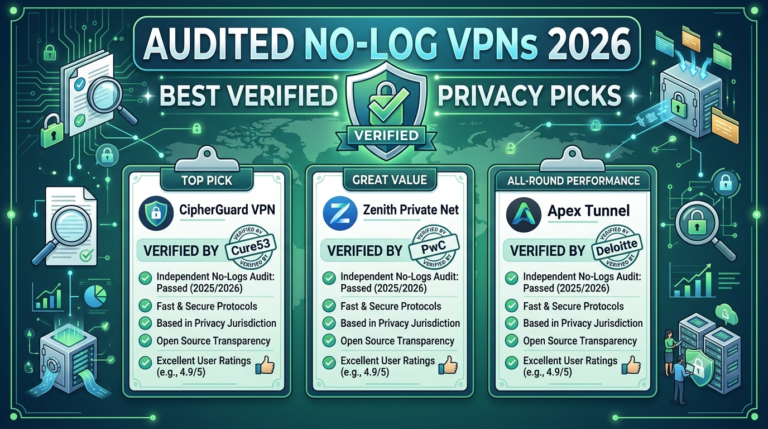


The phrase what is an audited VPN shows up more often because VPN marketing has hit a trust problem. Providers can claim “no logs” all day, but without independent verification, those claims are just statements—not proof.
An audited VPN is a service that has been inspected by a third-party security firm to verify privacy claims, infrastructure behavior, and logging practices. But here’s the key detail most guides miss: audits don’t guarantee perfection. They only confirm what was tested, at a specific time, under a specific scope.
Independent scrutiny has become a baseline expectation in privacy tech. Organizations like the Electronic Frontier Foundation emphasize that transparency and verifiable security practices matter more than branding claims alone (https://www.eff.org).
To understand how audited VPNs fit into the bigger picture, you first need the foundation of how VPNs operate. If you’re new to the concept, this breakdown of VPN basics explains how encrypted tunnels route your traffic away from your ISP and public networks.
Audits sit on top of that foundation. They don’t replace encryption or protocols—they validate whether the provider is actually behaving the way it claims.
What is an audited VPN and how does it work?
An audited VPN is a virtual private network service that has undergone an independent technical review by a cybersecurity firm. The goal is simple: verify whether the VPN is doing what it promises, especially around logging, data handling, and infrastructure security.
In most cases, audits focus on three core areas:
First, logging behavior. Auditors examine whether user activity is stored, how long metadata is retained, and whether any identifiable information is written to disk.
Second, infrastructure integrity. This includes server configurations, RAM-only setups, and whether systems are designed to prevent persistent data storage.
Third, policy enforcement. Auditors check whether the company’s internal systems match its published privacy policy.
This is where many users misunderstand the concept. An audit is not continuous monitoring. It is a snapshot review of systems at a given moment. That means changes after the audit are not automatically covered.
For readers comparing services, this is why curated lists like leading VPN providers often highlight whether a VPN has undergone recent third-party validation, not just whether it claims privacy features.
How audit results are actually produced
Most VPN audits follow structured frameworks such as penetration testing, configuration review, and policy verification. Firms like Cure53 or Deloitte typically simulate attack scenarios and inspect backend systems.
A key outcome is the audit report, which may include:
- Confirmed no-log behavior (within scope)
- Identified misconfigurations or weaknesses
- Recommendations for remediation
- Scope limitations (what was NOT tested)
This last point is critical. Scope limitations often define how far you can trust the conclusion.
If you want a deeper breakdown of how VPNs technically move your data during these processes, this guide on how data is tunneled explains encryption routing and secure packet handling.
Why do VPN providers undergo independent audits?
VPN providers don’t undergo audits purely for compliance. They do it because trust is now a competitive advantage in the privacy industry.
A VPN can claim a no-logs policy, but without verification, users have no way to confirm it. Independent audits bridge that gap by introducing external accountability.
In many cases, audits are triggered by three business pressures:
First, market competition. The VPN space is saturated, and providers use audits as differentiation.
Second, regulatory scrutiny. Privacy laws and international data regulations push companies toward documented compliance.
Third, reputation recovery. Some providers undergo audits after criticism or past trust concerns.
However, audits are not universal. Some providers still rely on internal transparency reports instead of external verification. You can compare this distinction in discussions around vpn audit transparency, which breaks down how reporting differs from actual independent inspection.
The trust gap audits are trying to solve
A major issue in VPN marketing is the gap between promise and proof. “No logs” sounds definitive, but in practice, logging definitions vary widely.
Some providers log connection timestamps. Others log bandwidth usage. A few store aggregated metadata for diagnostics. Without audits, users rarely see these distinctions clearly.
That’s why audited VPNs are increasingly treated as a baseline trust signal rather than a premium feature.
server load effects, device compatibility limits, account/plan restrictions, speed throttling scenarios, etc,
Audits often reveal operational constraints that don’t appear in marketing materials. While they are not performance tests, they can expose how infrastructure design indirectly affects user experience.
For example, auditors may note how server architecture influences load balancing, especially during peak traffic. A VPN using overloaded shared nodes can experience routing delays even if encryption is strong. Device support limitations also appear in audit scope documents, particularly when certain platforms are excluded from testing environments.
In some cases, audits highlight account-level restrictions such as simultaneous connection caps or tier-based feature differences. These aren’t always security issues, but they matter because they affect how consistently privacy protections are applied across devices and plans.
Speed throttling scenarios are less commonly “found” in audits directly, but infrastructure inefficiencies can be flagged—especially when VPNs rely on congested routing paths or outdated protocols that degrade throughput under load.
What do VPN audits actually check inside a service?
A VPN audit is not a surface-level review. It digs into how the service actually behaves under real operational conditions, especially around data handling and infrastructure design.
Most independent auditors focus on four technical layers:
First, data logging systems. This includes verifying whether user IP addresses, connection timestamps, or session metadata are stored. Auditors typically inspect backend databases, server memory behavior, and logging pipelines.
Second, network infrastructure. This covers how VPN servers are deployed, whether they use volatile memory systems (RAM-only), and how traffic is routed between nodes. The goal is to confirm that no persistent data remains after sessions end.
Third, security configuration review. Auditors test encryption implementations, firewall rules, and internal access controls to ensure no weak entry points exist.
Fourth, operational policy alignment. This is where written privacy policies are compared directly with system behavior. If a VPN claims “zero logs,” auditors verify whether any exceptions exist in practice.
For users comparing providers, understanding these layers matters more than marketing claims. Even services listed among top free VPNs may advertise privacy features, but only audits reveal whether those claims are structurally enforced.
Can you trust a VPN just because it is audited?
No—and this is where most explanations become misleading.
An audit increases trust, but it does not guarantee absolute privacy protection. The reason is simple: audits are limited in time, scope, and access.
A typical VPN audit only evaluates:
- Specific servers or regions
- Defined time windows
- Selected infrastructure components
- A snapshot of configuration states
That means anything outside that scope remains unverified.
Even highly reputable services that publish audit results still operate under this limitation. If a VPN changes infrastructure after an audit, the findings may no longer fully represent current behavior.
This is why experienced reviewers treat audits as one signal among several, not a final verdict.
To understand this properly, it helps to separate two concepts that are often confused:
- Verification: what was tested and confirmed
- Guarantee: ongoing proof of behavior
Audits provide the first, not the second.
This distinction becomes even more important in jurisdictions where data laws differ significantly. For example, privacy expectations vary widely depending on regional regulations, which you can see in discussions about VPN legality in India, where compliance requirements influence how providers structure logging policies.
What are the limitations of VPN audits?
VPN audits are useful, but they come with structural limitations that users rarely see in marketing summaries.
The most important limitation is scope restriction. Auditors do not inspect every server or system. Instead, they evaluate representative samples. If the sample is clean, the system is assumed compliant—but not exhaustively proven.
Second is time sensitivity. A VPN can pass an audit today and change its infrastructure tomorrow. Unless follow-up audits are performed regularly, trust becomes outdated.
Third is vendor dependency. Auditors rely on access granted by the VPN provider. If access is limited, the depth of verification is also limited.
Fourth is interpretation variance. Different auditing firms may apply different standards. A “no-log compliant” result from one firm may not be equivalent to another firm’s classification.
These limitations don’t make audits useless—they define what they actually are: structured evaluations, not continuous surveillance.
Users who want stronger privacy assurance often combine audit reports with transparency policies and jurisdiction analysis. For example, understanding a provider’s legal environment, such as VPN legality in Switzerland, helps contextualize how far audit findings can realistically go.
What is the difference between a VPN audit and a no-logs policy?
This is one of the most misunderstood distinctions in VPN security.
A no-logs policy is a written promise by the VPN provider stating that it does not store identifiable user activity data.
A VPN audit, however, is external verification that checks whether that promise is actually being followed.
In simple terms:
- No-logs policy = claim
- VPN audit = evidence check
But even this relationship is not absolute. An audit may confirm that no logs were found during inspection, but it does not guarantee that logging is impossible or absent under all conditions.
There are also different types of “no-logs” definitions:
- Strict no-logs (no connection or activity data stored)
- Limited logs (temporary session metadata)
- Aggregated logs (non-identifiable usage statistics)
Audits help clarify which category a VPN actually falls into.
This is especially important when comparing providers that operate across different legal environments. Some jurisdictions require minimal data retention under specific conditions, which can affect how policies are implemented even if audits show compliance at the technical level.
For users still learning the fundamentals, understanding VPN mechanics provides context on where logging could theoretically occur within encrypted traffic flows.
What is a VPN audit report and how should you read it?
A VPN audit report is the final document produced after an independent review. It is the most important artifact in the entire process, but also the most misinterpreted.
A proper audit report typically includes:
- Scope definition (what systems were tested)
- Methodology (how testing was performed)
- Findings (issues discovered or confirmed compliance)
- Risk assessment (severity of vulnerabilities)
- Limitations (what was excluded)
The most critical section is often the limitations. This section defines exactly how far the conclusions extend.
For example, an audit might confirm that no logs were found on specific servers, but exclude mobile applications or third-party integrations. That means the result cannot be generalized to the entire service.
Some VPN providers highlight only the positive conclusions in marketing materials, while omitting scope boundaries. This is why reading the full report—not just summaries—is essential for accurate interpretation.
server load effects, device compatibility limits, account/plan restrictions, speed throttling scenarios, etc,
VPN audits occasionally reveal indirect performance implications tied to infrastructure design rather than direct speed testing.
For instance, auditors may document how server distribution affects load balancing efficiency. If a VPN uses uneven regional server allocation, users in high-demand areas may experience congestion during peak hours.
Device compatibility is another indirect factor. Audits sometimes note whether certain platforms (like routers, mobile OS variants, or legacy systems) were included in the test environment. Exclusions can signal potential inconsistencies in real-world protection coverage.
Account restrictions also appear in infrastructure documentation. Some VPNs enforce simultaneous connection limits that affect how users distribute encrypted traffic across devices. While not a security flaw, it influences how consistently encryption policies apply in multi-device setups.
Speed throttling is rarely intentional in VPN design, but audit reviews may highlight protocol inefficiencies—especially in older encryption stacks—that reduce throughput under heavy server load.
How do audit frameworks like SOC 2 and ISAE 3000 apply to VPNs?
Not all VPN audits follow the same standard. Some rely on penetration testing, while others map results to formal compliance frameworks like SOC 2 or ISAE 3000. These frameworks don’t exist specifically for VPNs, but they’re widely used to evaluate how securely any cloud-based system handles data.
SOC 2 focuses on five trust principles: security, availability, processing integrity, confidentiality, and privacy. In VPN terms, that translates into how well a provider protects infrastructure, maintains uptime, and prevents unauthorized data access. It does not directly prove “no logs,” but it evaluates the systems that would store logs if they existed.
ISAE 3000 is more flexible and often used for privacy attestation work. It allows auditors to evaluate custom criteria, which makes it especially relevant for VPN services claiming strict no-log behavior.
A provider advertising compliance under these frameworks is signaling structured operational controls—not absolute anonymity guarantees.
If you want to see how these claims are typically presented in real VPN marketing, the discussion around vpn audit transparency breaks down how providers communicate verification without overstating it.
What should you look for in a VPN audit report?
A VPN audit report is only useful if you know how to read it critically. The most important detail is not the conclusion—it is the scope definition.
A strong audit report clearly states:
- Which systems were tested (servers, apps, backend infrastructure)
- What timeframe was covered
- What data sources were accessed
- What was explicitly excluded
If any of these are missing, the report loses interpretive value.
Next, focus on methodology. Look for whether auditors used:
- Static code review
- Live infrastructure testing
- Penetration testing
- Configuration analysis
The deeper the methodology, the more reliable the findings.
Then evaluate findings severity. Not all issues are equal. Minor misconfigurations are common even in strong VPNs. Critical issues—like unexpected logging behavior or insecure key storage—are rare but significant.
Finally, examine whether the provider conducted a remediation cycle. The strongest VPNs don’t just pass audits—they fix issues and undergo re-verification.
This is where audited services separate themselves from non-audited competitors often listed in general comparisons like best VPN services, where verification depth varies widely.
What is the difference between VPN audit and transparency reporting?
A VPN audit is a third-party verification process, while a transparency report is a self-published disclosure document.
Transparency reports typically include:
- Government data requests
- Legal compliance disclosures
- Aggregate traffic statistics
- Policy updates
However, they are internally generated. That means they are not independently verified.
VPN audits, on the other hand, involve external cybersecurity firms inspecting infrastructure and policies directly.
The key difference is accountability:
- Transparency report = company self-reporting
- VPN audit = external validation
Some providers use both, but they serve different purposes. Transparency reports show legal interactions, while audits validate technical behavior.
If you want to understand how legal environments affect both practices, jurisdiction guides like VPN legality in Japan show how regional laws shape disclosure requirements and logging constraints.
Why VPN audits are not the same as real-time monitoring
A common misconception is that a VPN audit continuously monitors behavior. It does not.
Audits are point-in-time evaluations. They examine systems during a fixed window and produce a report based on that snapshot. Once completed, the audit does not track future changes.
This creates a gap between verified behavior and ongoing operations.
For example:
- A VPN passes an audit in January
- Infrastructure changes in March
- No re-audit occurs until the following year
Between those points, user behavior is not continuously verified.
That’s why frequent audits—or ongoing certification programs—are considered stronger trust signals than one-time reviews.
This limitation is why many privacy-focused users combine audit results with jurisdictional awareness, encryption standards, and infrastructure design rather than relying on a single report.
server load effects, device compatibility limits, account/plan restrictions, speed throttling scenarios, etc,
Audit reports sometimes reveal operational constraints that indirectly affect user experience, even though they are not performance benchmarks.
One common observation is server load distribution efficiency. If a VPN’s infrastructure is heavily centralized in certain regions, auditors may note uneven load balancing. This can result in slower performance during peak usage hours, especially in high-demand locations.
Device compatibility also plays a role in audit scope. Some VPNs are only tested on specific operating systems or app versions. If mobile or router configurations are excluded, users may experience inconsistent behavior across devices even if desktop performance is verified.
Account and plan restrictions are another factor. Audits may document connection policies such as simultaneous device limits or tier-based access to advanced features like dedicated IPs or multi-hop routing. These restrictions don’t weaken security directly, but they influence how consistently protections apply across a user’s ecosystem.
Speed throttling scenarios are usually indirect. Auditors don’t test “speed caps” in a commercial sense, but they may identify protocol inefficiencies or encryption overhead that reduces throughput under high server utilization. Older protocols or misconfigured tunnels can amplify this effect.
What does “audited VPN” really mean for everyday users?
For most users, an audited VPN is not about technical validation details—it’s about reducing uncertainty.
If a VPN has been independently audited:
- You get external confirmation of at least part of its privacy claims
- You gain visibility into infrastructure behavior
- You can compare providers using documented evidence instead of marketing claims
But it does not eliminate risk. It reduces ambiguity.
That distinction matters more in regions where VPN usage intersects with legal or regulatory frameworks. In some countries, privacy expectations and enforcement differ significantly, which is why guides like is VPN legal in Turkey often appear alongside audit discussions.
Ultimately, audits help you separate verified systems from unverified promises, but they don’t replace ongoing due diligence.
What should you ultimately take from VPN audits?
A VPN audit is best understood as a structured credibility check, not a permanent certification. It confirms whether a provider’s infrastructure and policies matched its claims during a specific review period, using a defined scope and methodology.
In practical terms, that means audits reduce uncertainty—but they don’t eliminate it.
The strongest value comes from pattern consistency. When a VPN repeatedly undergoes independent reviews and maintains consistent findings, trust becomes more durable. When audits are one-off events with limited scope disclosure, the signal is weaker.
This is why experienced privacy users rarely rely on a single audit. They combine multiple signals: encryption standards, jurisdiction, infrastructure design, and third-party verification history.
If you are still building foundational knowledge of how VPN systems operate, reviewing VPN encryption mechanics helps connect audit findings to real data flow behavior.
How audited VPNs compare to unaudited providers
The difference between audited and unaudited VPNs is not binary—it is about verifiability density.
Audited VPNs provide:
- External validation of infrastructure claims
- Documented testing methodology
- Defined scope boundaries
- Publicly reviewable findings
Unaudited VPNs rely entirely on:
- Internal policy statements
- Marketing claims
- Limited transparency reporting (if any)
That does not automatically make unaudited VPNs unsafe. It simply means you have less independent evidence to evaluate them.
For example, some budget-friendly services may still offer strong encryption but lack third-party validation. Even among entry-level providers listed in comparisons like best free VPN, audit coverage varies significantly, and users often overlook that distinction when prioritizing cost over verification.
When you should prioritize an audited VPN
An audited VPN becomes more important when your risk profile increases.
You should prioritize audited providers if you:
- Handle sensitive work data or confidential communications
- Operate in regions with strict internet oversight
- Want stronger assurance around no-logs claims
- Rely on VPNs for consistent privacy protection across devices
On the other hand, if your use case is basic streaming or casual browsing, audits are still valuable—but not the only deciding factor.
The key is proportional trust. Higher sensitivity requires higher verification standards.
This is also where jurisdiction plays a supporting role. Some countries enforce stricter data handling requirements than others, which affects how VPNs design logging systems. Guides like is VPN legal in Switzerland help contextualize how legal environments influence provider behavior even before audits are considered.
Are VPN audits enough on their own?
No. VPN audits are necessary signals of trust, but they are not sufficient alone.
A complete evaluation requires multiple layers:
- Cryptographic strength (modern protocols like WireGuard or OpenVPN)
- Infrastructure design (RAM-only servers, no persistent storage)
- Jurisdictional risk (data retention laws, surveillance agreements)
- Audit frequency and depth (one-time vs recurring validation)
- Operational transparency (incident response, disclosures)
Even the most rigorous audit cannot continuously monitor a live network. It is always a snapshot, not a live feed.
This is why relying solely on audit status can create a false sense of security. The better approach is layered verification.
Final perspective: what “audited VPN” really signals
An audited VPN signals one core idea: someone independent has checked the system, at least once, under defined conditions.
That alone places it above providers that offer no external verification at all. But it does not guarantee invulnerability, nor does it replace technical fundamentals like encryption or secure architecture.
Think of audits as validation checkpoints, not final verdicts.
They answer one question clearly:
“Does this VPN behave as it claims within the tested scope?”
They do not fully answer:
“Will it always behave this way under all conditions?”
Understanding that gap is the difference between surface-level VPN selection and informed privacy decision-making.