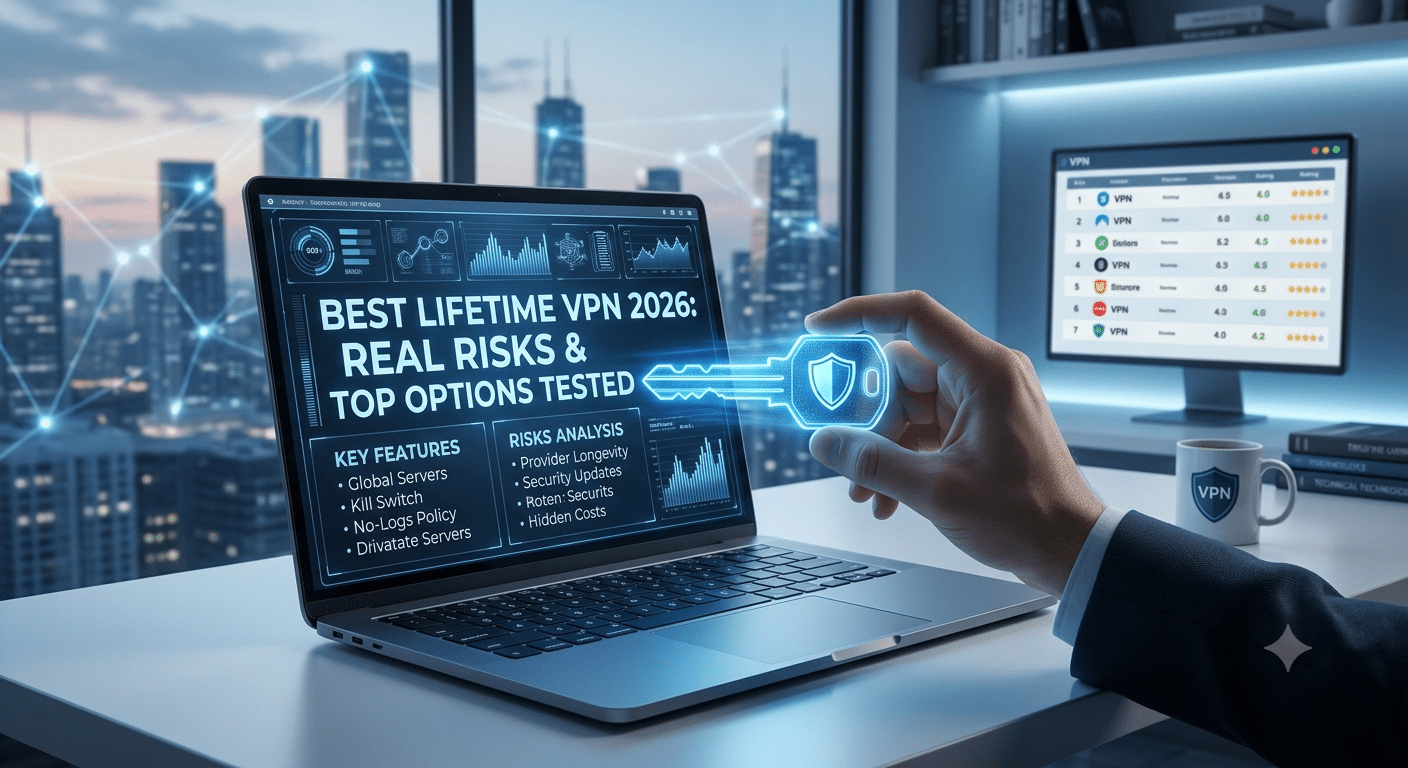

The idea of a best lifetime vpn sounds simple: pay once, stay protected forever, and never deal with monthly renewals again. In practice, the VPN market doesn’t work that cleanly. Most providers rely on continuous subscription revenue to fund servers, security updates, and infrastructure scaling—so “lifetime” deals often come with trade-offs that aren’t obvious at checkout.
If you’re evaluating long-term privacy tools, the first thing to understand is that VPN performance isn’t static. It depends on server maintenance, protocol updates, and ongoing investment in encryption standards. That’s why most reviewers consistently recommend established services from leading VPN providers that operate on subscription models rather than one-time purchases.
Before diving deeper, it’s useful to revisit the fundamentals. A VPN (Virtual Private Network) is essentially a secure tunnel between your device and the internet. If you need a clear breakdown of how that works, this VPN basics guide explains how encryption and routing protect your data from interception.
For broader privacy context, organizations like the Electronic Frontier Foundation have long warned users about how commercial VPNs handle data logging and trust models. Their analysis of VPN privacy risks highlights why ongoing accountability matters in any provider you choose: https://www.eff.org/deeplinks/2020/05/your-vpn-privacy
What is a lifetime VPN and how does it actually work?
A lifetime VPN is marketed as a one-time payment service that grants indefinite access to a VPN network. Instead of paying monthly or yearly fees, you pay upfront for “permanent” access.
On the surface, this model seems cost-efficient. In reality, VPN infrastructure is expensive to maintain. Servers require constant upgrades, bandwidth scaling, and security patching. This creates a structural tension: if revenue is only collected once, long-term service quality depends heavily on the provider’s ability to sustain operations without recurring income.
Most lifetime VPN offerings fall into one of three categories:
First, small or emerging VPN brands use lifetime deals as a customer acquisition strategy. They rely on high upfront volume to fund operations but often struggle with long-term scalability.
Second, some providers offer “lifetime” access with strict usage caps—such as limited bandwidth, fewer server locations, or throttled speeds during peak times.
Third, a few established brands occasionally run limited promotions, but these are typically capped, heavily discounted long-term plans rather than true unlimited lifetime access.
This is where expectations often diverge from reality. Users assume permanence, but VPN infrastructure behaves more like a continuously running utility than a static software license.
To understand why, it helps to look at how VPN traffic is handled. Every connection is routed through encrypted tunnels using protocols like WireGuard or OpenVPN, which must be updated regularly to remain secure. A static, non-revenue model makes it harder for providers to maintain this level of ongoing technical investment.
If you’re new to encryption and tunneling concepts, this breakdown of how VPN encryption works explains how data is packaged, routed, and protected in real time.
Are lifetime VPN subscriptions safe or too risky to trust?
The safety of lifetime VPN services depends less on the “lifetime” label and more on the provider’s long-term operational stability.
The main risk is service degradation over time. Even if a provider launches with strong infrastructure, ongoing costs like server leasing, security audits, and protocol updates don’t disappear after the first payment. If revenue slows, the quality of service often follows.
Another concern is transparency. Subscription-based VPNs usually publish regular audit reports, update logs, and security disclosures. Lifetime VPN providers are less consistent with this level of documentation, which makes it harder to verify their long-term privacy posture.
There’s also jurisdictional risk. VPN companies operating outside strong privacy jurisdictions may face regulatory pressure, data retention laws, or sudden shutdown risks that directly affect lifetime access promises.
In practical terms, most security analysts recommend treating lifetime VPN offers as “discounted long-term subscriptions” rather than permanent infrastructure ownership. That mental model alone helps set realistic expectations about reliability.
For users evaluating alternatives, comparing models is essential. Some providers emphasize affordability, while others focus on privacy-first architecture or multi-device support. If budget is the main concern, exploring reliable free VPN services can provide a short-term fallback while testing different providers before committing.
At this stage, the key takeaway is simple: lifetime pricing doesn’t eliminate operational costs—it just shifts how and when they’re paid.
The biggest misconception behind any best lifetime vpn deal is that it guarantees stability. In reality, VPN services are one of the most operationally expensive consumer software categories. Servers, bandwidth, IP rotation, and constant protocol updates create ongoing costs that don’t disappear after a one-time payment.
That’s why most established services you’ll find among top-rated VPN services avoid lifetime pricing entirely. The business model simply doesn’t align with long-term infrastructure demands unless restrictions are introduced somewhere else in the package.
Why do most major VPN providers avoid lifetime plans?
Large VPN companies avoid lifetime plans for one primary reason: predictable revenue is required to maintain infrastructure quality.
VPN networks are not static products. They require:
- Continuous server expansion to avoid congestion
- Regular security audits and penetration testing
- Protocol updates (WireGuard, OpenVPN improvements)
- IP rotation to maintain streaming access
- Abuse prevention systems and traffic balancing
Without recurring revenue, these systems degrade over time.
Major providers also face another constraint: scale. A VPN with millions of users cannot reliably fund lifetime accounts sold at a fixed historical price. A single surge in users can significantly increase bandwidth costs, making “unlimited lifetime access” mathematically unstable.
This is also why most reputable providers push yearly or multi-year subscriptions instead. If you compare long-term value across models, guides like best monthly VPN highlight how pricing structures reflect actual infrastructure costs rather than marketing incentives.
What features matter most when evaluating long-term VPN value?
If you’re judging whether a lifetime VPN is worth it, pricing should be your last filter—not your first.
The first layer is security architecture. Strong VPNs rely on modern encryption standards like AES-256 and secure tunneling protocols such as WireGuard. These aren’t optional—they determine whether your traffic is actually protected or just routed differently.
The second layer is privacy policy enforcement. A strict no-logs policy only matters if it’s backed by audits and technical enforcement, not just marketing claims. Many lifetime VPN providers skip third-party verification entirely, which weakens accountability.
The third layer is infrastructure scale. Server count, geographic distribution, and load balancing determine real-world performance more than theoretical speed claims.
Finally, device support matters more than most users expect. A VPN that works on one device but fails across a household ecosystem quickly loses value. If you’re managing multiple users or devices, understanding limitations from services like best VPN for multiple users becomes essential.
How do lifetime VPNs compare to monthly and yearly subscriptions?
Lifetime VPNs typically compete on upfront cost, not long-term performance.
Subscription-based VPNs spread infrastructure costs across time, which allows providers to continuously reinvest in:
- Faster servers
- Better streaming unblocking
- Improved mobile apps
- More stable connections under load
Lifetime VPNs, by contrast, often front-load revenue. That creates pressure to minimize ongoing expenses after the initial sale.
In practice, this leads to three observable differences:
First, performance consistency tends to decline faster in lifetime models, especially during peak usage hours.
Second, feature updates roll out more slowly. Subscription VPNs continuously iterate their apps, while lifetime models may lag behind in protocol adoption or UI improvements.
Third, support quality often decreases over time as operational budgets tighten.
From a user perspective, this is where long-term value diverges sharply from initial pricing appeal. A cheaper upfront cost doesn’t always translate into lower total cost of ownership if performance degrades.
For users prioritizing privacy over price, dedicated services focusing on encryption strength and jurisdictional safety—such as those highlighted in best VPN for privacy—tend to offer more predictable long-term reliability than lifetime deals.
server load effects, device compatibility limits, account/plan restrictions, speed throttling scenarios, etc.
One of the least discussed issues in lifetime VPN plans is how infrastructure strain directly impacts performance over time.
Server load is the first pressure point. As more lifetime users accumulate without proportional revenue growth, servers become congested. This leads to higher latency and inconsistent speeds during peak hours.
Device compatibility is another constraint. Many lifetime VPN offerings limit simultaneous connections or restrict certain platforms (such as routers or streaming devices) to reduce support costs.
Account-level restrictions also appear gradually. Some providers quietly introduce fair-use policies that cap bandwidth or reduce speeds after a threshold—effectively replacing “unlimited lifetime access” with soft usage limits.
Speed throttling can also emerge under load management systems. Instead of upgrading infrastructure, providers may prioritize certain traffic types or reduce throughput for high-usage accounts.
These limitations don’t always appear at purchase, which is why lifetime VPNs require closer scrutiny than subscription services with transparent SLA updates.
If you’re exploring safer entry points before committing to a paid provider, comparing options like reliable free VPN services can help you test real-world performance without long-term risk.
Lifetime VPN deals often look attractive because they remove recurring payments, but the real decision isn’t financial—it’s operational trust. The moment you commit to a best lifetime vpn, you’re also committing to a provider’s long-term ability to maintain infrastructure, security standards, and privacy guarantees without fresh revenue.
That’s where most of the trade-offs become visible. Unlike established subscription services listed among leading VPN providers, lifetime models tend to evolve more slowly and disclose less about internal operations over time.
What risks should you consider before buying a lifetime VPN?
The first risk is provider longevity. VPN companies are not immune to shutdowns, acquisitions, or funding issues. If a provider exits the market, lifetime access becomes irrelevant regardless of what was promised at purchase.
The second risk is infrastructure stagnation. VPN performance depends heavily on server upgrades, bandwidth expansion, and protocol updates. Without steady revenue, these improvements slow down, and users experience gradual performance decline instead of sudden failure.
The third risk involves privacy enforcement. A VPN is only as trustworthy as its logging policy and its ability to enforce it technically. Some lifetime providers reduce costs by limiting audit frequency or delaying security certifications.
The fourth risk is ecosystem compatibility. As operating systems and browsers evolve, VPN apps must be continuously updated. If development slows, users can experience broken apps, unstable connections, or limited platform support.
For users trying to avoid these risks, it helps to understand fundamentals first. A clear explanation of tunneling and encryption is available in this guide to VPN mechanics, which shows how traffic protection actually works under the hood.
Are lifetime VPN subscriptions safe or just marketing risk?
Safety depends on whether you evaluate “lifetime” as a pricing model or a technical guarantee.
Technically, a VPN cannot guarantee lifetime service in the same way software licenses do. It relies on ongoing infrastructure maintenance. That means any lifetime promise is ultimately dependent on business continuity, not technology durability.
In practice, safer VPNs are those that invest heavily in:
- Independent security audits
- Open policy transparency
- Frequent protocol updates
- Large distributed server networks
These traits are far more common in subscription-based services than lifetime models.
Some users mistake “no monthly cost” for “no future risk,” but the two are not equivalent. A VPN can be cheap upfront and still expensive in terms of reliability loss over time.
If cost flexibility is the priority instead, some users prefer hybrid strategies—starting with lower-cost trials or evaluating short-term alternatives like best free VPN options before committing long-term.
Why lifetime VPNs appeal to certain users anyway
Despite the risks, lifetime VPNs still attract users for specific reasons.
First, simplicity. Paying once removes subscription management and billing concerns. For users who dislike recurring charges, this is a psychological advantage even if long-term value is uncertain.
Second, low initial cost. Lifetime deals often appear heavily discounted compared to multi-year subscriptions, especially during promotions. This creates a strong perceived value gap.
Third, casual use cases. Some users only need VPN access for occasional browsing, streaming, or travel. In those scenarios, they may never stress-test the infrastructure enough to notice degradation.
However, this appeal is strongest in low-intensity usage environments. Once you introduce streaming demands, multi-device households, or privacy-sensitive workflows, limitations become more visible.
For example, households or shared environments often require stable multi-device support and consistent throughput. Services designed for that scenario, like best VPN for multiple users, tend to outperform lifetime deals in consistency and scalability.
What happens when a lifetime VPN service scales poorly?
Scaling is where lifetime VPN models face their most predictable failure points.
When user growth outpaces infrastructure investment, three things typically happen:
First, server congestion increases. More users share the same resources, leading to latency spikes and inconsistent speeds.
Second, feature stagnation begins. New protocols or platform updates are delayed because engineering resources are limited.
Third, support quality declines. Customer service becomes slower, and troubleshooting becomes less responsive.
Over time, this doesn’t always look like a failure—it looks like gradual degradation. Users may not notice immediately, but performance benchmarks often show declining speeds and increased connection failures compared to subscription competitors.
This is especially noticeable in high-demand scenarios such as streaming or privacy-heavy browsing. Services focused on secure browsing environments, like those covered in best VPN for dark web, typically maintain stricter infrastructure standards because they rely on continuous funding models.
How do lifetime VPNs compare in real-world privacy use cases?
In real-world usage, lifetime VPNs tend to perform best in low-risk, low-demand scenarios:
- Casual browsing on public Wi-Fi
- Light streaming in stable regions
- Occasional travel usage
- Non-sensitive traffic protection
They perform less reliably in:
- High-security environments
- Large households or shared accounts
- Heavy streaming workloads
- Long-term anonymity-focused browsing
The gap isn’t just technical—it’s structural. Privacy-focused VPNs need constant investment to stay ahead of tracking techniques, network monitoring systems, and platform restrictions.
That’s why many privacy-conscious users prefer providers listed under best VPN for privacy, where ongoing audits and infrastructure transparency are prioritized over one-time pricing models.
The core question behind any best lifetime vpn search isn’t really about features—it’s about whether paying once can realistically replace an ongoing infrastructure service. After reviewing how VPN networks operate, scale, and degrade over time, the answer depends less on marketing and more on economics.
VPNs are not static software products. They are live networks that depend on continuous funding to maintain speed, security, and global coverage. That reality shapes every meaningful comparison you’ve seen across leading VPN providers.
How do lifetime VPNs compare to long-term subscription value?
When you strip away marketing language, lifetime VPNs compete primarily on upfront pricing. Subscription VPNs compete on sustained performance.
That difference becomes obvious over time.
Subscription-based providers reinvest revenue into:
- Expanding server networks
- Updating encryption standards
- Improving streaming compatibility
- Maintaining low-latency routing
- Passing independent security audits
Lifetime VPN providers, by contrast, often operate under fixed revenue assumptions. That creates pressure to minimize ongoing costs after the initial purchase.
The result is a predictable divergence: subscription VPNs tend to improve over time, while lifetime VPNs tend to stabilize—or gradually degrade.
If you compare pricing models directly, resources like best monthly VPN show how recurring pricing reflects real operational costs rather than one-time discounts.
What is the final verdict on lifetime VPN safety and reliability?
Lifetime VPNs are not inherently unsafe, but they are structurally less predictable.
The key issue is sustainability. A VPN’s security posture depends on constant updates to encryption protocols, server infrastructure, and threat response systems. Without recurring revenue, those updates become harder to maintain at scale.
This is why most high-trust providers emphasize transparency, audits, and continuous development instead of lifetime pricing models.
For example, users prioritizing strict privacy guarantees often end up selecting services listed under best VPN for privacy, where ongoing operational funding supports consistent security improvements.
In short, lifetime VPNs can work—but only within limited expectations. They are best treated as budget tools, not long-term privacy infrastructure.
Who should actually consider a lifetime VPN?
A lifetime VPN only makes sense for a narrow group of users.
You might consider one if:
- Your usage is light and infrequent
- You primarily browse or stream casually
- You are highly price-sensitive upfront
- You don’t rely on VPNs for critical privacy workflows
However, even in those cases, limitations can emerge over time. Device compatibility updates, server congestion, and slower feature rollouts often reduce long-term value.
Users who operate across multiple devices or shared environments typically need more stable infrastructure. That’s why comparisons like best VPN for multiple users tend to favor subscription-based services designed for scalability.
For students or lighter users, more flexible models such as best VPN for students can offer better balance between cost and reliability without locking into a single long-term commitment.
The hidden trade-off: cost vs continuity
Every VPN purchase is a trade-off between upfront cost and ongoing continuity.
Lifetime VPNs optimize for immediate affordability. Subscription VPNs optimize for long-term reliability.
That distinction becomes more important when you consider how VPN ecosystems evolve. Streaming platforms adapt blocking techniques. Operating systems change permission models. Encryption standards evolve. Each of these shifts requires active development from VPN providers.
Even technical capabilities like port forwarding or advanced routing are not static. If you need more control over connections, services that support features discussed in VPN with port forwarding are typically maintained through subscription-funded development cycles.
Final recommendation: should you choose a lifetime VPN?
If your goal is long-term privacy protection with consistent performance, lifetime VPNs are rarely the strongest option. They can be useful for casual, low-risk browsing, but they introduce uncertainty around future performance and support.
Subscription-based VPNs remain the more stable choice because they align funding with ongoing infrastructure demands. That alignment directly impacts speed consistency, security updates, and global server reliability.
If you are still exploring options, it may help to step back and evaluate what a VPN is fundamentally designed to do. This beginner breakdown of VPN basics explains why continuous encryption updates and server maintenance matter more than one-time pricing models.
For most users, the long-term answer is clear: value comes from sustained performance, not permanent licenses.