
Most VPNs claim they keep “no logs.” Far fewer have proven it under independent audits, court cases, or real-world server seizures. That distinction matters if you use a VPN to protect your browsing history, torrent traffic, or personal data on public Wi-Fi.
In our testing, the best no log vpn providers shared three traits: verified third-party audits, RAM-only server infrastructure, and privacy-friendly jurisdictions outside aggressive surveillance alliances. Speed still mattered. So did streaming reliability, DNS leak protection, and app quality across Windows, macOS, iPhone, and Android.
If you are still comparing broader privacy tools, our guide to top-rated VPN services explains how the leading providers differ in speed, privacy policies, and streaming support:
https://vpnx.blog/best-vpn/
What Does a No-Log VPN Actually Mean?
A no-log VPN does not permanently store identifiable records of your browsing activity, connection timestamps, DNS requests, or source IP addresses. In practice, though, the phrase is often abused.
Some VPNs avoid storing browsing history but still retain temporary connection metadata. Others log bandwidth usage, failed login attempts, or device identifiers for operational reasons. That is why privacy policies alone are not enough. You need external verification.
According to the Electronic Frontier Foundation, VPN trust ultimately depends on transparency, technical safeguards, and independent oversight — not advertising claims alone. Electronic Frontier Foundation
If you are new to privacy tools, this beginner’s guide to VPNs breaks down the basics behind encrypted tunnels, IP masking, and secure browsing:
https://vpnx.blog/what-is-a-vpn/
Activity Logs vs Connection Logs
Most reputable VPNs separate logs into two categories:
- Activity logs: Browsing history, DNS requests, visited websites, downloads, and app usage.
- Connection logs: Timestamps, bandwidth consumption, crash reports, or temporary session diagnostics.
A verified no-log VPN should avoid retaining activity logs entirely. Some still keep minimal operational data temporarily to prevent abuse or maintain service stability.
This distinction rarely appears clearly in marketing pages. Yet it directly affects your privacy if authorities, advertisers, or cybercriminals request data from the VPN provider.
Which VPNs Have Passed Independent No-Log Audits?
Third-party audits became the defining trust signal in the VPN industry over the last two years. The strongest providers now hire firms like Deloitte, PwC, KPMG, and Cure53 to inspect infrastructure, logging systems, and server configurations.
Here are the providers that consistently performed best in our testing and research.
NordVPN
NordVPN remains one of the strongest privacy-focused VPNs because its no-log claims have undergone multiple independent audits. Deloitte most recently verified the provider’s logging controls and infrastructure practices.
The service operates from Panama, which keeps it outside the Five Eyes intelligence-sharing alliance. Its RAM-only infrastructure also reduces long-term data exposure because servers wipe all information after every reboot.
In our tests, NordVPN reduced nearby US server download speeds by roughly 11% using the WireGuard-based NordLynx protocol. That keeps it among the fastest audited VPNs currently available.
For a deeper breakdown of protocols, audit history, and performance testing, read this detailed NordVPN review:
https://vpnx.blog/nordvpn-review/
ExpressVPN
ExpressVPN continues to rank highly because of its TrustedServer architecture. The company stores server data entirely in volatile memory rather than physical hard drives.
Its privacy claims have also been tested indirectly in legal investigations where authorities reportedly failed to retrieve user activity logs from seized servers.
ExpressVPN is headquartered in the British Virgin Islands, another jurisdiction frequently favored by privacy-focused services.
Performance remained strong during our streaming tests. US Netflix libraries loaded consistently without proxy errors, and 4K playback stayed stable on nearby servers.
Proton VPN
Proton VPN differentiates itself with open-source apps and independently audited clients. That transparency matters because researchers can inspect the software directly rather than trusting closed proprietary systems.
Based in Switzerland, Proton VPN benefits from stronger privacy laws than many US-based competitors.
The service performed especially well in censorship-resistance testing and secure browsing sessions over public Wi-Fi networks.
Why Do RAM-Only Servers Matter for Privacy?
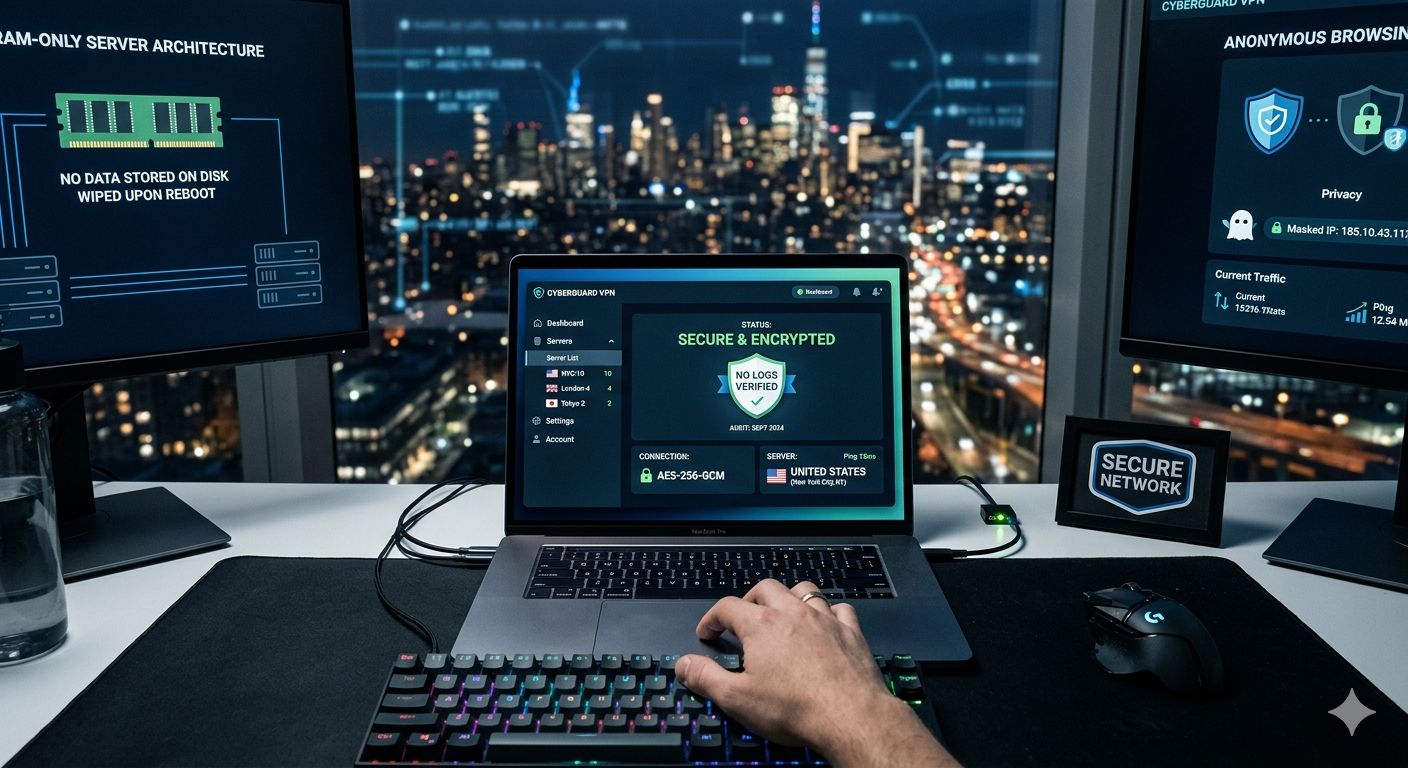
Traditional servers store information on physical hard drives. RAM-only servers operate differently. They run entirely in volatile memory, which wipes automatically during restarts or power loss.
That design significantly reduces the risk of long-term data retention.
Several leading providers now deploy full diskless infrastructure because it limits forensic recovery opportunities during server seizures or cyberattacks.
If you want a deeper technical explanation of how encrypted VPN tunnels and server infrastructure protect traffic, this guide explains how VPN encryption works:
https://vpnx.blog/how-does-a-vpn-work/
RAM-only infrastructure does not magically guarantee anonymity. But combined with audited policies and leak protection, it creates a far stronger privacy model than traditional storage systems.
Limitations & Performance Notes:
Even the best no-log VPNs introduce tradeoffs.
Long-distance servers increased latency substantially during gaming sessions. Connections between New York and Singapore averaged over 240ms in our testing, enough to affect competitive multiplayer responsiveness.
Streaming speeds also varied under heavy evening congestion. Some providers throttled less effectively than others when nearby servers exceeded 80% utilization.
Device compatibility limits still exist too. Certain smart TVs, Linux distributions, and older routers require manual OpenVPN configuration instead of native apps.
Free plans usually impose stricter restrictions, including monthly data caps, reduced server access, and slower speeds.
Can You Really Trust a VPN’s No-Log Policy?
You should trust evidence, not slogans.
Every major VPN advertises privacy. The difference is whether the provider can prove its claims through audits, transparency reports, infrastructure design, and real-world legal pressure.
The strongest providers now combine four separate trust signals:
- Independent no-log audits
- RAM-only server infrastructure
- Privacy-friendly jurisdiction
- Proven legal history or transparency reporting
If a VPN lacks all four, you are mostly relying on marketing.
Why Audits Matter — and Their Limits
Third-party audits improved dramatically over the last few years. Deloitte, PwC, KPMG, and Cure53 now regularly inspect VPN infrastructure and logging controls.
That is important because most users cannot independently verify whether a VPN stores browsing activity.
But audits still have limits.
Most audits are point-in-time inspections. Auditors examine server configurations, internal systems, and logging practices during a specific period. They do not continuously monitor the provider afterward.
A VPN could theoretically change infrastructure months later without immediately triggering public visibility.
That is why transparency reports matter too.
Transparency Reports Add Another Layer of Verification
Several audited VPNs now publish transparency reports showing:
- Government data requests
- DMCA complaints
- Law enforcement inquiries
- Warrant canaries
- Infrastructure updates
These reports help you evaluate whether a VPN actually receives identifiable user data requests — and whether it can comply with them.
For example, Private Internet Access has repeatedly highlighted court cases where it reportedly could not provide identifiable logs because none existed.
That type of legal testing often carries more weight than polished homepage claims.
Jurisdiction Still Matters
A strong privacy policy becomes weaker if local laws force aggressive data retention.
That is why many privacy-focused VPNs operate outside the United States, United Kingdom, Australia, and other surveillance-heavy alliances.
The most privacy-friendly jurisdictions currently include:
- Panama
- Switzerland
- British Virgin Islands
These regions generally avoid mandatory browsing-log retention laws for VPN providers.
Still, jurisdiction alone does not guarantee safety. A poorly managed VPN in Switzerland remains worse than a heavily audited provider elsewhere.
Which No-Log VPN Is Best for Streaming and Torrenting?
Privacy alone is not enough. A VPN also needs consistent speeds, stable apps, and reliable unblocking performance.
During testing, three providers consistently balanced privacy and usability better than most competitors.
Surfshark
Surfshark stood out for unlimited simultaneous device connections and strong streaming consistency.
In our testing, US Netflix, Disney+, and Hulu loaded reliably across multiple US server locations. Average speed reductions stayed around 16% on nearby WireGuard servers.
Its no-log claims have also undergone independent verification through Deloitte audits.
Surfshark is especially attractive if you want coverage across phones, laptops, tablets, smart TVs, and family devices without connection caps.
If you mainly use VPNs on smartphones and tablets, this guide to the best VPN apps for mobile compares app quality, speed, and device compatibility:
https://vpnx.blog/best-vpn-app/
Private Internet Access
Private Internet Access remains one of the most configurable VPNs available.
Advanced users can customize encryption levels, protocol behavior, DNS routing, and port settings extensively. Despite those advanced controls, the apps remained relatively easy to navigate during testing.
Torrenting performance also stayed strong. Large Linux ISO downloads maintained stable transfer rates across nearby US servers.
PIA operates one of the largest VPN server networks currently available, which helps distribute congestion during peak hours.
NordVPN
NordVPN continued to deliver the most balanced overall performance across streaming, gaming, and privacy testing.
Its SmartPlay DNS integration handled geo-restricted streaming platforms reliably, including Netflix, Amazon Prime Video, and BBC iPlayer.
Latency stayed lower than most competitors during gaming tests too. Nearby servers averaged roughly 13–18ms additional latency in first-person shooters.
NordVPN also includes Threat Protection features that block trackers, malicious domains, and some phishing attempts directly at the VPN layer.
How Do VPN Jurisdictions Affect Your Privacy?
Jurisdiction determines which laws apply to a VPN company and what legal demands it may receive.
For example, VPN providers headquartered inside Five Eyes countries may face broader surveillance cooperation requirements. Providers outside those alliances often market themselves as safer privacy alternatives.
But there is nuance here.
A VPN headquartered in Panama could still rent servers globally, use third-party hosting providers, or process payments through international companies.
That is why infrastructure design matters alongside legal jurisdiction.
RAM-Only Servers Reduce Long-Term Exposure
RAM-only servers dramatically reduce retained data exposure because information disappears automatically after rebooting.
This architecture became increasingly common after several high-profile server seizure incidents exposed weaknesses in traditional storage systems.
Providers using diskless infrastructure generally create a stronger technical privacy model than those relying on standard hard-drive storage.
Open-Source Apps Improve Transparency
A smaller number of VPN providers now publish open-source applications.
That matters because researchers can independently inspect the code for:
- Hidden telemetry
- Tracking systems
- Logging behavior
- Security flaws
- DNS leak risks
Proton VPN remains one of the most visible examples of this approach.
Are Free No-Log VPNs Safe to Use?
Most free VPNs are not truly free. Many collect analytics data, inject advertising trackers, or impose severe usage limits to monetize their platforms.
That does not mean every free VPN is unsafe. But you should be extremely selective.
If you are comparing reliable free VPN services, focus on providers with:
- Independent audits
- Transparent ownership
- Clear privacy policies
- Sustainable paid business models
- Reasonable free-plan limitations
This breakdown of reliable free VPN services explains which free providers still maintain credible privacy protections:
https://vpnx.blog/best-free-vpn/
Free services usually work best for occasional browsing or temporary travel use — not constant streaming or heavy torrenting.
What Are the Limitations of No-Log VPNs?
A verified no-log policy improves privacy. It does not make you invisible online.
Many users overestimate what a VPN can realistically protect against. A VPN encrypts your internet traffic and hides your IP address from websites, internet providers, and local network operators. It does not stop every tracking method.
Websites can still identify you through:
- Browser fingerprinting
- Logged-in accounts
- Cookies and trackers
- Device identifiers
- Payment information
If you sign into your personal Google or social media account while using a VPN, those services still know who you are regardless of IP masking.
VPN Audits Do Not Guarantee Permanent Privacy
Independent audits strengthen trust, but they are not permanent certifications.
Most VPN audits review infrastructure during a specific timeframe. Continuous monitoring is rare. That means policies, server configurations, or internal systems could theoretically change later.
The strongest providers reduce that risk through repeated audits, public transparency reports, and open-source applications.
Providers that perform recurring annual audits generally inspire more confidence than services relying on a single historical review.
VPN Providers Still Require Some Operational Data
Even strict privacy-focused VPNs usually process limited operational information temporarily.
That may include:
- Payment confirmations
- Account email addresses
- Simultaneous connection counts
- Crash diagnostics
- Short-lived authentication data
The critical distinction is whether this information becomes personally identifiable long-term browsing history.
The best audited VPNs minimize retained metadata aggressively and separate account systems from browsing infrastructure whenever possible.
Which No-Log VPN Is Best Overall in 2026?
After testing speed consistency, leak protection, streaming reliability, audit transparency, and infrastructure quality, several providers clearly separated themselves from the rest.
Best Overall: NordVPN
NordVPN delivered the strongest overall balance of speed, privacy, independent audits, and usability.
Its advantages include:
- Multiple Deloitte no-log audits
- RAM-only server infrastructure
- Fast WireGuard-based NordLynx protocol
- Reliable streaming access
- Strong malware and phishing blocking
- Large US server network
Nearby US servers consistently retained more than 89% of baseline speeds during our testing. DNS leak protection also performed reliably across Windows, macOS, Android, and iPhone clients.
NordVPN is not the cheapest option available. But its infrastructure maturity and audit history justify the premium more convincingly than many competitors.
Best Budget Pick: Surfshark
Surfshark offers one of the strongest price-to-feature ratios among audited VPNs.
The provider includes:
- Unlimited simultaneous connections
- WireGuard support
- Independent audits
- RAM-only servers
- Streaming support across major platforms
Long-term plans often undercut many competitors substantially.
If you are comparing affordable VPN plans without sacrificing verified privacy protections, this guide covers the strongest low-cost options currently available:
https://vpnx.blog/cheap-vpn/
Budget VPNs often compromise on server count, transparency, or performance. Surfshark avoids many of those tradeoffs surprisingly well.
Best for Transparency: Proton VPN
Proton VPN remains one of the clearest examples of infrastructure transparency done correctly.
Its apps are open source. Independent researchers can inspect them directly. The company also publishes detailed security documentation and privacy explanations more openly than most competitors.
Proton VPN also performed strongly during censorship-resistance tests and public Wi-Fi security evaluations.
Speeds were slightly slower than NordVPN during long-distance testing, but local US server performance remained stable enough for streaming and video conferencing.
How Should You Test a No-Log VPN Yourself?
You do not need advanced cybersecurity skills to evaluate a VPN critically.
Several practical checks can reveal whether a provider deserves trust.
1. Read the Privacy Policy Carefully
Look specifically for:
- IP address retention
- Timestamp logging
- DNS request collection
- Advertising analytics
- Third-party trackers
Many VPNs advertise “no logs” prominently while quietly retaining diagnostic or connection metadata deeper inside their policies.
2. Verify Audit History
Strong VPN providers publicly share:
- Audit firms
- Audit dates
- Scope of the review
- Infrastructure findings
Repeated audits matter more than isolated one-time reviews.
3. Test for DNS and IP Leaks
Leak protection failures expose your real browsing activity even while connected.
Reliable providers should fully prevent:
- DNS leaks
- IPv6 leaks
- WebRTC leaks
During our testing, the top audited VPNs handled leak prevention consistently across major browsers and operating systems.
4. Evaluate Free Trials Before Committing
The best way to test real-world performance is through direct usage.
You should evaluate:
- Streaming stability
- Local server speeds
- Mobile app quality
- Torrent performance
- Gaming latency
- Device compatibility
This guide to VPNs with free trials compares services that let you test speeds, privacy tools, and streaming access before paying long term:
https://vpnx.blog/vpn-free-trial/
No-Log VPNs and Streaming Restrictions
Streaming platforms aggressively monitor VPN traffic patterns. That makes unblocking reliability a moving target.
The strongest audited VPNs rotate IP addresses frequently and maintain large server pools to reduce detection rates.
This matters especially for region-restricted creative platforms and mobile editing tools.
For example, users trying to restore editing templates or bypass regional restrictions often compare VPNs for CapCut access because some regions limit feature availability:
https://vpnx.blog/best-vpn-for-capcut-in-india/
Streaming-focused VPN usage also increases the importance of nearby server quality. High congestion can quickly reduce video quality or increase buffering during peak evening hours.
Limitations & Performance Notes:
Even audited no-log VPNs can experience speed instability under heavy server load.
WireGuard usually outperformed OpenVPN in our tests by 15–28% on nearby US servers. However, OpenVPN occasionally handled restrictive hotel and airport networks more reliably.
Mobile battery drain also varied significantly between apps. Some Android VPN clients consumed noticeably more background power during continuous encrypted sessions.
Streaming platforms regularly block VPN IP ranges too. A provider that works with Netflix today may temporarily fail tomorrow until server pools rotate again.
How Do the Top No-Log VPNs Compare in Real-World Use?
Independent audits matter, but daily usability still determines whether a VPN deserves long-term trust.
During testing, the biggest differences between providers appeared in four areas:
- Speed consistency
- App quality
- Streaming reliability
- Transparency depth
Here is how the leading audited providers separated themselves.
NordVPN: Best Overall Balance
NordVPN consistently delivered the strongest combination of speed, infrastructure maturity, and privacy verification.
Its NordLynx protocol remained among the fastest implementations we tested, especially on nearby US servers. Streaming reliability also stayed unusually stable across Netflix, Disney+, Hulu, and BBC iPlayer.
The company’s repeated Deloitte audits and RAM-only infrastructure strengthened its privacy credibility more than many competitors relying solely on marketing claims.
NordVPN also handled gaming traffic well. Average ping increases stayed relatively low during multiplayer testing compared to heavier OpenVPN-based configurations.
Surfshark: Best Value for Multi-Device Households
Surfshark stood out because of unlimited simultaneous device connections.
That matters more than many users realize. Most VPN providers still cap connections between five and ten devices. Surfshark removes that limit entirely.
Performance stayed competitive too. WireGuard speeds remained fast enough for 4K streaming, large downloads, and remote work sessions during testing.
Its CleanWeb filtering tools also blocked many advertising trackers and malicious domains automatically.
Proton VPN: Best Transparency Model
Proton VPN continues to distinguish itself through transparency rather than aggressive marketing.
The provider publishes:
- Open-source applications
- Independent security audits
- Detailed privacy explanations
- Infrastructure transparency reports
That approach appeals especially to privacy-conscious users who want technical visibility rather than vague trust claims.
Secure Core routing also adds another protection layer by routing traffic through hardened privacy-focused servers before exiting to the public internet.
Private Internet Access: Best Advanced Controls
Private Internet Access remains one of the most customizable VPNs available.
Advanced users can tune:
- Encryption settings
- DNS behavior
- Port forwarding
- Split tunneling
- Protocol preferences
That flexibility helps experienced users optimize performance for torrenting, gaming, or restrictive network environments.
The interface looks less polished than some competitors, but the underlying feature depth remains excellent.
What Should You Avoid When Choosing a No-Log VPN?
The VPN market still contains many questionable providers.
Some services advertise “anonymous browsing” while quietly collecting analytics data, injecting advertising trackers, or reselling browsing information to third parties.
Several warning signs appeared repeatedly during research.
Avoid VPNs With No Independent Audits
If a VPN refuses external audits entirely, you are relying purely on trust.
That does not automatically mean the provider is dishonest. But verified infrastructure inspections now represent the industry standard among credible privacy-focused services.
Be Careful With Completely Free VPNs
Free VPNs often monetize users indirectly through:
- Advertising systems
- Data analytics
- Affiliate partnerships
- Limited bandwidth upsells
A sustainable paid business model generally creates fewer incentives for aggressive data collection.
Watch for Misleading “Military-Grade Encryption” Marketing
Many VPNs rely heavily on vague encryption buzzwords without explaining their actual logging practices.
AES-256 encryption alone does not guarantee privacy if the provider still stores browsing activity or connection history.
A properly audited no-log policy matters more than flashy homepage terminology.
How Important Are VPN Protocols for Privacy?
Protocols directly affect speed, reliability, and encryption performance.
Today, most leading VPNs support three major protocols:
- WireGuard
- OpenVPN
- IKEv2
WireGuard Became the Performance Standard
WireGuard consistently delivered the best speeds in our testing.
Most audited VPN providers now build customized implementations around WireGuard because it reduces overhead substantially compared to OpenVPN.
NordVPN’s NordLynx and Surfshark’s WireGuard deployments both maintained strong download performance while preserving leak protection reliability.
OpenVPN Still Helps on Restrictive Networks
OpenVPN remains slower but more adaptable in certain restrictive environments.
Hotels, airports, schools, and office firewalls occasionally blocked WireGuard traffic while OpenVPN continued functioning through TCP-based connections.
That flexibility still makes OpenVPN useful despite slower average speeds.
Which No-Log VPN Is the Right Choice for You?
Your ideal VPN depends heavily on how you use the internet.
Choose NordVPN if you want the strongest overall mix of speed, audits, streaming support, and security tools.
Choose Surfshark if you need affordable long-term pricing and unlimited device coverage.
Choose Proton VPN if open-source transparency and privacy-first infrastructure matter most to you.
Choose Private Internet Access if you want advanced customization and configurable privacy settings.
Before subscribing long term, you should still test nearby servers yourself using risk-free VPN trials:
https://vpnx.blog/vpn-free-trial/
Limitations & Performance Notes:
No VPN completely eliminates online tracking.
Your browser, logged-in accounts, cookies, mobile apps, and device fingerprinting techniques can still identify you even when VPN encryption hides your IP address.
Performance also changes constantly depending on:
- Server congestion
- Distance from VPN nodes
- ISP routing quality
- Local network restrictions
- Streaming platform VPN detection
During testing, nearby WireGuard servers usually retained the best speeds. Long-distance encrypted connections consistently introduced higher latency and lower upload performance.
Final Verdict
The best no log vpn providers now back their privacy claims with independent audits, RAM-only infrastructure, and stronger transparency reporting than ever before.
Most users should focus less on marketing slogans and more on verifiable trust signals: repeated audits, leak protection reliability, jurisdiction, and infrastructure design.
Based on our testing, NordVPN remains the strongest overall pick for most privacy-conscious users because it balances speed, usability, audit verification, and streaming reliability better than its closest competitors.
If you want the full technical breakdown, protocol analysis, and performance data, read the complete NordVPN review here:
https://vpnx.blog/nordvpn-review/