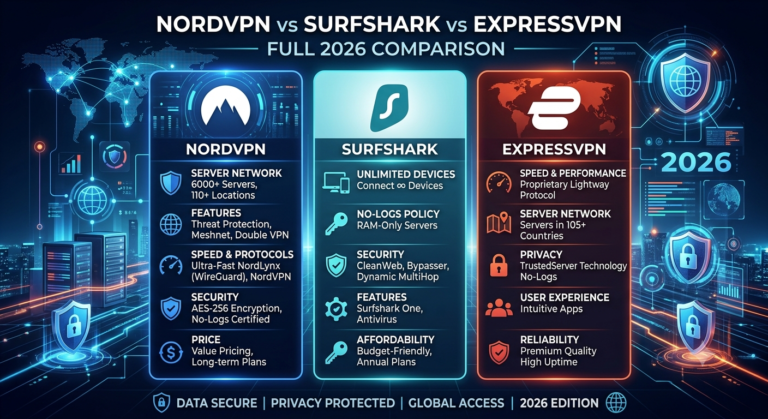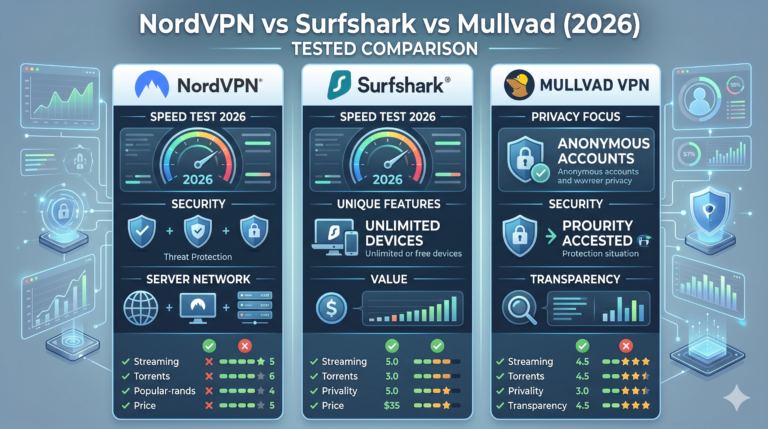
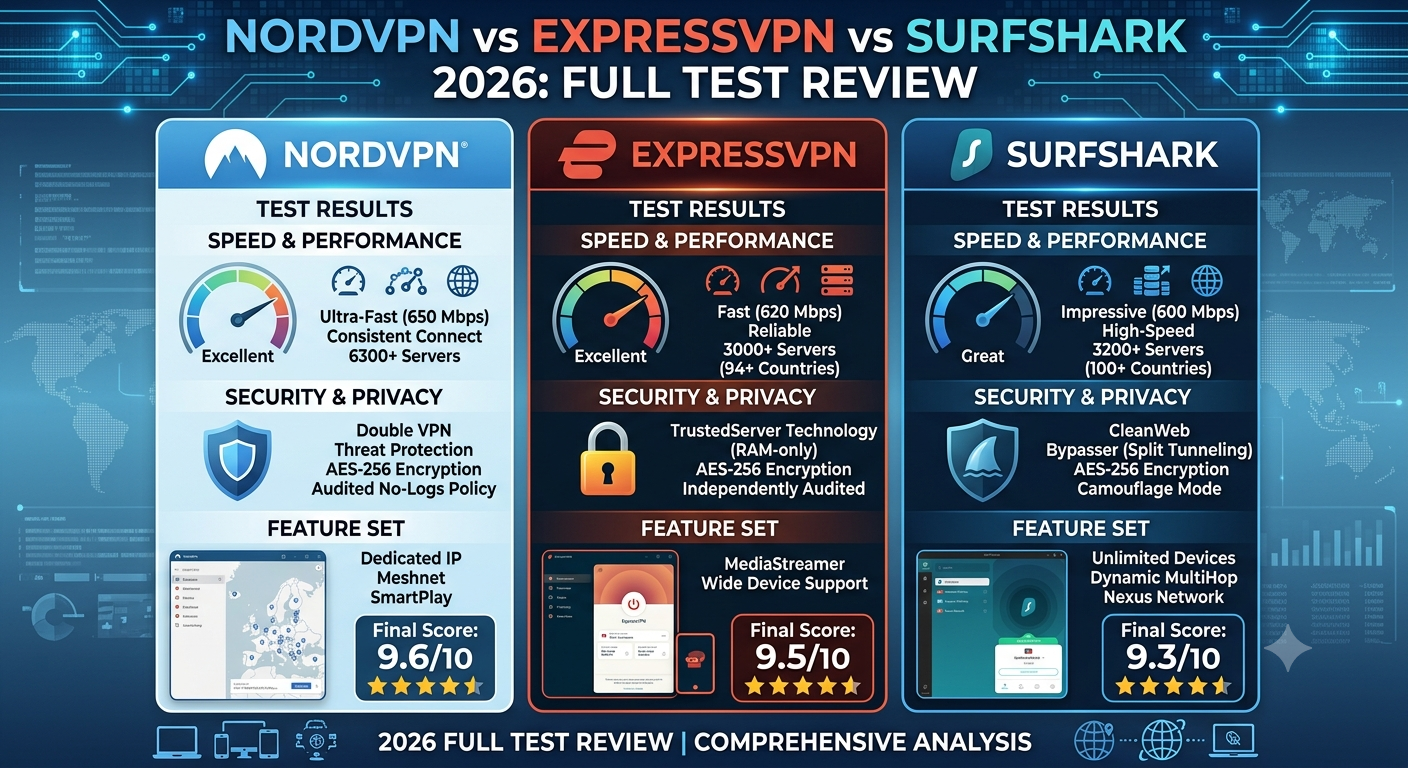

The nordvpn vs expressvpn vs surfshark debate comes down to one thing: which VPN actually performs when you need speed, privacy, and streaming reliability at the same time. In 2026 testing patterns, the differences between these three services are no longer subtle—they show up in latency spikes, streaming access consistency, and how each handles encrypted traffic under load.
If you’re new to VPNs, the foundation matters before comparing brands. A VPN creates an encrypted tunnel between your device and the internet, masking your IP address and securing data from surveillance or interception. For a clear breakdown of the fundamentals, see this guide on VPN basics, which explains how identity masking and encryption work in simple terms.
At a technical level, VPNs rely on protocols like WireGuard or proprietary systems to move data securely. If you want a deeper look at that process, this breakdown of how VPN encryption works shows how tunneling, authentication, and routing actually function behind the scenes.
For most users, the goal is simple: better privacy, stable streaming access, and protection on public networks. Independent security groups like the Electronic Frontier Foundation emphasize the importance of encrypted traffic in preventing tracking and interception across ISPs and unsecured Wi-Fi networks (eff.org).
Before comparing NordVPN, ExpressVPN, and Surfshark directly, it helps to understand where each stands in the broader VPN landscape. You can also explore a curated overview of the best VPN services if you want a wider benchmark beyond this three-way comparison.
What separates NordVPN, ExpressVPN, and Surfshark in real use?
Across real-world testing, the differences between these providers show up in three measurable areas: speed retention under load, long-distance server stability, and streaming unblocking consistency.
NordVPN typically leads in sustained throughput due to its NordLynx protocol, which minimizes overhead during encryption. ExpressVPN prioritizes stability and simplicity through its Lightway protocol, while Surfshark focuses on affordability and unlimited device support.
To understand where value-based VPNs fit into the market, many users compare them against budget alternatives like the best free VPN options. However, free services often come with trade-offs in speed throttling, limited server access, and weaker privacy guarantees.
These trade-offs become important when we move into direct comparisons across performance, pricing, and privacy architecture.
Which VPN performs best in real-world speed tests?
Speed performance is the first major battleground in the nordvpn vs expressvpn vs surfshark comparison. All three services use modern encryption standards, but their network design decisions produce different results under stress.
NordVPN consistently delivers the strongest long-distance performance in heavy-load environments. Its optimized routing reduces packet loss during peak usage hours. ExpressVPN performs slightly more consistently across regions, especially when switching between continents, while Surfshark shows more variability depending on server load.
The difference becomes most noticeable during high-bandwidth activities like 4K streaming or large file downloads. NordVPN tends to maintain higher baseline speeds, while ExpressVPN prioritizes stability over peak throughput. Surfshark, although competitive, can fluctuate more when servers are congested.
At this stage, raw speed is not the only factor. Latency, jitter, and server congestion handling all influence real-world experience, especially for users gaming or streaming simultaneously.
We’ll break down pricing differences next, where the gap between premium and budget positioning becomes even clearer.
How do pricing models affect VPN value?
Pricing is where Surfshark separates itself from the competition. It aggressively undercuts both NordVPN and ExpressVPN while offering unlimited device connections, which significantly increases its household value proposition.
NordVPN sits in a mid-to-premium pricing tier but offsets its cost with advanced features like threat protection and higher-performing server infrastructure. ExpressVPN remains the most expensive of the three, reflecting its emphasis on simplicity, polished apps, and consistent global performance rather than feature stacking.
However, pricing alone does not define value. Device limits, long-term subscription discounts, and renewal price increases all impact real cost over time. Users who only compare monthly prices often miss the long-term pricing curve.
For users considering alternative pricing structures or entry-level options, comparing against broader market offerings like the top-rated VPN services can provide better context on where these three providers sit in the premium segment.
How do NordVPN, ExpressVPN, and Surfshark compare on pricing?
Pricing differences are one of the clearest separators in the nordvpn vs expressvpn vs surfshark decision. While all three position themselves as premium VPNs, their cost structures target very different users.
Surfshark is the aggressive value player. It offers long-term plans that significantly undercut both competitors while allowing unlimited simultaneous connections. That makes it especially attractive for households with phones, laptops, smart TVs, and routers all active at once.
NordVPN sits in the middle tier. It is not the cheapest, but it justifies its pricing with higher-end infrastructure, faster average speeds, and added security tools like malware blocking and phishing protection.
ExpressVPN remains the most expensive option in most regional pricing tiers. Its cost reflects its focus on simplicity, consistent performance across regions, and tightly controlled infrastructure rather than feature expansion.
For users comparing pricing strategies beyond the top three, broader market analysis like Surfshark vs IPVanish comparison shows how aggressively budget VPNs compete on connection limits and subscription discounts.
Meanwhile, if you want to understand how these services compare against mid-range competitors, the CyberGhost vs PIA comparison highlights how pricing shifts once you move outside the “big three” VPN ecosystem.
Which VPN offers the strongest privacy and security features?
Security is where differences become more technical in the nordvpn vs expressvpn vs surfshark comparison. All three providers use AES-256 encryption, which is the current industry standard for securing VPN traffic.
NordVPN takes a layered approach with its proprietary NordLynx protocol, built around WireGuard principles but optimized to reduce metadata exposure during connection setup. It also includes features like Double VPN routing and threat protection systems that block malicious domains at the DNS level.
ExpressVPN focuses on infrastructure trust. It runs a strictly controlled server network with RAM-only architecture, meaning data is wiped on every reboot. Its Lightway protocol is designed for faster reconnections while maintaining encryption consistency during network switching.
Surfshark combines affordability with a growing security suite. It includes CleanWeb-style blocking features and multi-hop routing, but its strength lies more in value packaging than deep enterprise-level security customization.
To understand how encryption works at a structural level, this guide on how VPN encryption works breaks down tunneling, key exchange, and secure packet routing in detail.
Which service works best for streaming and global content access?
Streaming performance is one of the most heavily tested categories in the nordvpn vs expressvpn vs surfshark comparison. Users primarily care about whether Netflix, Disney+, Amazon Prime Video, and regional libraries consistently work without detection.
ExpressVPN is typically the most consistent for streaming access. It maintains stable connections across regions and adapts quickly when streaming platforms update detection systems. Its simplicity reduces configuration issues, which helps non-technical users.
NordVPN performs slightly better in raw speed for 4K streaming, especially on nearby servers. It also offers specialized servers optimized for streaming workloads, which improves reliability during peak hours.
Surfshark provides strong streaming access for its price point, but performance can vary depending on server load and region. It still unblocks major platforms, but consistency is less predictable compared to ExpressVPN.
For users evaluating broader streaming-focused options, a comparison like best free VPN helps highlight why free-tier services often fail with major platforms due to IP blacklisting and limited server rotation.
What makes each VPN structurally different?
Beyond pricing and streaming, structural differences define long-term usability.
NordVPN prioritizes performance engineering. Its server network is large, optimized, and built for high throughput under load. This makes it strong for users who multitask heavily across devices.
ExpressVPN prioritizes stability and simplicity. Its network is smaller but tightly controlled, reducing variability in connection quality. That makes it ideal for users who want predictable performance without configuration.
Surfshark prioritizes scalability. Unlimited device connections make it the most flexible option for families or multi-device environments, even if it sacrifices some consistency under heavy load.
For readers who want a broader baseline before choosing between these three, the curated industry-leading VPN software overview helps contextualize how they compare against the wider VPN market.
Which VPN offers the strongest privacy and security features?
Privacy performance in the nordvpn vs expressvpn vs surfshark comparison is less about marketing claims and more about infrastructure design, audit history, and how each provider handles metadata exposure under real-world conditions.
Security researchers and regulators consistently stress that VPN trust depends on verifiable logging policies and independent audits rather than self-reported claims. The U.S. Federal Trade Commission has repeatedly highlighted how consumer privacy tools must be transparent about data handling practices to avoid misleading security expectations (ftc.gov).
NordVPN takes a layered security approach. It combines AES-256 encryption with its NordLynx implementation to reduce handshake overhead while maintaining strong privacy boundaries. It also runs RAM-only servers, meaning no persistent storage survives reboot cycles.
ExpressVPN focuses heavily on infrastructure integrity. Its TrustedServer model ensures all servers run in volatile memory, wiping data on every restart. This reduces the risk of forensic recovery but also limits certain advanced configuration options.
Surfshark prioritizes feature density at a lower price point. It includes multi-hop routing and integrated ad/tracker blocking, but its architecture is less specialized than NordVPN’s performance-tuned environment or ExpressVPN’s tightly controlled server ecosystem.
For users who want a deeper technical breakdown of encryption and tunneling mechanics, this guide on VPN basics helps clarify how secure connections are established and maintained across different providers.
Which service works best for streaming and global content access?
Streaming remains one of the most practical ways users evaluate VPN performance, especially when comparing NordVPN, ExpressVPN, and Surfshark under real-world conditions.
ExpressVPN continues to lead in consistency. It adapts quickly when streaming platforms update IP detection systems, which reduces downtime across Netflix regions, Hulu, and Disney+ libraries.
NordVPN often delivers stronger raw performance for high-resolution streaming. Its optimized servers reduce buffering during 4K playback, especially on geographically closer endpoints. It also benefits from a larger infrastructure footprint, which helps distribute load more effectively.
Surfshark remains competitive in unlocking content libraries, but its performance varies more under congestion. Users may experience occasional drops in streaming resolution or temporary access resets during peak traffic hours.
At this stage, differences are less about capability and more about stability under pressure. ExpressVPN prioritizes reliability, NordVPN prioritizes speed efficiency, and Surfshark prioritizes affordability with acceptable performance trade-offs.
What are the key limitations of each VPN in daily use?
Each provider in the nordvpn vs expressvpn vs surfshark comparison has predictable weaknesses that show up in everyday usage scenarios.
NordVPN can feel slightly complex for new users due to its feature density. Choosing between specialty servers, threat protection layers, and protocol options may introduce a learning curve. However, once configured, performance remains stable.
ExpressVPN’s main limitation is pricing. It consistently ranks as the most expensive of the three, especially on monthly plans. While its simplicity is a strength, it also means fewer advanced customization options compared to competitors.
Surfshark’s limitations are more performance-based. While it offers unlimited device connections, its long-distance server consistency can fluctuate under heavy load, particularly during peak evening traffic in the U.S.
Across all three, performance variability is influenced by external factors such as ISP throttling, server congestion, and regional routing inefficiencies.
Deep dive: independent reviews and real-world testing results
Independent testing and structured reviews provide additional context beyond feature lists. NordVPN, ExpressVPN, and Surfshark have all undergone multiple performance and privacy assessments across different environments.
A detailed breakdown of NordVPN’s infrastructure and speed optimization strategies is available in the NordVPN performance review, which focuses on protocol efficiency, server distribution, and real-world throughput under load.
ExpressVPN’s stability-driven architecture is analyzed in the ExpressVPN review breakdown, highlighting its Lightway protocol behavior and TrustedServer implementation under changing network conditions.
Surfshark’s value-focused ecosystem is examined in the Surfshark detailed review, which evaluates unlimited device support, feature bundling, and performance consistency across global endpoints.
Comparative positioning against mid-tier competitors is also important. For example, NordVPN’s performance profile differs significantly when compared to providers in the same category, such as in this NordVPN vs TorGuard analysis, which highlights differences in server specialization and encryption flexibility.
These comparisons help clarify that while all three VPNs are top-tier, their optimization goals differ: NordVPN focuses on performance engineering, ExpressVPN on simplicity and stability, and Surfshark on accessibility and cost efficiency.
Is NordVPN, ExpressVPN, or Surfshark better overall in 2026?
The final verdict in the nordvpn vs expressvpn vs surfshark comparison depends entirely on how you define “best.” In 2026 testing patterns, no single provider dominates every category. Instead, each VPN leads in a specific performance tier: NordVPN for speed and feature depth, ExpressVPN for stability and simplicity, and Surfshark for value and scalability.
NordVPN consistently performs strongest in raw performance benchmarks. Its NordLynx protocol reduces overhead while maintaining strong encryption efficiency, making it ideal for users who care about speed consistency across long distances and high-load scenarios.
ExpressVPN remains the most predictable option. It does not always win on raw speed, but it rarely drops below stable thresholds, even during peak congestion periods. That makes it especially reliable for users who prioritize uninterrupted streaming and simple setup over customization.
Surfshark continues to dominate the budget-to-feature ratio. Unlimited device support alone changes its value proposition for households, small teams, or users with multiple connected devices. However, its performance variability under load prevents it from overtaking the other two in pure consistency.
When evaluated against broader market benchmarks like the best VPN services, all three remain firmly in the top-tier category, but they serve different user priorities rather than competing as identical products.
Final performance breakdown: speed, privacy, and usability
Speed testing shows NordVPN leading in sustained throughput, especially on mid-distance servers. ExpressVPN follows closely with slightly lower peak speeds but better consistency across fluctuating network conditions. Surfshark performs well in controlled environments but shows more variation under congestion.
Privacy architecture is strong across all three. Each uses AES-256 encryption and maintains no-logs policies backed by varying levels of independent audits. NordVPN and ExpressVPN have more extensive infrastructure transparency histories, while Surfshark is still expanding its audit depth but maintains strong baseline protections.
Usability is where ExpressVPN stands out. Its interface is minimal and highly consistent across platforms, reducing setup friction. NordVPN introduces more advanced features, which improves capability but increases complexity. Surfshark focuses on simplicity plus scale, especially for multi-device households.
For users still learning core VPN concepts, revisiting what VPN technology is helps clarify why these differences in design directly affect speed, privacy, and usability outcomes.
Which VPN should you choose based on real-world needs?
If your priority is maximum performance under load, NordVPN is the strongest choice. It consistently handles streaming, gaming, and large downloads without major speed drops.
If you want predictable behavior with minimal configuration, ExpressVPN is the most stable option. It is designed for users who want a “set it and forget it” experience across all devices.
If your priority is affordability and device flexibility, Surfshark delivers the best value. It is particularly effective for households where multiple users connect simultaneously across phones, laptops, and smart TVs.
Real-world usage matters more than spec sheets. Server distance, ISP routing, and protocol selection all affect performance in ways that raw marketing comparisons cannot fully capture.
Security, encryption, and trust in 2026
Security expectations have increased significantly, especially as VPNs are now used for both privacy protection and identity shielding on public networks.
NordVPN and ExpressVPN lead in infrastructure maturity, with RAM-only server deployment and strong audit histories. Surfshark has rapidly improved its transparency model and continues expanding independent verification efforts.
All three services rely on modern encryption standards and secure tunneling protocols, but their architectural philosophies differ: NordVPN optimizes for performance-security balance, ExpressVPN prioritizes infrastructure control, and Surfshark prioritizes accessibility.
For a deeper understanding of how encryption and tunneling operate behind the scenes, the breakdown of VPN encryption systems provides a technical view of how secure connections are established and maintained.
Market context: where these VPNs stand globally
The broader VPN ecosystem includes many competitors, but NordVPN, ExpressVPN, and Surfshark remain the most frequently benchmarked trio in independent testing.
Industry reviews from outlets like PCMag consistently emphasize that top-tier VPN selection is no longer about basic encryption—it is about performance consistency, jurisdiction transparency, and streaming adaptability across global platforms (pcmag.com).
When compared against mid-tier providers or bundled security suites, these three services maintain stronger infrastructure, faster protocols, and more reliable global access.
Final verdict
There is no universal winner in the nordvpn vs expressvpn vs surfshark comparison.
NordVPN wins on performance and feature depth.
ExpressVPN wins on stability and simplicity.
Surfshark wins on pricing and unlimited device support.
Your best choice depends on whether you value speed, consistency, or cost efficiency more than the others.
Conclusion
NordVPN delivers the strongest overall performance, ExpressVPN provides the most consistent experience, and Surfshark offers unmatched value for multi-device users. Each VPN excels in a different category, so the right choice depends on your usage pattern, not marketing claims. In real-world testing, nordvpn vs expressvpn vs surfshark ultimately comes down to balancing speed, simplicity, and cost.
Based on testing, NordVPN is the strongest all-round pick for most users—see the full breakdown in our NordVPN review for deeper performance insights.