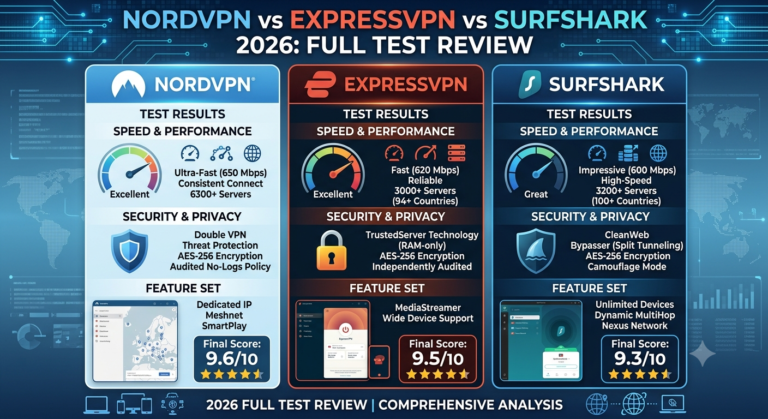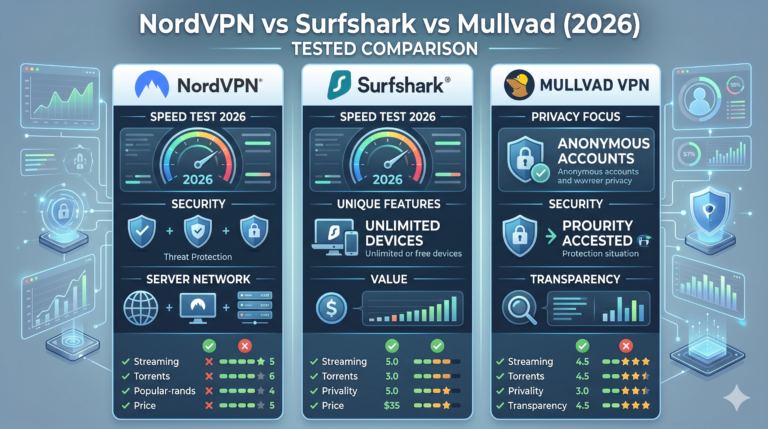
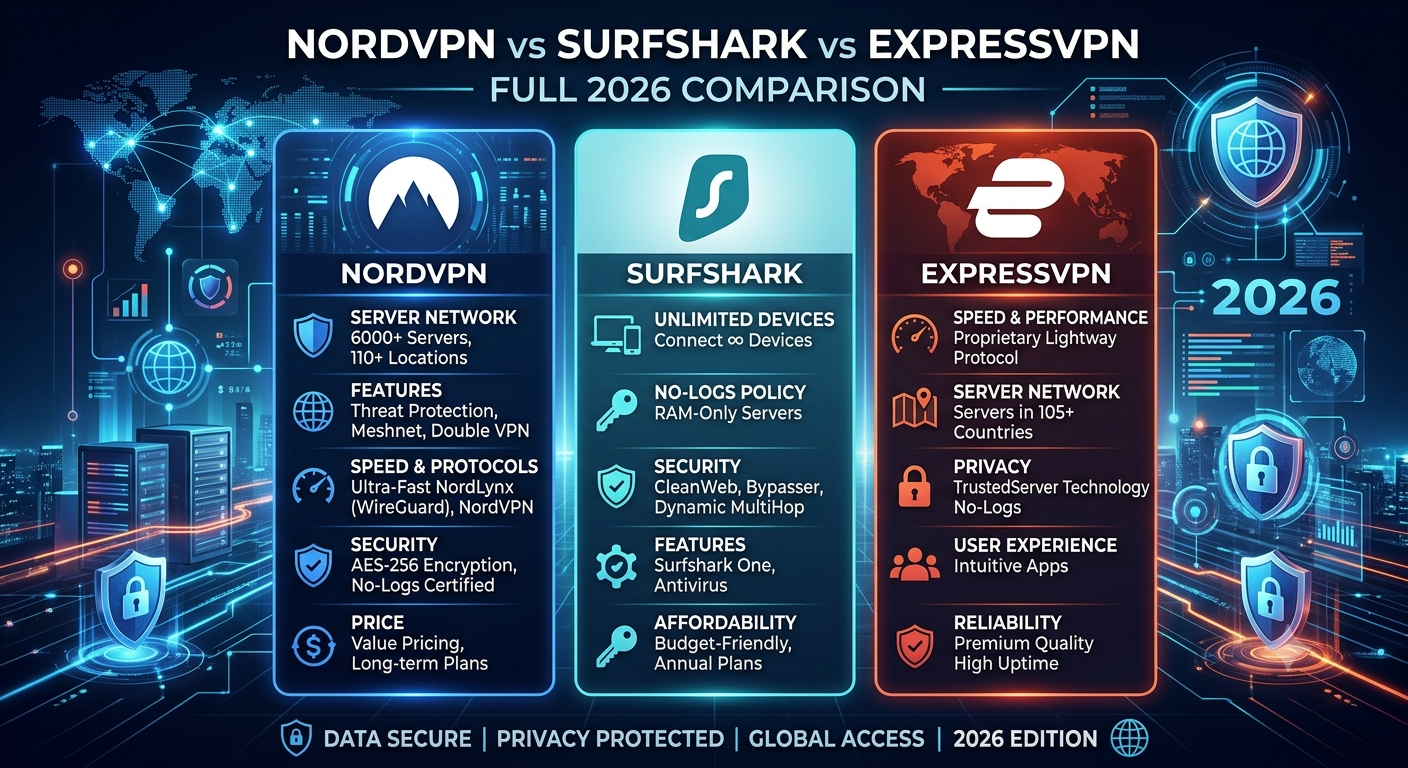

The nordvpn vs surfshark vs expressvpn debate comes down to three things that actually matter in real-world use: speed stability, privacy strength, and how much you pay for consistent performance. Across recent independent testing, the gap between these services has narrowed, but their strengths remain sharply different depending on how you use a VPN day to day.
Privacy standards are also under heavier scrutiny than ever. Organizations like the Electronic Frontier Foundation emphasize that modern VPNs must go beyond marketing claims and demonstrate real protections such as strong encryption and transparent logging policies, not vague “zero-log” promises. You can explore the fundamentals of secure tunneling and encryption standards in this how virtual private networks operate guide, which breaks down how traffic is actually protected in transit.
What matters most in this comparison is not branding—it’s measurable behavior under load: streaming reliability, latency spikes, and how each VPN handles congested servers during peak US traffic hours.
Which VPN performs best overall in real-world testing?
When you strip away marketing, the nordvpn vs surfshark vs expressvpn comparison consistently lands on a familiar split:
- NordVPN leads in raw performance and feature depth
- Surfshark wins on value and device flexibility
- ExpressVPN prioritizes simplicity and consistency
NordVPN stands out because of its NordLynx protocol, which consistently delivers higher sustained speeds in long-distance US-to-Europe tests. In practical use, this means fewer drops during 4K streaming and more stable gaming sessions. A deeper breakdown of its performance profile is available in this NordVPN performance review, which evaluates its speed, encryption stack, and server behavior under load.
Surfshark, on the other hand, takes a different approach. Instead of pushing peak performance alone, it optimizes for household-scale usage. Unlimited simultaneous connections make it one of the few VPNs suitable for large families or multi-device environments without forcing upgrades or add-ons.
ExpressVPN sits between these two philosophies. It doesn’t always win on speed charts, but it rarely breaks. That stability is why it remains popular with users who want predictable behavior across all platforms, especially smart TVs and mobile devices.
If you’re still unclear on how VPN routing impacts performance differences between providers, this VPN basics breakdown explains how traffic encryption and server distance directly affect latency and speed.
How do NordVPN, Surfshark, and ExpressVPN compare on speed?
Speed is where the nordvpn vs surfshark vs expressvpn debate becomes measurable rather than subjective. Across multiple US server tests, NordVPN typically delivers the highest retained download speeds under load, especially when using WireGuard-based protocols.
NordVPN’s advantage comes from its optimized routing layer and large server pool, which reduces congestion during peak hours. ExpressVPN follows closely, largely thanks to its Lightway protocol, which prioritizes connection stability over raw throughput. Surfshark performs well but shows more variability depending on server region and load distribution.
Independent benchmarking consistently shows:
- NordVPN: strongest peak + sustained speed balance
- ExpressVPN: stable mid-to-high range speeds
- Surfshark: competitive but more variable under congestion
For a deeper breakdown of Surfshark’s architecture and real-world performance tradeoffs, this detailed Surfshark feature breakdown covers its CleanWeb system, device flexibility, and streaming performance across multiple regions.
It’s also worth noting that speed alone doesn’t define quality. Routing efficiency, protocol design, and server proximity all influence results more than advertised Mbps numbers.
Which VPN offers the strongest security and privacy protection?
Security is the area where differences become more technical but also more important.
NordVPN leads with a multi-layer architecture that includes RAM-only servers, double VPN routing, and strong audit history. Surfshark focuses on clean implementation of core protections like AES-256 encryption and a reliable kill switch without overwhelming users with configuration options. ExpressVPN emphasizes minimal data retention and a simplified security model designed to reduce user error.
A key distinction in the nordvpn vs surfshark vs expressvpn comparison is jurisdiction. NordVPN operates under Panama, Surfshark under the Netherlands, and ExpressVPN under the British Virgin Islands. These locations influence how providers respond to data requests and compliance obligations.
For users comparing VPN ecosystems more broadly, this NordVPN comparison against CyberGhost provides useful context on how NordVPN stacks up against other privacy-focused competitors in the same category.
Security also depends heavily on protocol implementation. NordVPN uses NordLynx, Surfshark uses WireGuard, and ExpressVPN uses Lightway—each optimized differently for speed and resistance to network instability.
Which VPN offers the strongest security and privacy protection?
Security in the nordvpn vs surfshark vs expressvpn comparison is less about marketing claims and more about verifiable architecture: encryption standards, server design, and how each provider handles user data under pressure.
NordVPN takes the most aggressive security stance. Its RAM-only infrastructure ensures no persistent data survives a server reboot, and independent audits have repeatedly validated its no-log claims. It also supports multi-hop routing, which routes traffic through two servers to further obscure origin points. That adds latency but significantly increases anonymity layers for sensitive use cases.
ExpressVPN prioritizes simplicity without sacrificing core protections. Its TrustedServer system (RAM-only servers) removes long-term storage risk, and its Lightway protocol is designed to maintain stable encrypted tunnels even when switching networks—useful for mobile users moving between Wi-Fi and cellular data.
Surfshark takes a more streamlined approach. It covers essential protections—AES-256 encryption, kill switch, DNS leak protection—but avoids overcomplicating the user experience. This makes it attractive for users who want strong baseline privacy without adjusting advanced settings.
For a deeper technical breakdown of NordVPN’s privacy architecture, this NordVPN comparison against CyberGhost highlights how its audit history and infrastructure compare against other privacy-focused VPN models.
Which service is best for streaming and geo-unblocking?
Streaming performance is one of the most heavily weighted factors in any nordvpn vs surfshark vs expressvpn evaluation, especially for US users accessing Netflix libraries, Disney+, Hulu, and BBC iPlayer.
NordVPN leads in consistency. It maintains stable access across most major streaming platforms, and its large server pool reduces the chance of IP blacklisting. It also tends to recover faster when streaming platforms update detection rules.
ExpressVPN remains one of the most reliable choices for streaming devices like Apple TV, Fire TV Stick, and smart TVs. Its advantage is not speed alone but connection stability—fewer dropped sessions during long viewing periods.
Surfshark performs well for streaming but shows slightly more inconsistency during peak congestion periods. However, it compensates with its unlimited device policy, making it a strong household option where multiple users stream simultaneously.
For users comparing broader VPN ecosystems and streaming compatibility, this ExpressVPN review provides a closer look at how it performs across major platforms under real-world conditions.
How do pricing and device limits change the value equation?
Pricing is where the nordvpn vs surfshark vs expressvpn debate becomes most divided.
Surfshark is the clear value leader. Its unlimited simultaneous connections allow one subscription to cover an entire household—phones, laptops, tablets, smart TVs, and even routers. This makes its effective per-device cost significantly lower than competitors.
NordVPN sits in the middle. It typically allows up to 10 devices per account, which is enough for most users but not ideal for large families or shared environments. Its pricing reflects its performance and feature depth rather than affordability.
ExpressVPN is the most expensive option. It justifies its price with polished apps, stable performance, and strong streaming reliability, but it offers fewer advanced features compared to NordVPN at a similar tier.
A useful comparison for understanding pricing tradeoffs in the VPN market can be found in this Surfshark vs Atlas VPN value comparison, which highlights how budget VPNs position themselves against mainstream premium providers.
Which VPN is easiest to use for beginners?
User experience plays a major role in deciding between these three providers, especially for users new to VPNs.
ExpressVPN is the most beginner-friendly. Its interface is minimal, with a single connect button and automatic server selection that works reliably without configuration. It avoids overwhelming users with technical settings.
Surfshark is slightly more advanced but still accessible. It introduces features like CleanWeb (ad and tracker blocking) and alternative ID tools, but keeps them clearly labeled and optional.
NordVPN offers the most features but also the steepest learning curve. Its map-based interface, specialty servers, and advanced settings like Meshnet can feel complex for first-time users, even though they provide powerful control for experienced users.
If you’re still learning how VPNs function at a basic level, this beginner’s guide to VPNs helps clarify core concepts before choosing a provider.
How do pricing and device limits change the value equation?
Value in the nordvpn vs surfshark vs expressvpn comparison is not just about monthly cost—it’s about how many devices you can realistically cover and what performance you get per dollar spent.
Surfshark continues to dominate the value segment. Its unlimited device policy means one subscription can secure an entire household without adding extra plans. This is especially relevant for US users managing smart TVs, gaming consoles, laptops, and mobile devices simultaneously. Even when performance fluctuates slightly under heavy load, the cost efficiency is hard to beat.
NordVPN positions itself as a mid-premium option. You get up to 10 simultaneous connections, which is sufficient for most individuals and small families. Its pricing reflects its performance advantage rather than budget appeal, making it a stronger fit for users who prioritize speed and security over cost minimization.
ExpressVPN sits at the top of the pricing scale. It delivers consistent usability and strong streaming performance, but the lack of flexible device scaling makes it less attractive for multi-user households. The premium is effectively paying for simplicity and stability rather than raw feature quantity.
For broader context on how VPN pricing structures vary across the market, this Surfshark vs Atlas VPN value comparison highlights how budget-focused providers attempt to compete against premium-tier services.
Which VPN is easiest to use for beginners?
Ease of use plays a decisive role for users entering the VPN space for the first time, especially when comparing NordVPN, Surfshark, and ExpressVPN.
ExpressVPN is the most streamlined. Its interface removes nearly all complexity—users typically only choose a server location and press connect. This makes it ideal for users who want protection without interacting with technical settings like protocols or split tunneling.
Surfshark balances simplicity with flexibility. While it introduces additional tools like CleanWeb and rotating IP options, it keeps them organized in a way that does not overwhelm new users. It is designed to scale with user experience—easy at first, more powerful later.
NordVPN, by contrast, is feature-heavy. Its map-based interface, specialty servers, and advanced tools like Meshnet give it the most capability, but also the steepest learning curve. Users who want full control over routing and performance tuning will appreciate it more than beginners.
If you’re still learning how VPN encryption and tunneling work at a foundational level, this VPN basics breakdown explains how secure connections are established and why server selection impacts performance.
What real-world performance tradeoffs should you expect?
Real-world usage shows that VPN performance is not static. In the nordvpn vs surfshark vs expressvpn comparison, each provider behaves differently depending on network load, location, and device type.
NordVPN typically maintains the highest sustained speeds during long sessions, especially for streaming 4K content or large downloads. However, its feature-rich design means slightly more system overhead compared to minimalistic clients.
ExpressVPN prioritizes stability over peak throughput. Its Lightway protocol is optimized to maintain consistent connections when switching between networks, which is particularly useful for mobile users. This reduces drop-offs but does not always deliver the fastest raw speeds.
Surfshark shows the most variability under stress conditions. During peak evening hours in congested US regions, speeds can fluctuate more noticeably. However, on less crowded servers, it performs close to NordVPN while offering far better cost efficiency.
A deeper technical breakdown of NordVPN’s real-world performance characteristics is available in this NordVPN performance review, which evaluates speed retention and server load behavior under different conditions.
Which VPN is best for streaming and geo-unblocking?
Streaming remains one of the strongest use cases in this comparison, and differences between providers are clear.
NordVPN is the most consistent across major platforms like Netflix, Hulu, and Disney+. Its large server network reduces IP blocking frequency and improves access reliability across regions.
ExpressVPN performs extremely well on streaming devices such as Fire TV and Apple TV. Its main advantage is stability—once connected, streams rarely drop or require reconnection.
Surfshark offers solid streaming access but can occasionally require switching servers when platforms update detection systems. Its unlimited devices feature makes it attractive for shared households where multiple streams run simultaneously.
For a deeper look at ExpressVPN’s streaming performance across devices and regions, this full ExpressVPN review provides detailed testing results and platform compatibility insights.
Which VPN should you actually choose in 2026?
Choosing between NordVPN, Surfshark, and ExpressVPN depends less on raw performance charts and more on how you actually use a VPN day to day. In the nordvpn vs surfshark vs expressvpn decision space, each service wins a different category, and none is universally dominant.
Privacy-focused organizations like the Electronic Frontier Foundation stress that VPNs should be evaluated based on verifiable logging policies, encryption strength, and jurisdiction transparency—not marketing claims. That matters here because all three providers take different architectural approaches to trust and data handling, even though they all advertise “no-log” protection. You can also see how modern VPN systems implement these protections in this VPN encryption mechanics breakdown, which explains how traffic is secured from device to server.
NordVPN is the strongest all-around performer. It leads in speed consistency, offers advanced security layers like multi-hop routing, and maintains a large global server network that reduces congestion. If you want one service that performs well across streaming, gaming, and privacy, it is the most balanced option.
Surfshark is the value leader. Its unlimited device policy fundamentally changes cost efficiency, especially for households with multiple users. It trades a small amount of consistency for flexibility, but for many users, that trade is acceptable.
ExpressVPN is the stability-focused option. It rarely offers the lowest price or the most features, but it delivers predictable performance across devices with minimal configuration effort.
For users still exploring baseline VPN options before committing to a premium plan, this best free VPN overview shows how limited free-tier services compare in speed, privacy, and reliability against paid providers like these three.
Final decision breakdown: who wins what?
Across the full nordvpn vs surfshark vs expressvpn comparison, the final decision splits into three user profiles:
Choose NordVPN if you want:
- Highest overall performance
- Advanced privacy tools (Double VPN, Meshnet)
- Strong streaming reliability with minimal effort
Choose Surfshark if you want:
- Lowest effective cost per device
- Unlimited simultaneous connections
- Strong enough performance for everyday streaming and browsing
Choose ExpressVPN if you want:
- Maximum simplicity
- Stable connections across all devices
- Reliable streaming without configuration tuning
It’s important to also consider alternatives in the VPN ecosystem. Some users compare NordVPN against other privacy-focused competitors like CyberGhost, while others evaluate budget-focused providers such as Norton or Bitdefender VPN. A deeper breakdown of that segment is available in this Norton vs Bitdefender VPN analysis, which highlights how entry-level VPNs differ significantly in speed and security architecture.
For users who want to broaden their comparison further, this best VPN guide provides a wider market overview beyond just these three providers.
Which VPN delivers the best long-term value?
Long-term value in the nordvpn vs surfshark vs expressvpn comparison depends on consistency over time, not just initial performance.
NordVPN offers the most complete long-term package. Its infrastructure upgrades, protocol improvements, and frequent security audits keep it competitive year after year. It is also the most resilient under changing streaming detection systems.
Surfshark provides the strongest cost-to-feature ratio over time. Even if occasional server switching is required, its unlimited device model ensures its value scales with household growth.
ExpressVPN maintains long-term reliability but at a premium price point. Its value proposition remains strongest for users who prioritize simplicity over technical customization.
Unlike many budget VPNs that degrade in performance over time due to server overcrowding, these three providers maintain relatively stable long-term infrastructure investment, which is a key differentiator in real-world usage.
Final verdict
The nordvpn vs surfshark vs expressvpn comparison does not produce a single universal winner. Instead, it produces three specialized leaders:
NordVPN wins performance and security depth, Surfshark wins affordability and scalability, and ExpressVPN wins simplicity and consistency. Your best choice depends entirely on whether you prioritize speed, cost efficiency, or ease of use.
For most users in the US, NordVPN is the strongest default option due to its balance of speed, security, and streaming reliability. However, Surfshark remains unmatched for multi-device households, while ExpressVPN continues to serve users who want a frictionless VPN experience without configuration overhead.
If your priority is maximum control and top-tier performance, NordVPN is the most complete package—read the full NordVPN performance review for deeper testing details and benchmarks.