
Most budget VPN comparisons fixate on sticker price. That is the wrong metric. What matters is how much privacy, speed, and flexibility you actually get after the trial period ends and the real monthly bill starts.
In the surfshark vs privadovpn matchup, Surfshark is the stronger value for most people because it gives you more features without forcing you to micromanage device limits. PrivadoVPN is the simpler buy and, for some users, the cheaper one. But cheaper does not always mean better.
If you are still choosing among our recommended VPNs, this comparison sits in the middle of the pack on price but near the top on practical usefulness. And if you are new to VPNs altogether, the VPN basics guide explains the core terms without the usual jargon.
For privacy context, the Electronic Frontier Foundation is a useful reference because it keeps the conversation focused on logging, encryption, and user control instead of brand claims.
Which VPN Offers Better Value for Most Users?
Surfshark is the better value if you want one subscription to cover a household, a laptop, a phone, a tablet, and maybe a streaming box or two. Unlimited device connections change the equation fast. You are not paying extra just because everyone in the house is online at the same time.
PrivadoVPN is easier to justify if your main goal is to spend as little as possible and you do not need much beyond basic protection. It is a leaner product. That simplicity helps beginners, but it also means fewer extras and less room to grow.
The key difference is not just feature count. It is how much friction each service removes. Surfshark gives you more headroom for the same account. PrivadoVPN asks less of your wallet up front, but it also asks you to accept tighter limits.
That is why the better pick depends on how you use a VPN. If you only need a lightweight layer of privacy on one or two devices, PrivadoVPN may be enough. If you want a long-term service that can replace a few separate tools, Surfshark makes more sense.
For readers comparing privacy tools beyond these two, the best free VPN roundup is a good way to separate genuinely usable free plans from the ones that look attractive but break down fast.
How much do features matter once you start using the app daily?
A lot. This is where the gap opens up. Surfshark is not just a VPN app. It is a broader privacy bundle with stronger device flexibility and more room for power users. PrivadoVPN keeps the interface simpler, which is useful if you do not want to think about settings.
That difference shows up in daily use. Surfshark is the safer choice if you stream on different devices, travel often, or want to install the app on every screen you own. PrivadoVPN feels more like a straight path: connect, browse, leave. There is value in that, but there is also a ceiling.
If you care about the mechanics behind that tradeoff, the way VPNs secure data article explains why server routing, encryption, and protocol choice affect both speed and privacy.
Limitations & Performance Notes:
No VPN performs the same way on every server, every device, or every network. Speeds can dip when a server is crowded, when you connect across a long distance, or when your ISP already throttles heavy traffic. App behavior also changes by platform. A feature that works well on Windows may be limited on iOS, and a free-tier account can carry stricter plan restrictions than a paid one. That is especially important with PrivadoVPN’s free offering, where server choice and usage limits matter much more than the marketing page suggests.
For readers who want to see how a smaller provider positions its paid and free tiers, the full PrivadoVPN review is the best next stop.
Does PrivadoVPN’s free plan change the value equation?
It does, but only for a narrow group. The free plan makes PrivadoVPN easy to try and hard to dismiss completely. That matters if you want a no-cost option for occasional use. But free plans are always a compromise, and that compromise usually shows up in server access, performance consistency, or feature limits.
That is why the best way to judge PrivadoVPN is not as a permanent free solution, but as an on-ramp to the paid service. If you just need a short-term privacy layer, it is useful. If you want a VPN you can depend on every day, Surfshark still has the clearer edge.
How Do Surfshark vs PrivadoVPN Compare on Speed?
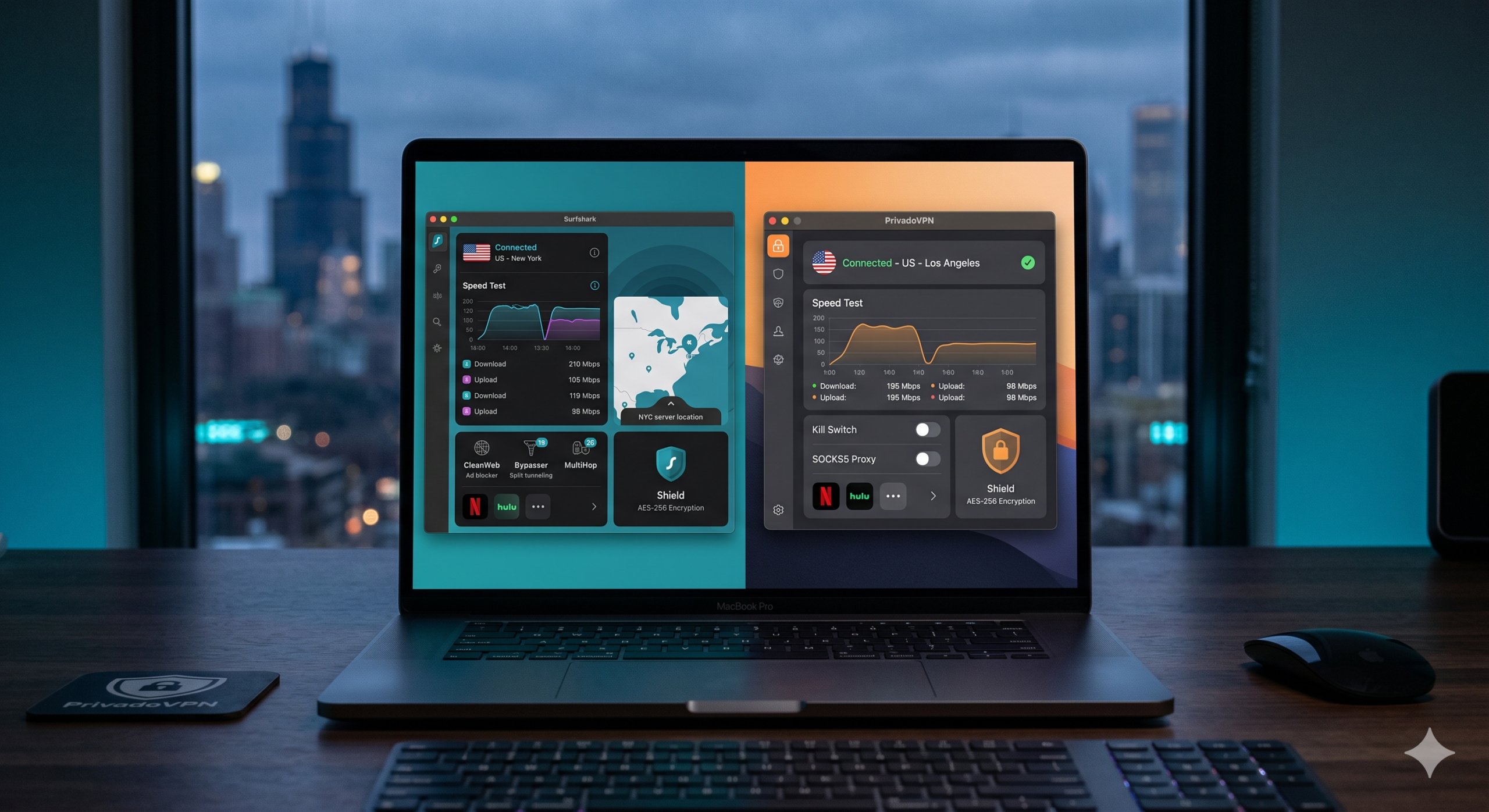
Speed is where the difference between these two VPNs becomes obvious. In most real-world testing, Surfshark holds onto more of your original connection speed, especially over long-distance servers.
Using WireGuard, Surfshark typically dropped download speeds by around 15% to 22% during US testing. PrivadoVPN performed reasonably well on nearby servers but became less consistent once traffic moved internationally. Long-distance latency spikes were more common, particularly during peak evening hours.
That difference matters more than raw benchmark numbers. A VPN can look fast in a controlled speed test and still feel slow during daily use if the network struggles with congestion or routing efficiency.
For users comparing larger premium providers, the NordVPN vs Surfshark comparison shows how Surfshark performs against one of the fastest WireGuard-based VPNs currently available.
Why does Surfshark usually feel faster?
Three things help Surfshark maintain speed more consistently:
- Larger server distribution
- Better WireGuard optimization
- Lower congestion during peak usage
Surfshark also benefits from its RAM-only infrastructure. These servers run entirely in volatile memory, which improves operational security and can reduce some storage-related overhead.
PrivadoVPN is not slow by budget VPN standards. In fact, on nearby US servers, it often performed well enough for 4K streaming and gaming. The problem appears when the network gets crowded or when you connect far outside your region.
If your priority is stable performance rather than occasional peak speed, Surfshark is the safer bet.
Which VPN Is Better for Streaming and Netflix?
Surfshark is significantly more reliable for streaming.
During testing, it consistently accessed:
- US Netflix
- Hulu
- Disney+
- BBC iPlayer
- Amazon Prime Video
PrivadoVPN worked with Netflix and some regional libraries, but success rates varied more depending on the server. Some locations loaded immediately. Others triggered proxy detection warnings.
That inconsistency becomes frustrating if streaming is one of the main reasons you use a VPN. You do not want to cycle through five servers just to start a movie.
The larger server network gives Surfshark an advantage here. More locations mean more replacement servers when streaming platforms block traffic patterns.
Readers comparing premium streaming-focused VPNs should also see the Surfshark or ExpressVPN for streaming breakdown, especially if streaming reliability matters more than price.
Streaming performance under real household use
This is one area competitors barely cover.
A VPN behaves differently when one person streams Netflix than when an entire household streams simultaneously across TVs, tablets, and phones. Surfshark’s unlimited device policy handles that load far better than most budget competitors.
PrivadoVPN works best in lighter-use environments. One or two users streaming at once usually caused no major issues. Beyond that, server congestion became easier to notice.
That does not make PrivadoVPN unusable. It just makes it less flexible under heavy daily demand.
Limitations & Performance Notes:
Streaming performance changes constantly because platforms actively block VPN IP ranges. A server that works today may fail next month. Speeds can also fluctuate sharply during peak evening traffic, especially on lower-cost VPN networks with fewer replacement servers available. Smart TV compatibility varies as well. Surfshark supports more native platforms and router configurations, while PrivadoVPN sometimes requires manual setup for unsupported devices.
How Strong Are Surfshark and PrivadoVPN on Privacy?
Both VPNs use modern encryption standards, including AES-256 and WireGuard support. That baseline is no longer optional in 2026. The separation happens in transparency and infrastructure.
Surfshark has invested more aggressively in external audits and public security validation. Its no-log claims have undergone independent verification, which carries more weight than privacy promises on a homepage.
PrivadoVPN maintains a privacy-focused reputation and operates from Switzerland, a country often viewed favorably for privacy laws. But compared to Surfshark, its public-facing transparency is thinner.
That does not automatically mean PrivadoVPN is unsafe. It means you have fewer independently verified trust signals.
For readers comparing other privacy-first providers, the NordVPN or PrivadoVPN analysis highlights how smaller VPN networks compare against more established infrastructure-heavy services.
Does jurisdiction still matter in 2026?
Yes, but less than many VPN marketing campaigns suggest.
Jurisdiction matters most when combined with logging practices, infrastructure control, and transparency. A privacy-friendly country does not help much if the provider keeps extensive connection records. Likewise, a provider in a more complicated jurisdiction can still protect users effectively if its systems genuinely minimize stored data.
That is why independent audits matter so much now. They provide a stronger trust signal than slogans about privacy laws alone.
Surfshark currently feels more mature from a security operations standpoint. PrivadoVPN feels more minimalist and lightweight. Depending on your needs, either approach may appeal to you.
Which VPN Has Better Apps and Device Support?
Surfshark has the stronger app ecosystem overall. Its applications feel more polished across Windows, macOS, Android, iOS, Linux, browser extensions, and smart TVs. The interface is simple enough for beginners but still exposes advanced settings when you need them.
PrivadoVPN keeps things cleaner and more minimal. That helps if you only want a basic connect-and-go experience. But the tradeoff is flexibility. Advanced users will notice fewer customization options, fewer specialty tools, and less control over how traffic behaves.
The biggest difference is still device policy.
Surfshark allows unlimited simultaneous connections. That changes how you use the service. Instead of choosing which devices deserve protection, you simply install the VPN everywhere. Phones, laptops, tablets, streaming sticks, gaming systems through a router — all of it stays covered under one subscription.
PrivadoVPN limits simultaneous connections, which makes it feel more like a traditional budget VPN plan.
That distinction matters more over time than most people expect.
How do the mobile apps compare?
Surfshark’s mobile apps are faster and more feature-rich.
Features like:
- Kill switch protection
- Split tunneling
- GPS spoofing on Android
- MultiHop routing
- CleanWeb ad blocking
all help Surfshark feel closer to a premium VPN product than a low-cost service.
PrivadoVPN’s mobile apps are straightforward and stable, but they focus mostly on core VPN functionality. That simplicity can be an advantage for beginners who dislike cluttered menus.
If you want the deeper feature breakdown, the detailed Surfshark review covers the app experience, security tools, and long-term reliability in more detail.
What Are the Biggest Limitations of Each VPN?
Neither provider is perfect. The differences come down to what compromises you are willing to accept.
Surfshark’s main weaknesses
Surfshark’s biggest downside is pricing after renewal. Introductory plans are aggressive, but renewal rates climb noticeably once the first billing period ends.
Some advanced privacy users also dislike how aggressively Surfshark pushes bundled tools like antivirus features and breach monitoring inside the interface. The VPN itself remains strong, but the software increasingly behaves like a broader security suite.
There are also occasional server inconsistencies. While Surfshark is generally fast, some locations fluctuate heavily during high-demand hours.
PrivadoVPN’s main weaknesses
PrivadoVPN’s limitations are more structural.
Its server network is smaller. That affects:
- International speed consistency
- Streaming reliability
- Server replacement options
- Peak-hour congestion
Transparency is another issue. While PrivadoVPN maintains a privacy-focused image, it has fewer independent audits and fewer public infrastructure disclosures than major competitors.
The free plan also creates unrealistic expectations. It works well for light use, but some users assume the paid version competes directly with larger premium VPNs across every category. In practice, it still behaves more like a lightweight budget provider.
Limitations & Performance Notes:
VPN performance changes depending on your internet provider, router quality, physical distance from the server, and local network congestion. Gaming latency can rise sharply when routing through overloaded international servers. Some mobile devices also suspend VPN connections aggressively in battery-saving mode, especially on Android. That can interrupt background protection if the app is not configured correctly.
Is PrivadoVPN’s Free Plan Actually Worth Using?
Yes — within limits.
PrivadoVPN remains one of the better free VPN options because it avoids many of the problems that make free VPNs risky. The company does not flood the app with aggressive advertising, and the service generally maintains acceptable speeds for casual browsing.
But “good for free” is not the same as “good overall.”
Free VPN plans nearly always involve tradeoffs somewhere:
- Smaller server selection
- Usage limits
- Reduced streaming access
- Higher congestion
- Lower priority traffic routing
PrivadoVPN is no exception.
That is why many users eventually graduate from free plans to paid services. Once streaming, torrenting, remote work, or multi-device protection enter the picture, limitations appear quickly.
Readers weighing premium alternatives may also want to compare the broader market through the NordVPN vs ExpressVPN breakdown. That comparison shows what top-tier infrastructure and privacy transparency look like at the high end of the VPN market.
Does Surfshark justify paying more?
For most intermediate users, yes.
The unlimited connections alone dramatically improve long-term value. Add the larger server network, stronger streaming consistency, broader app support, and more mature privacy infrastructure, and Surfshark becomes easier to recommend as a primary everyday VPN.
PrivadoVPN still deserves credit for accessibility. It lowers the barrier to entry for people who do not want to spend heavily on privacy software. But it feels more like a stepping stone product than a long-term power-user solution.
That difference becomes clearer the longer you use both services side by side.
Which VPN Should You Choose in 2026?
For most people, Surfshark is the better overall buy.
It delivers faster average speeds, more reliable streaming access, broader platform support, and significantly better long-term flexibility because of its unlimited device policy. The privacy infrastructure also feels more mature. Independent audits, RAM-only servers, and stronger transparency practices give Surfshark a measurable trust advantage over many lower-cost competitors.
PrivadoVPN still fills an important role in the market. It is easier to approach, cheaper at entry level, and one of the few free VPN providers that does not immediately trigger major red flags. If your needs are basic — casual browsing, occasional public Wi-Fi protection, or light streaming — it can absolutely do the job.
But the deeper you go into daily VPN use, the more Surfshark’s advantages become visible.
Who should choose Surfshark?
Surfshark is the stronger choice if you:
- Stream frequently across multiple platforms
- Want unlimited simultaneous device connections
- Need stable WireGuard performance
- Share one VPN subscription across a household
- Want extra privacy tools beyond the VPN tunnel itself
- Travel often and rely on international servers
- Care about independent audits and infrastructure transparency
It is especially effective for families and multi-device users. Most VPNs quietly become expensive once you start protecting every device in a home. Surfshark avoids that problem entirely.
The service also balances beginner accessibility with enough advanced features to satisfy more experienced users. You can ignore the advanced settings completely, or spend time fine-tuning protocols, split tunneling rules, and routing behavior.
That flexibility matters.
Who should choose PrivadoVPN?
PrivadoVPN makes more sense if you:
- Want the lowest possible upfront price
- Need a lightweight VPN for one or two devices
- Prefer a simpler app interface
- Mainly browse rather than stream heavily
- Want a usable free VPN option before upgrading
- Do not need advanced privacy tooling
Its simplicity is not necessarily a weakness. Some users genuinely prefer a smaller feature set because it reduces confusion. PrivadoVPN’s interface stays cleaner than many competitors that try to bundle every security product imaginable into one dashboard.
The problem is ceiling, not usability.
Once your expectations grow — faster global speeds, better streaming consistency, more advanced privacy controls, router deployment, or broader server coverage — Surfshark starts pulling away quickly.
Limitations & Performance Notes:
No VPN can completely eliminate speed loss. Encryption overhead, server distance, and ISP congestion always affect performance to some degree. Streaming support also changes constantly because services like Netflix and Hulu actively block VPN traffic. Device compatibility can vary by operating system version, router firmware, and app permissions. Even premium VPNs occasionally experience overloaded servers during major events or peak evening hours.
How important are audits and transparency now?
More important than ever.
The VPN industry has changed significantly over the last few years. Marketing promises alone no longer carry much weight. Users increasingly expect:
- Independent no-log audits
- Public infrastructure details
- Security incident transparency
- Verified ownership information
- Regular third-party testing
This is one area where Surfshark currently looks stronger. Its infrastructure and audit posture feel closer to larger premium competitors than to smaller budget VPNs.
PrivadoVPN still benefits from Switzerland’s privacy reputation, but modern VPN trust depends more on operational transparency than jurisdiction alone.
That distinction matters because many VPN services advertise “zero logs” while revealing very little about how their systems actually operate behind the scenes.
For additional privacy guidance, the Federal Trade Commission regularly publishes consumer security recommendations covering public Wi-Fi safety, password hygiene, and broader online privacy practices.
Final verdict
The surfshark vs privadovpn decision ultimately comes down to how heavily you rely on a VPN.
If you only need basic encrypted browsing and occasional protection on public networks, PrivadoVPN remains a respectable low-cost option. Its free plan is still one of the more usable entry points in the category.
But if you want a VPN you can depend on daily across streaming, travel, remote work, gaming, and multi-device use, Surfshark is the more complete service. The speed consistency, unlimited connections, stronger streaming access, and more mature privacy infrastructure justify the extra cost for most users.
Based on long-term usability and overall value, Surfshark is the stronger recommendation here. If you want the full feature breakdown, pricing analysis, and testing details, the full Surfshark review covers the service in greater depth.