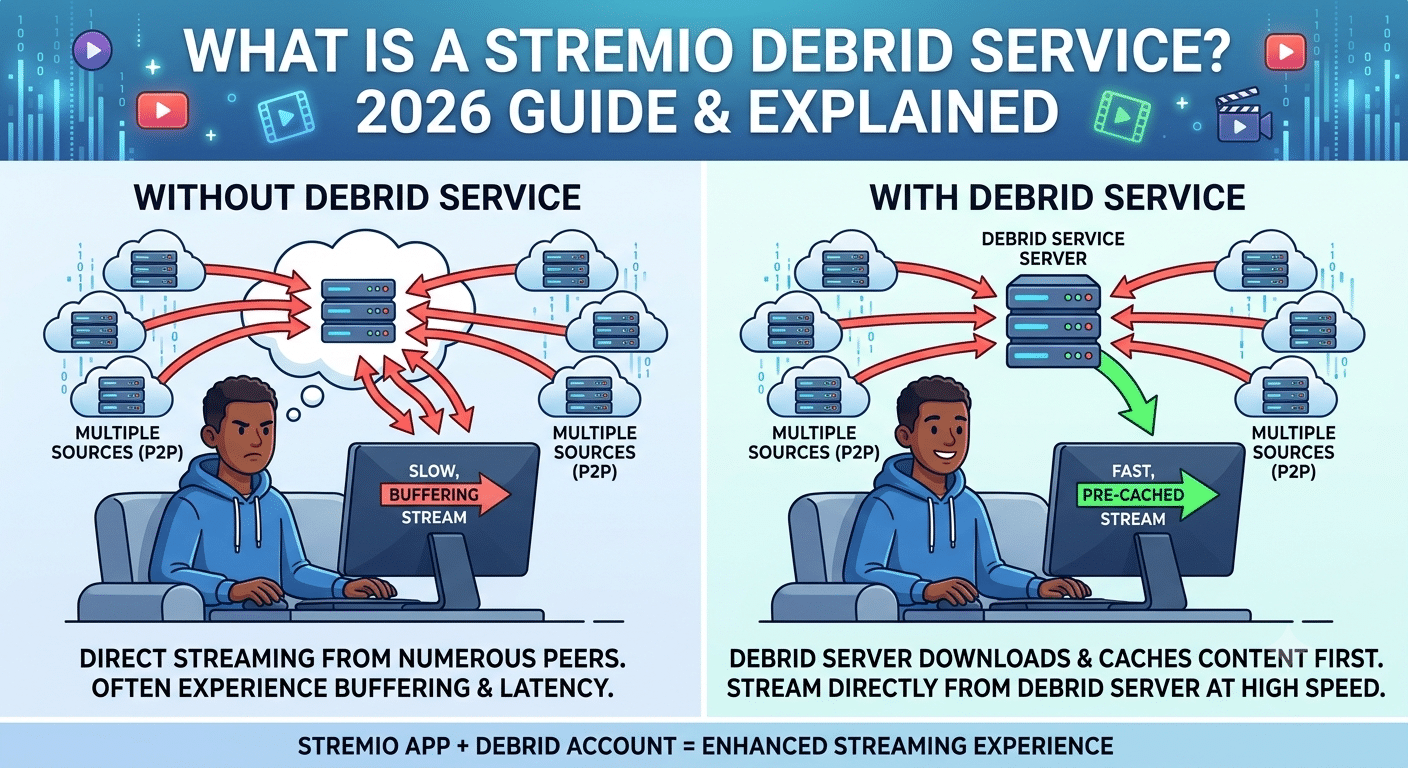

A Stremio debrid service is a cloud-based caching layer that sits between you and streaming sources, designed to replace unstable or slow links with pre-fetched, high-speed streams. Instead of pulling video data directly from multiple peers or hosters in real time, it routes requests through a third-party server that already has the content cached and ready to deliver.
The result is simpler at the surface: faster playback, fewer buffering interruptions, and more consistent stream quality. But under the hood, it’s a hybrid system combining link aggregation, cloud caching, and accelerated delivery.
To understand why this matters in Stremio, you need to know how the app normally behaves without it.
How Stremio Works Without a Debrid Layer
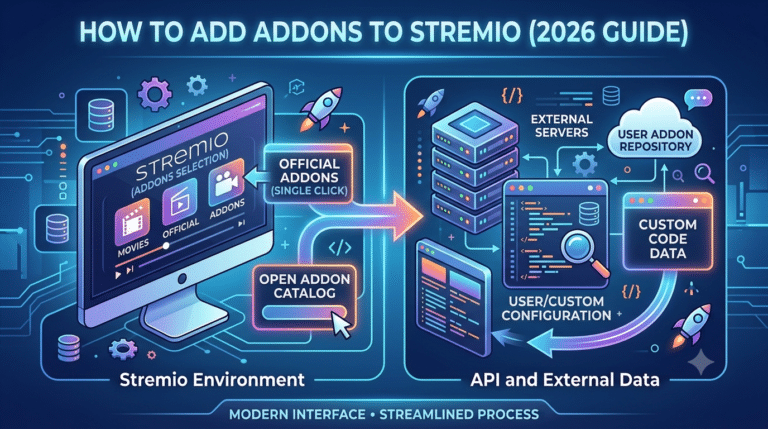
Stremio itself is just a media aggregator. It doesn’t host content. Instead, it relies on add-ons that fetch streaming sources from torrents, file hosters, or community indexers. These sources vary wildly in quality.
Some are fast and stable. Others:
- Disconnect mid-stream
- Depend on low-seed torrents
- Throttle bandwidth based on region or ISP conditions
This is where playback issues like buffering or resolution drops come from. The app is only as good as the sources it finds in real time.
If you want a broader technical baseline on how encrypted routing and traffic handling works in similar systems, it helps to understand VPN basics, since both technologies influence how data moves across networks, even though they serve different purposes.
What a Debrid Service Actually Adds
A debrid service changes the delivery model entirely. Instead of your device connecting directly to multiple unstable sources, the add-on sends a request to a debrid provider. That provider:
- Fetches the file from torrents or hosters in advance
- Stores it temporarily on high-speed servers
- Generates a direct, high-bandwidth streaming link
When you press play in Stremio, you’re no longer waiting for peers or scraping hosters. You’re pulling from a centralized cache.
This architecture removes two major bottlenecks:
- Peer availability (in torrents)
- Host reliability (in file lockers)
In practice, this is why users report smoother playback even on lower-end internet connections.
For context on performance improvements across streaming systems, similar optimization principles are discussed in setups involving real debrid streaming configuration, where caching is explicitly integrated into Stremio add-ons.
Why Caching Matters More Than Speed Alone
Most people assume debrid services just “increase speed,” but that’s not accurate. Your ISP speed remains unchanged.
What actually improves is:
- Source consistency (fewer broken links)
- Latency to first frame (faster playback start)
- Throughput stability (less fluctuation during playback)
Instead of negotiating with multiple peers or servers in real time, your stream behaves like a standard CDN delivery (similar to Netflix-style infrastructure).
This is especially noticeable on high-resolution content (1080p and 4K), where unstable sources tend to buffer frequently due to large segment sizes.
Why Stremio Relies on Add-Ons in This Model
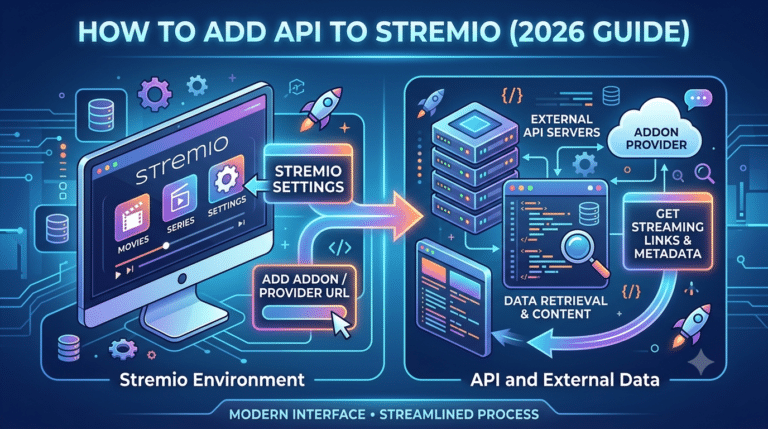
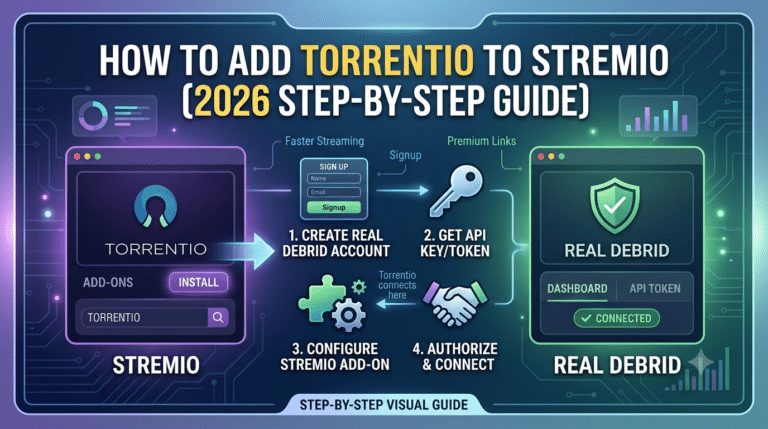
In a debrid-based setup, Stremio still depends on add-ons like Torrentio or similar indexers. These tools:
- Search for available torrents or host links
- Send metadata (not the video itself) to the debrid API
- Receive back a cached streaming URL
So the workflow becomes:
Stremio → Add-on → Debrid API → Cached file → Playback
This reduces randomness in streaming results. Instead of 20 inconsistent links, you often get a few high-confidence streams that actually work.
If buffering still occurs at the device level, it may be related to local playback settings or buffering thresholds, which are sometimes adjustable—similar to what is discussed in guides on adjusting buffering settings in Stremio.
Debrid vs Direct Streaming: The Core Difference
Without debrid:
- You depend on peer-to-peer availability or unstable hosters
- Speeds vary per source
- Streams may fail mid-playback
With debrid:
- You rely on pre-cached content
- Streams are served from optimized infrastructure
- Playback behaves more like traditional streaming platforms
This is why debrid services are often described as a “performance bridge” between torrent ecosystems and CDN-style streaming.
Where VPNs Fit Into This Picture (Briefly)
A debrid service does not anonymize your traffic. It does not encrypt your connection in the same way a VPN does. It focuses purely on performance and caching.
If you’re comparing tools, VPNs operate at the network privacy layer, while debrid services operate at the content delivery layer.
For example, if you want to understand how encrypted tunnels differ from caching systems, a leading VPN providers overview helps clarify how privacy tools are structured differently from streaming optimization tools.
The combination of Stremio and debrid services is driven less by novelty and more by performance consistency. When users move beyond basic streaming setups, they usually encounter the same core problem: source volatility. Streams appear and disappear, quality fluctuates, and playback stability depends heavily on external hosting conditions.
Debrid integration changes that dynamic by shifting responsibility away from public sources and toward controlled caching infrastructure. Instead of relying on unpredictable availability, the system prioritizes pre-validated and high-speed delivery paths.
The Real Reason Behind the Combination: Stability Over Variety
At first glance, Stremio already offers a wide range of add-ons and content sources. However, variety does not guarantee reliability.
When users combine it with caching services, the goal is not necessarily to access “more content,” but to reduce uncertainty in playback behavior.
This introduces a fundamental shift:
- Without debrid: focus is on finding working streams
- With debrid: focus is on delivering the best available version instantly
That difference is what drives adoption in advanced setups.
How Add-ons Select and Prioritize Sources
Add-ons in Stremio operate as lightweight discovery engines. They don’t stream content directly; instead, they scan metadata indexes and return a list of possible sources.
The prioritization process typically follows this order:
- Metadata match accuracy (title, season, episode alignment)
- Source availability (active vs dead links)
- Quality tags (720p, 1080p, 4K, HDR)
- Response time of source providers
- Compatibility with external caching layers
When a debrid service is connected, a new priority layer is introduced: cache eligibility. Sources that can be resolved through the caching provider are often ranked higher because they are more likely to result in immediate playback.
What Happens When a Stream Is Requested
To understand the integration properly, it helps to break down what happens in real time when a user clicks a title:
Step 1: Query Initiation
The user selects a movie or episode inside Stremio, triggering a metadata request.
Step 2: Add-on Aggregation
Multiple add-ons respond with potential stream links sourced from different indexes.
Step 3: Link Filtering
The system evaluates which links are valid, which are dead, and which are compatible with connected services.
Step 4: Cache Check (Debrid Layer)
For compatible links, the caching service checks whether the file already exists in its infrastructure.
- If cached → instant stream URL is returned
- If not cached → the file is fetched and processed
Step 5: Playback Delivery
Once a valid stream URL is resolved, playback begins through Stremio’s internal player.
This entire process usually happens within seconds when caching is available, which is why users perceive it as “instant streaming.”
Why Caching Changes Add-on Behavior
Once a debrid layer is introduced, add-ons behave differently in practice, even if their code remains unchanged.
The key difference is resolution confidence.
Without caching:
- Add-ons return many uncertain or unstable links
- Users may need to try multiple sources manually
With caching:
- Add-ons favor fewer but more reliable links
- Playback success rate increases significantly
This leads to a simplified user experience where fewer choices produce better outcomes.
Real-Time Matching and Source Validation
Behind the scenes, one of the most important processes is real-time source validation.
When an add-on returns a list of links, those links are not equal. They may originate from:
- Public file hosts
- Torrent-style metadata indexes
- Community-maintained catalogs
- Hybrid mirror systems
The caching layer evaluates these links based on:
- File hash recognition
- Metadata consistency
- Previously cached identifiers
- Access speed potential
Only links that meet compatibility rules are passed forward for streaming.
The Performance Gap: Why It Feels Faster
The noticeable speed improvement users report is not just perception. It comes from structural differences in delivery.
Traditional streaming flow:
Search → unstable host → slow response → buffering → retries
Cached streaming flow:
Search → cache verification → direct high-speed delivery → playback
The removal of unreliable hosting layers is what reduces buffering and startup delays.
Even when content is not pre-cached, the temporary processing delay is often offset by significantly smoother playback afterward.
The Hidden Optimization Layer
A less visible but important aspect is adaptive source ranking.
Over time, add-ons and caching services implicitly optimize based on usage patterns:
- Frequently successful sources are ranked higher
- Slow or failing sources are deprioritized
- Cached content is surfaced earlier in results
This creates a feedback loop where the system gradually becomes more efficient without requiring manual configuration changes.
Where This Model Fits in Modern Streaming Architecture
This hybrid model—aggregated metadata plus external caching—is part of a broader shift in streaming infrastructure design.
Instead of relying on centralized platforms, it distributes responsibilities:
- Add-ons handle discovery
- Caching services handle delivery
- Players handle playback
Each layer is independent, but optimized when combined.
What This Means Going Forward
Understanding this architecture is key to evaluating performance differences between setups. The next area of focus is how quality selection actually works inside add-ons—why certain 4K streams appear first, why duplicates exist, and how ranking logic decides what the user sees at the top of the list.
Once debrid caching enters the equation, the visible stream list inside Stremio starts to feel more structured—but what you see is still the result of multiple hidden ranking decisions happening in milliseconds.
Add-ons don’t just “list streams.” They filter, score, and reorganize them before they ever reach the user interface. When caching services are involved, that ranking becomes even more aggressive and performance-driven.
The Hidden Scoring System Behind Stream Lists
Every stream returned by an add-on carries implicit attributes. Even if not shown directly, they influence ranking order.
Common factors include:
- Resolution (720p, 1080p, 4K, HDR)
- File size (proxy for quality and bitrate)
- Source reliability history
- Cache availability status
- Filename metadata consistency
- Upload or indexing freshness
These signals are combined into a scoring model. Streams with higher scores appear at the top of the list, even if they are not the newest or most abundant.
When a caching provider is active, an additional boost is typically applied to any stream that can be resolved through cached infrastructure.
Why 4K Streams Appear First (Even When They’re Not Always Best)
Users often assume the top result is the “best” stream. In reality, it’s usually the best match based on ranking rules, not necessarily the best playback experience in every scenario.
4K or high-bitrate entries are often prioritized because:
- They signal higher content quality
- They tend to have more complete metadata
- They are more likely to exist in cache systems
- They align with premium source expectations
However, this can sometimes lead to edge cases where a lower-resolution cached stream would actually start faster, but appears lower in the list.
Duplicate Streams and Why They Exist
It’s common to see multiple entries that appear identical. This is not redundancy by mistake—it’s a result of how different indexes label the same underlying file.
Duplicates typically come from:
- Multiple add-ons indexing the same source
- Different metadata tags pointing to identical files
- Mirror sources with slight naming variations
- Cache-resolved vs non-cache-resolved versions of the same stream
Even if two entries look the same, their delivery paths can differ significantly in performance.
One may route through a slow external host, while another resolves instantly through a cached endpoint.
How Debrid Integration Changes Ranking Behavior
When a caching layer is active, stream ranking is no longer just about metadata—it becomes performance-driven.
The system starts favoring:
- Previously cached files
- Known high-success retrieval sources
- Faster response endpoints
- Verified hash-matched content
This leads to a subtle but important shift: availability becomes more important than theoretical quality.
A perfectly labeled 4K stream is less valuable if it requires long retrieval times, while a slightly lower-quality cached stream may be prioritized for instant playback.
Real-Time Decision Making at Playback Time
Ranking doesn’t stop when the stream list is displayed. A second decision layer happens when the user selects a stream.
At that moment, the system evaluates:
- Whether the stream is still valid
- Whether the cache status has changed
- Whether a faster mirror exists
- Whether fallback sources should be used
If the selected stream fails validation, fallback logic may automatically attempt alternative sources without requiring manual user input.
This is why playback sometimes “just works” even after selecting a seemingly unstable link.
Why Some Streams Start Instantly and Others Don’t
Startup speed is influenced by more than just file size.
Key factors include:
- Cache residency (already stored vs newly fetched)
- Server proximity and load distribution
- Stream packaging format (direct file vs segmented delivery)
- Verification overhead before playback begins
Pre-cached streams skip most of these steps entirely, which is why they start almost instantly compared to uncached ones.
On-demand cached streams may introduce a short delay, but still benefit from optimized delivery once ready.
Adaptive Learning in Stream Prioritization
Over time, systems begin to “learn” which sources perform best under real usage conditions.
This is not machine learning in a strict sense, but a pattern-based optimization process:
- Frequently successful streams are ranked higher
- Failed or slow sources are deprioritized
- Cached routes become more prominent in results
As a result, the stream list you see today is not static—it evolves based on collective usage patterns and cache performance history.
Why Your Stream List May Look Different Than Someone Else’s
Even with identical titles, two users may see different stream rankings due to:
- Regional availability differences
- Cache proximity and distribution
- Add-on configuration differences
- Timing of cache updates
- Recent playback history influencing prioritization
This variability is normal in distributed streaming architectures and is a direct consequence of decentralized source aggregation.
The Transition Point: From Selection to Delivery
Up to this stage, everything is about ranking and choosing a stream. The next phase is where the real infrastructure difference appears: how the selected stream is actually delivered to the device.
That involves routing, buffering strategies, and adaptive bitrate handling—especially when cached providers dynamically adjust stream delivery based on network conditions.
At this stage of the system, everything depends on delivery. Once a stream is selected and validated, the focus shifts from discovery and ranking to how the video is actually transmitted to the device in real time.
This is where the difference between standard streaming and cached delivery becomes most noticeable.
From Selection to Playback: The Final Handshake
After a stream is chosen inside Stremio, the system performs a final handshake before playback begins. This step determines whether the stream can be delivered directly or requires additional processing.
The process typically includes:
- Final URL validation
- Cache confirmation (if a debrid layer is used)
- Stream protocol negotiation
- Player initialization
If everything checks out, playback starts immediately. If not, fallback or re-routing is triggered automatically in the background.
Why Cached Streams Feel Immediate
The perception of “instant playback” comes from eliminating traditional bottlenecks.
In a standard setup, a stream must be:
- Located on a public host
- Downloaded in real time
- Buffered progressively
- Stabilized during playback
With caching systems involved, most of these steps are removed or compressed.
Instead, the flow becomes:
- Verified file already stored
- Direct high-speed delivery path
- Minimal buffering requirement
- Immediate playback initiation
The difference is not just speed—it’s predictability. The stream behaves consistently every time it is selected.
Buffering Strategy: How Data Is Preloaded
Even in optimized setups, buffering still exists, but it operates differently.
Modern playback systems use adaptive buffering strategies that:
- Preload only the next required segment
- Adjust buffer size based on connection stability
- Prioritize uninterrupted playback over full-file loading
- Reduce memory overhead on low-power devices
When a cached provider is involved, buffer fill rates are typically much higher due to faster upstream delivery speeds.
This reduces playback interruptions even on unstable networks.
Adaptive Bitrate and Dynamic Quality Control
Another important layer is adaptive bitrate streaming.
Instead of locking into a single quality level, the player continuously evaluates network performance and adjusts stream quality in real time.
This means:
- If bandwidth increases → higher resolution is loaded
- If bandwidth drops → stream is downgraded temporarily
- If instability is detected → buffer size increases automatically
When combined with cached delivery, adaptive bitrate becomes more stable because the source speed is already optimized, reducing the frequency of quality switches.
Why Some Streams Still Buffer Despite Caching
Even with caching services, buffering can still occur. This is usually not due to the file source itself, but external factors such as:
- Local internet fluctuations
- Device performance limitations
- CDN congestion or routing inefficiencies
- Overloaded playback endpoints
- Suboptimal player configuration
In other words, caching improves delivery reliability, but it does not fully control the end-to-end network path between server and device.
The Role of Fallback Routing
One of the most important behind-the-scenes mechanisms is fallback routing.
If a stream fails during playback initialization or mid-stream, the system may:
- Detect interruption or timeout
- Query alternative cached or indexed sources
- Re-initiate playback using a different endpoint
- Resume with minimal user interaction
This creates the impression of resilience—streams rarely “fully fail,” even if individual sources are unstable.
How the System Handles Load and Performance Spikes
During high traffic periods, performance differences become more visible.
Cached delivery systems manage load by:
- Distributing requests across multiple servers
- Prioritizing active cache nodes
- Redirecting traffic away from congested endpoints
- Preemptively serving popular content from optimized locations
This load balancing is a key reason why performance remains stable even when demand spikes.
The End-to-End Experience: Why It Feels Like a Single Platform
When everything is combined—metadata aggregation, ranking systems, caching layers, and adaptive playback—the user experience feels unified.
Even though multiple independent systems are involved, the interface hides that complexity.
From a user perspective, it looks like:
- Search
- Click
- Play
But behind that simplicity is a multi-layer pipeline involving:
- Distributed add-on indexing
- Real-time source validation
- Cache resolution logic
- Adaptive streaming delivery
- Fallback and recovery systems
Each layer contributes to reducing friction and improving consistency.
Final Takeaway: Why This Architecture Became the Standard for Advanced Setups
The combination of Stremio-style aggregation and external caching infrastructure succeeded for one key reason: it replaces unpredictability with structured delivery.
Instead of relying on unstable sources, the system prioritizes:
- Pre-verified content paths
- Faster initialization times
- Consistent playback quality
- Automated recovery when issues occur
The result is a streaming environment that behaves less like a search engine and more like a controlled media delivery system.
That shift—from discovery-based streaming to cache-optimized playback—is what defines modern setups and explains why this architecture continues to evolve.