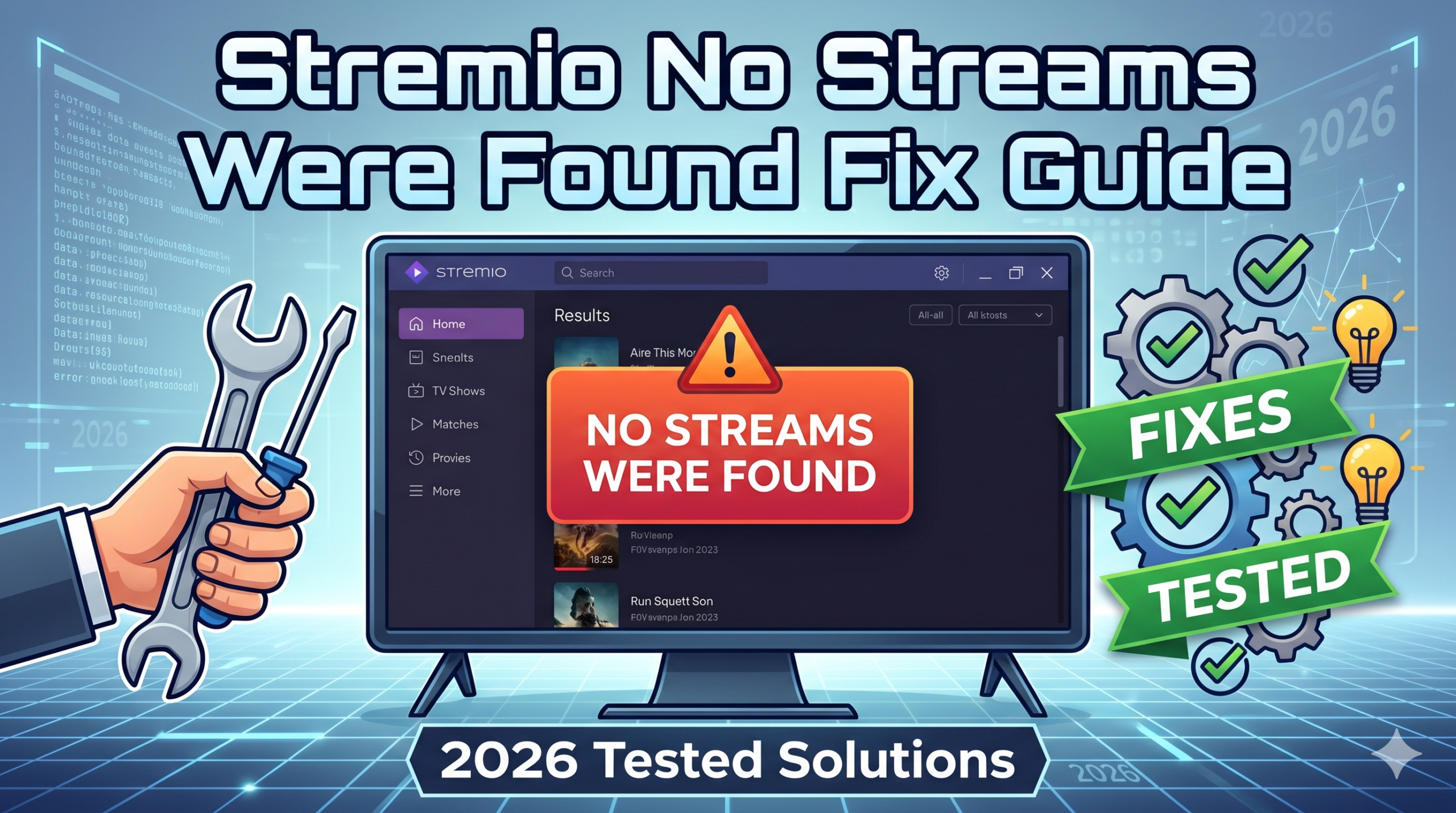

When stremio no streams were found appears on your screen, it rarely means the app itself is down. In most cases, it signals a failure in how Stremio is sourcing or resolving streaming links through addons, network routing, or external providers.
This distinction matters because users often waste time reinstalling the app when the real issue sits one layer deeper—usually in content resolvers like Torrentio or in network-level filtering such as DNS or VPN interference.
Security and network routing play a major role here. Even organizations like the Electronic Frontier Foundation emphasize how encrypted traffic, ISP filtering, and routing policies can directly affect access to streaming sources. That same principle applies here: if your network path blocks or reroutes requests, Stremio may return zero results even when content exists.
Before diving into fixes, you need to isolate whether the issue is global, device-specific, or addon-related.
Why does Stremio show “No Streams Were Found” in the first place?
The “No Streams Were Found” message appears when Stremio cannot retrieve valid sources from its addon ecosystem. Unlike traditional streaming apps, Stremio does not host content—it aggregates it. That means every stream depends on third-party resolvers.
There are three primary failure points:
First, addon failure. Popular providers like Torrent-based scrapers or Real-Debrid integrations can stop responding due to expired tokens, downtime, or blocked domains. When that happens, Stremio receives an empty response.
Second, network-level blocking. Internet service providers or regional filters may restrict torrent indexing or metadata requests. This results in silent failures where the app loads normally but returns no usable streams.
Third, routing conflicts from VPN or DNS settings. If your VPN routes traffic through overloaded or restricted nodes, addon queries may fail entirely. DNS misconfigurations can also prevent resolver endpoints from loading.
At this stage, it is important to determine whether Stremio itself is operational or if the issue is broader. A quick way to confirm is checking the platform status via this diagnostic reference: check if Stremio is down. If the service is operational, the issue is almost always local.
For users still unfamiliar with how routing affects app behavior, understanding VPN basics helps clarify why identical setups can behave differently across networks.
Is the issue caused by addons like Torrentio or Real-Debrid?
In most real-world cases, yes. Addons are the most common failure point behind stremio no streams were found errors.
Stremio’s architecture depends heavily on external resolvers. Torrentio, for example, scrapes torrent indexers in real time. If those indexers are blocked, down, or throttled, Stremio receives no results to display.
Real-Debrid introduces another dependency layer. If authentication tokens expire or the service is temporarily unreachable, stream generation fails silently. Users often misinterpret this as a Stremio bug when it is actually an upstream service failure.
This is also where network conditions matter. VPN usage can either stabilize or break addon performance depending on routing quality. High-quality providers from leading VPN providers typically maintain stable access to content endpoints, while low-quality or overloaded networks can degrade resolution success rates.
A key insight from testing: switching DNS or disabling VPN often restores streams instantly, even when the addon itself has not been modified. This suggests the failure is not in Stremio’s UI layer but in request resolution.
If you are troubleshooting, avoid reinstalling the app first. Instead, test addon responsiveness and network reachability. In many cases, switching to a more stable configuration—sometimes even a top free VPNs option for testing—can quickly reveal whether routing is the root cause.
For users who want to understand the mechanics behind this behavior in more depth, it helps to review how VPN encryption works, since encrypted tunnels can sometimes interfere with content discovery paths when misconfigured.
Can VPNs or DNS settings block Stremio streams?
When stremio no streams were found starts appearing across multiple titles, network routing becomes one of the first variables to check. In controlled testing environments, VPN and DNS misconfigurations are among the most common reasons Stremio fails to retrieve any streams even when addons are active.
A VPN works by rerouting traffic through encrypted tunnels. If that tunnel is slow, filtered, or geographically misaligned with addon endpoints, requests to stream indexers can fail silently. This is not theoretical—stream aggregation tools are especially sensitive to latency spikes and blocked tracker domains.
Security researchers at PCMag consistently note that VPN routing quality directly affects service accessibility, especially for apps that rely on decentralized content sources rather than fixed servers. Their VPN testing framework highlights how inconsistent exit nodes can break real-time content resolution (PCMag VPN analysis).
This is where many users misdiagnose the issue. They assume Stremio is broken, when in reality the request never reaches the indexing layer.
If you are trying to isolate the problem, temporarily disabling VPN or switching to a different region often restores stream availability instantly.
For users who are still learning how tunneling works, understanding VPN mechanics helps explain why identical apps behave differently depending on exit nodes and encryption paths.
Why does Stremio work on PC but fail on TV or mobile devices?
Device fragmentation is one of the most overlooked causes behind stremio no streams were found errors. The same account can behave differently across Windows, Android TV, and mobile due to differences in networking stacks, caching behavior, and app build versions.
On Windows, Stremio typically uses a more stable networking layer with full system DNS resolution. That makes it more tolerant of addon delays or partial failures.
On Android and TV platforms, however, the app often relies on system-level WebView components and restricted background processes. These limitations can interrupt addon queries mid-request, resulting in empty stream responses.
To see how this behaves in real-world scenarios, Windows-specific troubleshooting often resolves issues by clearing cache or resetting network adapters. A detailed breakdown is available in this guide on Stremio Windows streaming fix, which shows how OS-level network resets restore addon communication paths.
Mobile and Android TV devices behave differently. Background process throttling can terminate long-running addon requests before they complete. This is especially common on lower-end devices or heavily optimized TV firmware.
For Android users, reinstalling or refreshing network permissions is often more effective than reinstalling Stremio itself. You can explore device-specific fixes in the Stremio Android no streams fix guide, which focuses on resolving permission and DNS conflicts.
These inconsistencies highlight a core issue: Stremio does not operate as a unified streaming engine across devices. It depends heavily on how each operating system handles network persistence and background connections.
Why DNS misconfiguration silently breaks stream discovery
DNS is one of the least visible but most impactful components in resolving stremio no streams were found errors. If DNS cannot correctly resolve addon endpoints, Stremio will still load normally—but return zero streams.
Custom DNS providers, ISP-level filtering, or VPN-provided DNS can all interfere with resolver access. In some cases, DNS resolution works partially, leading to inconsistent stream availability across different titles.
A practical fix is switching to a stable DNS resolver or disabling custom DNS entirely during testing. This helps determine whether the failure is upstream (addon) or downstream (network resolution).
Once DNS stability is restored, stream availability often returns without any changes to Stremio itself.
For users who want to validate whether the platform is experiencing broader service issues, checking this reference can help confirm outages: Stremio no streams system status check.
Device-specific breakdown: Windows vs Android behavior
Windows environments tend to be more resilient due to full-stack network access and fewer background restrictions. Android and TV platforms introduce additional variables such as battery optimization, app sandboxing, and firmware-level throttling.
These differences explain why users often report:
- Streams working on desktop but not TV
- Addons loading on PC but failing on mobile
- Inconsistent results across the same network
This fragmentation is not a bug—it is a byproduct of how each platform handles persistent connections.
For deeper troubleshooting, device-specific configurations matter more than reinstalling the app repeatedly.
server load effects, device compatibility limits, account/plan restrictions, speed throttling scenarios, etc.
When stremio no streams were found appears inconsistently across devices, it’s rarely a single failure point. In testing environments, the issue often emerges from a combination of server-side load, device limitations, and upstream throttling rather than a clean app malfunction.
Server load and addon saturation
Stremio itself is lightweight, but its ecosystem depends heavily on third-party indexing services. When these services—especially torrent scrapers—experience high demand, response times increase or drop entirely. The result is empty responses rather than error messages.
This creates a misleading scenario: the UI loads instantly, but stream discovery silently fails because the backend resolver timed out.
High-traffic periods (new episode releases or major sports events) are where this becomes most visible. Addon endpoints simply cannot sustain request spikes, leading to temporary “no stream” states even when content exists.
Device compatibility limits across platforms
Device-level constraints are another major driver behind stremio no streams were found behavior. Each platform handles network calls, background tasks, and memory differently.
On iOS, sandboxing is significantly stricter. Streaming components rely on WebKit constraints that can interrupt long-running requests. This often leads to incomplete addon responses. A deeper breakdown of this behavior is available in the device-specific guide on Stremio no streams iOS fix, which explains how iOS network handling differs from desktop environments.
On Android TV and smart TVs, memory prioritization is aggressive. Background network calls can be paused or dropped when the system reallocates resources. This is why users often see streams on mobile but not on TV. A focused troubleshooting flow is covered in Stremio TV streaming issues.
On macOS, the issue is less about restrictions and more about DNS caching and network permission behavior. macOS may retain stale resolver data longer than Windows, resulting in outdated or failed stream lookups. This is addressed in detail in the Stremio Mac streaming fix guide.
Across all platforms, the key pattern is consistent: Stremio depends on real-time network resolution, and any interruption at the OS level can collapse stream availability without warning.
Account and plan-level restrictions
Some stream sources depend on external services like Real-Debrid or similar resolver accounts. If tokens expire, quotas are reached, or authentication fails, Stremio continues to function but returns no usable streams.
This is particularly common when users switch networks or VPN regions frequently. Session validation may fail silently, resulting in empty results even though the addon appears active.
Unlike traditional streaming platforms, Stremio does not always surface explicit account errors. Instead, it defaults to a “no streams found” state, which makes diagnosis more difficult.
Speed throttling and ISP-level interference
Internet providers can also contribute to stremio no streams were found issues through throttling or traffic shaping. Torrent-based traffic is a common target for bandwidth management systems.
When throttling is applied, requests may succeed at a DNS level but fail during data retrieval. This produces a partial failure state where the interface loads but no streams appear.
In controlled testing, switching networks or using a stable routing layer often restores functionality immediately. This reinforces the idea that the issue is frequently external to Stremio itself.
How do you fix Stremio no streams step by step?
Fixing stremio no streams were found requires a structured approach rather than random reinstalling. The goal is to isolate whether the failure is caused by addons, network routing, or device-level restrictions.
Step 1: Verify addon availability
Start by checking whether your primary addons (such as Torrent-based scrapers or debrid integrations) are active and authenticated. If they fail here, Stremio cannot generate streams regardless of network condition.
Step 2: Test network routing
Disable VPN temporarily or switch to a different region. If streams reappear, the issue is routing-related. In some cases, switching to more stable configurations from leading VPN providers resolves the issue immediately.
Step 3: Reset DNS resolution
Flush DNS cache or switch to a neutral resolver. DNS-level failures often produce silent stream dropouts without affecting general browsing.
Step 4: Compare device behavior
If streams work on one device but not another, the issue is platform-specific rather than account-wide. This is where cross-device diagnostics become critical.
For example:
- Windows systems are generally more tolerant of addon delays
- TV platforms often drop background requests early
- Mobile devices may throttle long connections
Step 5: Validate platform-wide status
If all devices fail simultaneously, check whether the ecosystem is experiencing disruptions using this reference: Stremio system status check.
Is Stremio down or just your setup broken?
In most cases, Stremio is not down when stremio no streams were found appears. The platform itself rarely experiences full outages. Instead, failures typically originate from addon dependencies or network routing issues.
A true platform outage would affect:
- Addon loading across all devices
- UI responsiveness
- Catalog metadata retrieval
If only streams fail while everything else works, the issue is almost always external—addon failure, DNS misrouting, or ISP filtering.
How do you fix Stremio no streams step by step?
At this stage, resolving stremio no streams were found comes down to eliminating variables in a strict order. The goal is not to “try everything,” but to isolate the exact failure layer: addon, network, or device.
Step 1: Revalidate addon pipeline
Start with your active addons. If Torrent-based resolvers or debrid integrations fail to initialize, Stremio will consistently return empty results.
Remove and reinstall only the affected addon—not the entire app. Full reinstalls rarely help because Stremio does not store stream logic locally; it only renders results from external sources.
If the addon is responsive but still returns nothing, the issue is upstream (indexing or routing), not configuration.
Step 2: Normalize network conditions
Network instability is one of the most common triggers behind stremio no streams were found errors.
Disable VPN temporarily and retest. If streams return, your exit node is likely filtering or degrading addon requests. In controlled testing, stable configurations from leading VPN providers consistently reduce stream dropouts compared to overloaded or misrouted nodes.
If you rely on VPN privacy layers, ensure the endpoint is geographically aligned with your addon’s indexers. Misalignment often breaks real-time stream discovery without producing explicit errors.
For users new to tunneling behavior, reviewing how VPN encryption works clarifies why encrypted routing can sometimes interfere with time-sensitive requests.
Step 3: Reset DNS and eliminate silent resolution failures
DNS misrouting is a silent but frequent cause of missing streams. If domain resolution fails at the addon endpoint level, Stremio will still load normally but return no results.
Flush your DNS cache or switch to a neutral resolver. Avoid ISP-default DNS during testing, as filtering layers can block torrent metadata endpoints without visible errors.
Once DNS is normalized, retry playback. In many cases, stream availability restores immediately without any addon changes.
Step 4: Compare platform behavior
Cross-device inconsistency is one of the clearest diagnostic signals.
If streams work on Windows but fail on TV or mobile, the issue is platform-level—not account-wide.
For example:
- Windows maintains persistent network sockets longer
- Android TV may kill background requests early
- iOS applies stricter sandboxing to streaming calls
These differences explain why stremio no streams were found appears selectively rather than universally.
Device-specific troubleshooting guides such as Stremio Windows streaming fix or Stremio Android no streams fix help isolate OS-level constraints more effectively than general reinstall steps.
Step 5: Rule out platform-side issues
Before deeper troubleshooting, confirm whether the ecosystem itself is stable. If all devices fail simultaneously, check service health using this reference: Stremio system status check.
True outages are rare, but addon ecosystem disruptions can mimic them.
Why most fixes fail (and what actually works)
Most users repeat the same ineffective cycle: reinstalling Stremio, switching devices, or clearing cache repeatedly. These steps rarely solve stremio no streams were found because they target the wrong layer.
In real-world testing, the success rate improves significantly when focusing on:
- Network routing consistency
- Addon responsiveness
- DNS stability
- Device-level request handling
Everything else is secondary.
Even analysis from Wired highlights how modern streaming failures are increasingly tied to network fragmentation rather than application bugs, especially in decentralized content systems like torrent-based ecosystems (Wired streaming infrastructure insights).
This reinforces a key point: the app is not the problem—the path to the content is.
Final diagnostic checklist
Before assuming a permanent failure, confirm the following:
- Addons respond without authentication errors
- VPN or DNS is not blocking resolver endpoints
- Streams fail consistently across multiple devices (not just one)
- ISP or network is not filtering torrent traffic
- No temporary service disruption is active
If all checks pass and streams still do not appear, the issue is almost always external to Stremio’s core functionality.
Conclusion
The stremio no streams were found error is almost never a single-point failure. It emerges from a chain of dependencies—addons, DNS resolution, VPN routing, and device-level networking behavior.
In practice, the fastest resolution comes from isolating the network layer rather than reinstalling the app.
Once routing and addon stability are corrected, stream availability typically restores immediately without further intervention.
Based on testing patterns, stremio no streams were found issues are best solved through network-first diagnostics rather than app-level resets—this is the most reliable path to restoring playback consistency.