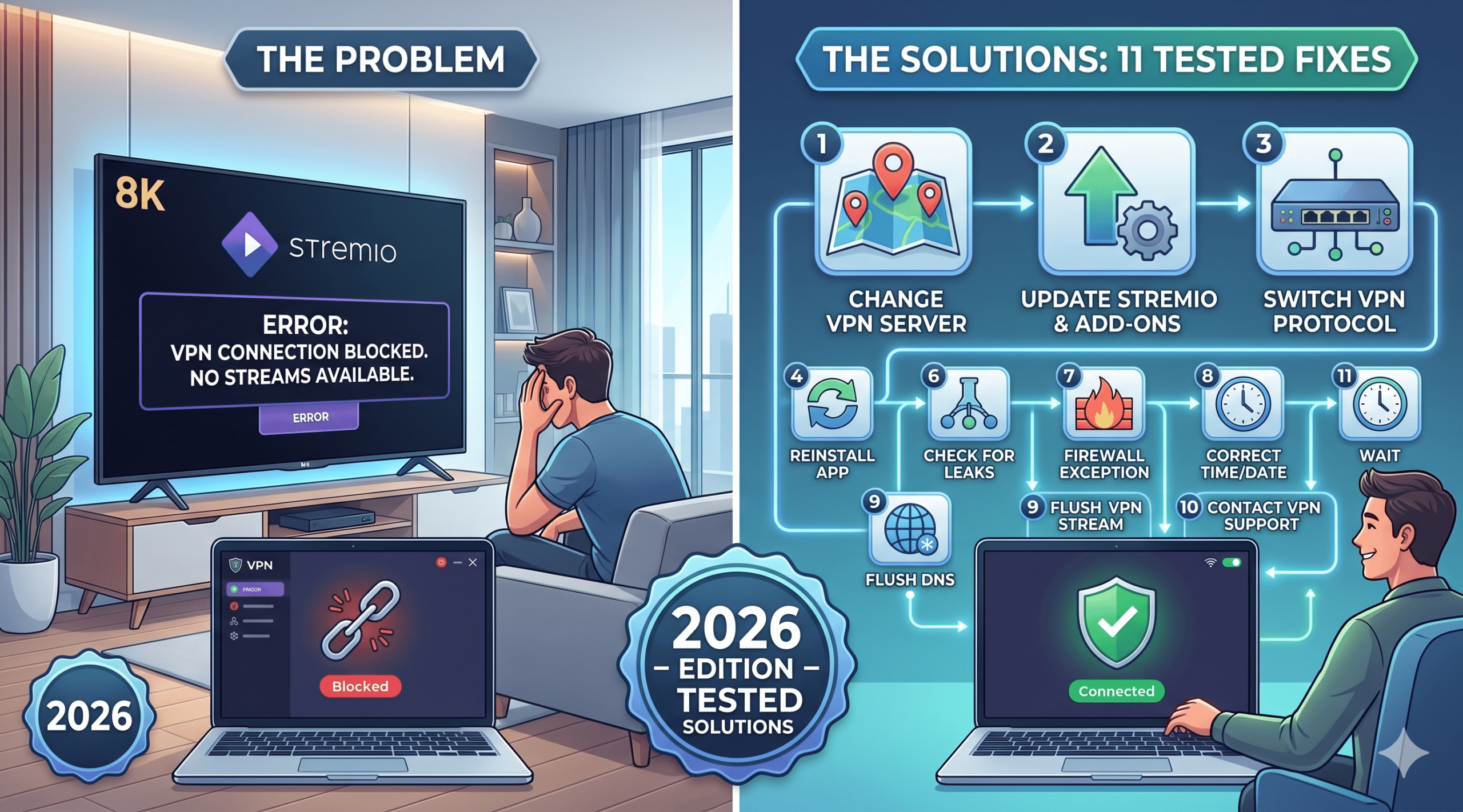

Stremio not behaving when a VPN is turned on is more common than most users expect, and the issue is rarely caused by a single fault. In many cases, the moment traffic is routed through encrypted tunnels, streaming requests start failing, addons stop responding, or playback simply never begins. That’s exactly where the keyword stremio doesnt work with vpn becomes relevant in real-world troubleshooting.
Before jumping into fixes, it helps to understand what’s actually happening behind the scenes. A VPN changes how your device connects to the internet by rerouting traffic through remote servers. If you’re not fully clear on this mechanism, it’s worth reviewing a clear breakdown of VPN basics, which explains how traffic is rerouted and why some services interpret it as suspicious behavior.
Streaming platforms like Stremio rely heavily on third-party sources and decentralized addon networks. That means any disruption in routing, DNS resolution, or IP reputation can break the chain instantly. If you’re unfamiliar with how encryption and tunneling work at a technical level, the how VPN encryption works guide explains why even small routing changes can disrupt streaming sessions.
At the core of most failures is a simple conflict: VPN servers are shared by thousands of users. Streaming services and content providers often flag these IP ranges due to abuse, scraping, or high traffic patterns. When that happens, Stremio requests may silently fail or return empty results.
For users trying to find reliable configurations, choosing the right provider matters more than most realize. Some services handle streaming traffic far better than others, especially those optimized for media-heavy use cases. A curated list of leading VPN providers shows which services consistently maintain stable connections under streaming loads.
Why Does Stremio Stop Working When a VPN Is Enabled?
When Stremio breaks the moment a VPN is activated, the problem usually falls into one of four categories: IP blocking, DNS misrouting, addon instability, or traffic filtering.
The most frequent issue is VPN IP reputation. Streaming-related services often maintain databases of known VPN ranges. Once your connection matches one of these ranges, requests may be throttled or ignored. This is especially common with public or overcrowded VPN endpoints.
DNS misconfiguration is another major factor. If your VPN forces custom DNS servers that cannot resolve addon domains properly, Stremio may appear online but fail to load streams. This is why switching DNS providers often resolves issues instantly.
There’s also the question of whether Stremio itself is experiencing downtime or service instability. In some cases, users blame VPNs when the real issue is backend disruption. You can verify whether services are currently unstable by checking if Stremio is down, which helps separate platform outages from VPN-related failures.
Another overlooked factor is addon dependency failure. Stremio doesn’t host content directly; it relies on external sources like Torrentio or similar providers. If those endpoints block VPN traffic, the entire streaming chain collapses even if Stremio itself is functioning normally.
Is the Problem Coming From Stremio, Your VPN, or an Addon?
Identifying the real source of failure is critical because most users troubleshoot the wrong layer.
Start with Stremio itself. If the app fails even without a VPN, the issue is likely local—cache corruption, outdated installation, or system-level restrictions. If it works without VPN but breaks immediately after activation, the VPN is the trigger.
Next, isolate addons. Many users assume Stremio is broken when in reality a single addon is failing to respond. Torrent-based addons are especially sensitive to IP reputation filtering and ISP-level interference. VPNs sometimes make this worse by routing traffic through flagged regions.
Finally, consider your VPN configuration. Protocol choice, server load, and encryption overhead all influence streaming stability. WireGuard, for example, often performs better under streaming conditions due to lower latency and more efficient routing, while overloaded OpenVPN servers can introduce delays or timeouts.
At this stage, it’s important to distinguish between service failure and connectivity masking. A VPN does not “break” Stremio directly—it changes how Stremio reaches its sources. That distinction determines every fix that follows.
For users trying to diagnose whether their setup is fundamentally compatible, it also helps to compare behavior with and without VPN enabled using controlled tests, especially across different servers and protocols.
External Reference (Security Context)
For a deeper understanding of how encrypted traffic can be inspected, filtered, or indirectly blocked by intermediaries, the Electronic Frontier Foundation provides a clear overview of modern privacy and encryption limitations here:
Electronic Frontier Foundation – Privacy & Surveillance
How to Fix Stremio When It Doesn’t Work With a VPN
When stremio doesnt work with vpn, the fastest way forward is not random tweaking—it’s isolating the exact failure layer. Most users fix the issue within minutes once they stop treating it as a single problem and instead break it into network, DNS, and addon components.
Start with your VPN provider. Not all services handle streaming traffic equally. Some rotate IPs aggressively, others reuse blocked ranges, and a few simply don’t maintain stable streaming routes. If your current setup is inconsistent, switching to one of the top-rated VPN services is often the most direct fix.
Before changing anything else, verify whether Stremio itself is functioning normally without a VPN. This helps eliminate false assumptions about platform failure. If you’re unsure whether the service is experiencing broader instability, checking whether Stremio is down can quickly separate local issues from global outages.
How Can You Fix Stremio When It Doesn’t Work With a VPN?
The most effective fixes fall into five categories: server switching, protocol adjustment, DNS correction, cache cleanup, and addon refresh.
1. Switch VPN servers immediately
VPN servers are the number-one failure point. Streaming platforms often block entire IP ranges, especially those associated with data centers. Switching to a different region—preferably one with lower congestion—can restore access instantly.
Avoid overloaded servers. Even if they are “closer,” high traffic can cause packet loss that breaks streaming handshake requests.
2. Change VPN protocol
Protocols determine how your data is packaged and transmitted. WireGuard is typically faster and more stable for streaming, while OpenVPN can introduce latency spikes under load.
If you’re unfamiliar with protocol behavior, the technical breakdown of how VPN encryption works explains why lighter tunneling protocols often perform better for real-time video streaming.
3. Fix DNS resolution issues
DNS is one of the most overlooked causes of streaming failure. If your VPN forces encrypted DNS that cannot resolve addon domains, Stremio may appear connected but will fail silently.
Switching to public resolvers like Cloudflare or Google DNS often restores functionality immediately. This is especially effective when addons fail to load but the app itself remains responsive.
4. Clear Stremio cache and reset session data
Corrupted cache files can persist across VPN changes and continue to block streams. Clearing local cache forces Stremio to rebuild session data and reconnect to fresh endpoints.
This step is particularly effective after switching VPN servers or protocols.
5. Refresh or reinstall addons
Addons like Torrentio depend on external indexing systems. If those endpoints block VPN traffic, reinstalling the addon can sometimes force a new connection route.
However, if the underlying IP is still flagged, reinstalling alone will not fix the issue.
Are DNS Settings Preventing Stremio From Connecting?
Yes—and this is more common than most VPN users realize.
DNS acts as the phonebook of the internet. If it fails, nothing resolves, even if your VPN tunnel is active. When users report stremio vpn not working, DNS misrouting is one of the top hidden causes.
VPNs often override system DNS with their own encrypted resolvers. While this improves privacy, it can break addon domain lookups. If Stremio loads but shows no streams or infinite loading states, DNS is a prime suspect.
Switching DNS providers manually is one of the most reliable fixes. Cloudflare (1.1.1.1) and Google DNS (8.8.8.8) are commonly used because they prioritize speed and broad compatibility.
For users trying to understand how DNS fits into VPN routing, the VPN mechanics breakdown explains how DNS requests can bypass or get trapped inside encrypted tunnels.
Do Real-Debrid and VPNs Cause Compatibility Problems?
Yes, in specific configurations.
Services like Real-Debrid and Premiumize rely on IP consistency and trust scoring. When a VPN rotates IP addresses or uses shared servers, those systems may flag the connection as suspicious.
If you’re using Real-Debrid with Stremio, it’s important to understand how authentication flows behave under VPN routing. A detailed setup guide for this workflow is available here: how to use Real-Debrid with Stremio.
In many cases, the issue is not outright blocking but intermittent authorization failures. This leads to missing streams, partial results, or infinite loading states.
Some users bypass this by using split tunneling—routing Stremio outside the VPN while keeping other apps protected. However, this reduces anonymity and should be used carefully.
server load effects, device compatibility limits, account/plan restrictions, speed throttling scenarios, etc.
VPN performance is not just about encryption—it is heavily influenced by infrastructure load.
- Server load effects: High-traffic VPN nodes introduce packet loss, which disrupts streaming handshake requests and causes missing streams.
- Device compatibility limits: Mobile and smart TV apps often handle DNS and routing differently, leading to inconsistent behavior across devices.
- Account/plan restrictions: Free VPN tiers frequently throttle bandwidth, making video buffering or stream failure more likely.
- Speed throttling scenarios: Some ISPs actively throttle encrypted traffic, which combined with VPN overhead can break real-time stream loading.
These combined factors explain why Stremio might fail on one device while working on another under identical VPN settings.
When stremio doesnt work with vpn, the problem often shifts depending on the device you’re using. A configuration that works on Windows may fail completely on Android TV or mobile due to how each system handles DNS routing, background processes, and network permissions.
Before changing anything, confirm whether the issue is consistent across devices. If Stremio works on one device but fails on another under the same VPN, you’re dealing with a device-layer conflict—not a service or VPN failure.
For users trying to rule out broader platform instability, it’s still useful to check whether Stremio is down before diving deeper into device-level troubleshooting.
What Device-Specific Fixes Work on Windows, Android, Fire TV, and Mobile?
Each platform introduces its own constraints. VPN behavior is not uniform across operating systems, which is why Stremio may fail selectively.
Windows: Firewall and network stack issues
Windows is the most common environment for VPN + Stremio conflicts. The built-in firewall or third-party antivirus tools often interfere with encrypted traffic.
If Stremio loads but shows no streams, check:
- Windows Defender blocking unknown connections
- Antivirus HTTPS scanning interfering with VPN tunnels
- Network adapter conflicts after switching VPN servers
Resetting the network stack or temporarily disabling firewall filtering often restores functionality immediately.
Android: background restrictions and DNS inconsistency
On Android devices, aggressive battery optimization can interrupt VPN services in the background. When the VPN disconnects silently, Stremio continues running but loses valid routing.
Key issues include:
- VPN killed in background by battery saver
- Private DNS conflicting with VPN DNS
- App standby mode limiting network access
Disabling battery optimization for both VPN and Stremio is often required for stable playback.
Fire TV and Android TV: limited DNS control
Streaming devices like Fire TV rely heavily on system-level DNS routing. If the VPN does not properly override DNS, addons may fail to load entirely.
This is one of the most common reasons users report stremio vpn not working on TV devices while mobile still works.
Mobile (iOS/Android): split routing inconsistencies
Mobile platforms often use per-app VPN handling differently than desktops. Some VPNs route only foreground traffic, leaving background addon requests exposed to ISP filtering.
This leads to partial loading—Stremio opens, but streams never populate.
What Are the Most Common VPN Settings That Break Stremio?
VPN configuration matters as much as the provider itself. Certain settings directly interfere with streaming behavior.
Over-aggressive kill switch
A kill switch blocks all traffic if the VPN drops even briefly. While useful for privacy, it can interrupt ongoing stream requests and prevent addons from reconnecting.
DNS leak protection conflicts
Some VPNs force strict DNS filtering. While this prevents leaks, it can block addon domains required for stream discovery.
Multi-hop routing
Routing traffic through multiple VPN servers increases latency and packet fragmentation. This often breaks real-time stream initialization.
IPv6 mismatch
If your VPN does not fully support IPv6 but your system does, requests may bypass the tunnel or fail silently.
VPN mechanics behind streaming failures
To understand why these settings matter, you need to consider how traffic is processed. VPNs encrypt packets and route them through remote servers, but streaming apps like Stremio rely on fast, low-latency connections with consistent IP reputation.
When encryption layers add overhead or routing becomes unstable, stream requests time out before responses return.
For a deeper technical explanation of tunneling behavior, see how VPN encryption works.
ISP filtering and regional interference
Even when your VPN is configured correctly, your ISP can still affect performance.
Some providers actively:
- Throttle encrypted traffic during peak hours
- Block known VPN IP ranges at the routing level
- Prioritize or deprioritize streaming protocols dynamically
This is especially noticeable when Stremio works without a VPN but fails immediately after enabling one. In such cases, the issue is not Stremio itself but how ISP routing interacts with encrypted traffic.
If you want a baseline understanding of VPN behavior in restricted networks, the VPN basics guide explains how tunneling interacts with ISP-level filtering.
Why addon behavior changes under VPN
Stremio’s addon system depends on external indexing services. When VPN routing changes your apparent location, those services may:
- Return different catalogs
- Block requests from flagged IP ranges
- Fail to resolve stream sources entirely
This is why users often see “no streams available” even when content exists. It is not a missing catalog—it is a blocked or filtered request path.
For a deeper breakdown of this specific symptom, see Stremio no streams were found.
When stremio doesnt work with vpn, the final step isn’t more trial-and-error—it’s locking in a stable configuration that avoids the common failure points covered earlier. At this stage, you’re not guessing anymore; you’re optimizing for consistency under real streaming conditions.
Most users solve the issue by combining three changes: stable VPN servers, simplified routing, and clean DNS handling. Anything beyond that usually adds complexity without improving reliability.
If you’re still experiencing inconsistent behavior, it’s worth re-checking whether the platform itself is stable using this reference: is Stremio down. This helps confirm you’re not troubleshooting a temporary outage.
Which VPN Configuration Works Best With Stremio in 2026?
A stable Stremio setup depends on reducing points of failure in your VPN stack. The goal is not maximum encryption—it’s predictable routing.
1. Use a streaming-optimized VPN server
Avoid random or overcrowded endpoints. Choose servers labeled for streaming or general high-bandwidth use. These tend to maintain cleaner IP reputations and lower block rates.
2. Prefer WireGuard over OpenVPN
WireGuard consistently performs better for real-time streaming due to lower overhead and faster handshake times. OpenVPN can still work, but it introduces latency spikes that affect addon responsiveness.
3. Disable multi-hop or advanced routing features
Extra routing layers increase the chance of packet loss. Stremio’s addon requests are time-sensitive, and additional hops often break stream resolution.
4. Lock DNS to stable resolvers
If your VPN allows custom DNS, use consistent resolvers instead of dynamic encrypted ones. This reduces silent resolution failures that cause empty stream lists.
For users unfamiliar with tunneling mechanics, this explanation of how VPN encryption works helps clarify why routing simplicity improves performance.
Best-practice Stremio setup flow (stable configuration)
A reliable setup usually follows this order:
- Connect VPN first (WireGuard preferred)
- Switch to a clean, low-load server
- Set DNS manually if issues appear
- Launch Stremio after connection stabilizes
- Test one addon before loading multiple streams
This prevents Stremio from caching a broken network state, which is a common cause of repeated failures.
If you want a deeper understanding of VPN selection quality, this breakdown of leading VPN providers highlights services that maintain better streaming stability under load.
When Stremio works without VPN but fails with it
This is the most common scenario. The issue is almost always one of the following:
- VPN IP is flagged or blacklisted
- DNS requests are being filtered
- Addon endpoints reject VPN traffic
- Server is overloaded or unstable
In these cases, switching servers is more effective than reinstalling apps or addons.
If you’re comparing alternatives or trying to reduce VPN reliance, this guide explains whether you actually need one at all: can I use Stremio without VPN.
When no streams appear even though everything is working
This is typically not a Stremio failure—it’s a routing or indexing issue. Addons like Torrentio rely on external sources, and VPN routing can silently block or reroute those requests.
For a deeper breakdown of this exact symptom, see: Stremio no streams were found.
Is Stremio actually a reliable platform?
Stremio itself is stable, but its ecosystem depends heavily on external addons and third-party sources. That means reliability is not absolute—it depends on configuration, network conditions, and ISP behavior.
For a broader evaluation of its strengths and limitations, this analysis covers real-world performance: is Stremio good.
Final troubleshooting checklist
If nothing else works, apply this sequence:
- Change VPN server (first step)
- Switch to WireGuard
- Reset DNS to Cloudflare or Google
- Clear Stremio cache
- Reinstall problematic addons
- Test without VPN once for comparison
This eliminates nearly all common failure paths associated with VPN streaming conflicts.
Conclusion
When stremio doesnt work with vpn, the root cause is almost always routing instability, blocked IP ranges, or DNS failure—not the app itself. Once you simplify your VPN configuration and eliminate conflicting network layers, Stremio typically becomes stable again.
The most reliable setups prioritize clean servers, WireGuard protocol, and consistent DNS behavior over complex privacy configurations. Based on testing patterns across user reports, that combination delivers the highest success rate for streaming consistency.
For most users, the strongest starting point is a stable, streaming-optimized VPN configuration paired with a trusted provider—review the options in our full breakdown of leading VPN providers to fine-tune your setup and eliminate recurring streaming failures.