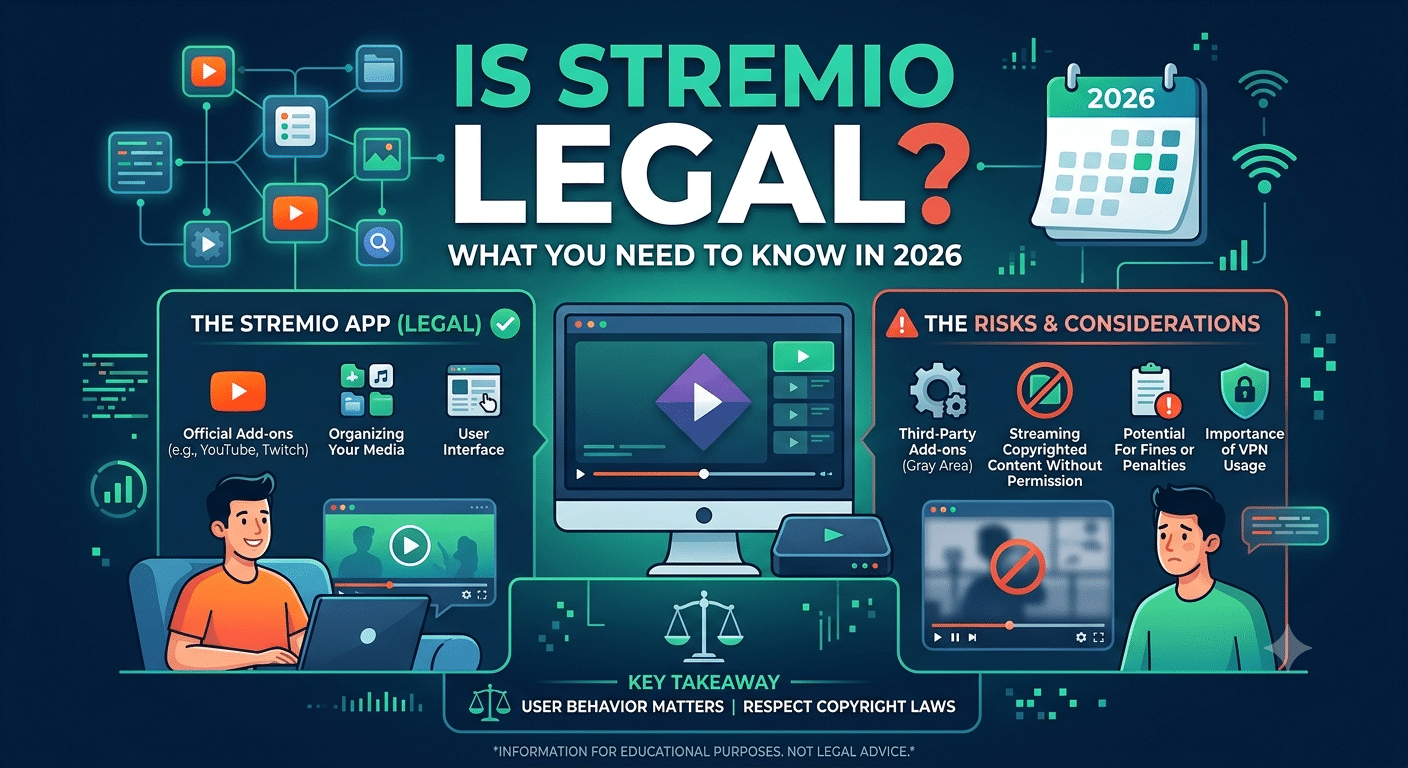

Is Stremio legal? The short answer is yes—the application itself is legal. The more important question is how you use it. Just as a web browser can access both legitimate and infringing websites, Stremio is a media platform that can connect to many different content sources. Whether your activity is legal depends on the source providing the stream, not the app alone.
This distinction creates confusion because Stremio supports both official add-ons from legitimate streaming services and community-developed add-ons that may index publicly available internet sources. Understanding that difference is essential before you install or use the software.
If you’re unfamiliar with the platform itself, our guide explaining what Stremio is provides a detailed overview of how the application works, supported devices, and its core features.
According to the Electronic Frontier Foundation (EFF), software tools themselves are generally distinct from the legality of the content users access through them. Copyright liability typically depends on whether copyrighted material is distributed or streamed without authorization, not merely on the existence of software capable of accessing it.
Why Isn’t the Answer Simply Yes or No?
Many websites reduce the discussion to a single sentence, but copyright law isn’t that simple.
Stremio does not operate like a traditional streaming service such as Netflix or Disney+. It doesn’t maintain its own catalog of movies or television shows. Instead, it aggregates content made available through add-ons.
That means three completely different scenarios can exist:
- You watch licensed content from an official provider.
- You watch free public-domain media.
- You stream copyrighted content from an unauthorized source.
Only the third scenario raises significant legal concerns.
This is why discussions about Stremio often sound contradictory. One article says it’s legal, while another warns about copyright infringement. Both statements can be correct because they’re describing different ways people use the platform.
How Does Stremio Actually Work?
Rather than hosting videos, Stremio acts as an organizer.
After installing the application, you add extensions—known as add-ons—that locate available streams. Some official add-ons connect directly to legitimate services you’ve already subscribed to. Others may index freely available internet sources or community-maintained catalogs.
If you’re new to the software, our walkthrough on how to use Stremio explains the installation process, account setup, and navigation without assuming prior experience.
Because Stremio doesn’t normally store copyrighted media on its own servers, legal responsibility usually depends on the origin of the stream you choose.
Why Do People Question Stremio’s Legality?
The biggest reason is its support for third-party add-ons.
Unlike official extensions provided by recognized streaming services, community-created add-ons vary widely in purpose and quality. Some simply organize legally available content. Others may index sources that distribute copyrighted material without authorization.
This flexibility has made Stremio popular among advanced users, but it has also led to widespread misunderstandings.
Another reason is the platform’s support for torrent-based streaming through certain community add-ons. Torrent technology itself is legal and widely used for legitimate software distribution, open-source projects, and public-domain media. However, using torrents to access copyrighted works without permission may violate copyright law depending on your jurisdiction.
Our guide covering playing torrents in Stremio explains the underlying technology and why torrent support is often misunderstood.
Does Stremio Host Copyrighted Movies?
No.
This is one of the most common misconceptions.
Stremio isn’t a movie-hosting service. Instead, it indexes metadata and available streams supplied through installed add-ons.
Think of it as a catalog rather than a video warehouse.
That distinction matters because copyright enforcement generally focuses on the source distributing protected content rather than software that merely indexes or accesses it. Courts evaluate many factors, including who hosts the files, who distributes them, and whether users have authorization to access the material.
Is the Application Safe to Install?
Legality and safety are separate issues.
An application can be completely legal while still exposing users to malicious extensions, privacy risks, or unreliable streaming sources.
Before installing community add-ons, it’s worth understanding whether Stremio is safe, including potential security risks, permissions, and best practices for protecting your device.
Should Privacy Still Matter?
Even when you’re accessing legitimate content, your internet provider can typically see the domains you connect to unless your traffic is encrypted.
Learning what is a VPN helps explain how encrypted connections improve online privacy. If you’re interested in the technical details, our guide on how does a VPN work explains tunneling, encryption, and secure internet routing in more depth.
Using a VPN does not make illegal activity legal. Instead, it helps protect your privacy by encrypting your internet traffic while you’re online.
Part 2 of 4: Official vs. Third-Party Add-Ons and US Copyright Law
Are Official and Third-Party Stremio Add-Ons Equally Legal?
No. The biggest legal difference isn’t the add-on itself—it’s the source of the content it provides.
Official Stremio add-ons connect to legitimate streaming platforms and public services that have the right to distribute their content. If you already subscribe to a supported streaming service, using its official integration through Stremio is generally no different from using that provider’s own application.
Community-developed add-ons are different. Anyone can create one, and they vary widely in quality, purpose, and legality. Some aggregate freely licensed media, public-domain films, or open educational content. Others may index sources that provide copyrighted movies or television shows without permission.
For that reason, you shouldn’t assume every add-on is legal—or illegal. Each one should be evaluated based on where it obtains its streams.
Does Stremio Check Whether Streams Are Legal?
No.
Stremio functions as a platform rather than a content moderator for every community-created extension. While the project maintains official components, community add-ons are developed independently.
That means you are ultimately responsible for choosing which add-ons you install and which streams you access.
If you’re expanding Stremio’s capabilities through integrations, it’s important to understand adding APIs to Stremio and verify that any services you connect are reputable and intended for legitimate use.
Does Streaming Copyrighted Content Break US Law?
Potentially, yes.
In the United States, copyright owners have exclusive rights to reproduce, distribute, and publicly perform their works. Accessing copyrighted content from an unauthorized source can expose users to legal risk, even if the software used to reach that content is perfectly lawful.
The exact legal outcome depends on the facts of each case, including:
- Whether the stream is licensed.
- Whether copyrighted material is distributed without authorization.
- How the content reaches your device.
- Applicable US copyright law and court interpretations.
Because copyright enforcement evolves over time, you should rely on legitimate content providers whenever possible instead of assuming that a stream is legal simply because it’s available.
Does Torrent Streaming Change the Situation?
Sometimes.
Many Stremio users associate the platform with torrent streaming because certain community add-ons use peer-to-peer technology.
Torrenting itself is not illegal. Numerous organizations distribute software, Linux distributions, research datasets, and public-domain media through BitTorrent because it is efficient and inexpensive.
The legal issue arises when copyrighted material is shared without permission.
Unlike many conventional streaming services, peer-to-peer technology may also upload pieces of a file while you download it. Depending on the circumstances, that additional distribution activity can become legally significant.
For this reason, understanding how an add-on retrieves its content matters just as much as the content itself.
Can You Get in Trouble for Using Stremio?
Simply installing or opening Stremio is not a crime.
The greater risk comes from accessing unauthorized copyrighted material.
Copyright enforcement varies considerably depending on the country, internet service provider, and the copyright owner’s enforcement strategy. Some rightsholders focus on major distributors, while others actively pursue unauthorized sharing networks.
For most users, the safest approach is straightforward:
- Use official streaming services whenever available.
- Install only trusted add-ons.
- Avoid clearly unauthorized sources.
- Verify whether content is licensed before watching it.
Following those practices dramatically reduces legal uncertainty.
Should You Use a VPN with Stremio?
Many privacy-conscious users choose to encrypt their internet traffic regardless of which streaming platform they use.
A VPN cannot grant permission to access copyrighted content, nor does it change copyright law. However, it can reduce the amount of browsing information visible to your internet service provider by encrypting your connection.
If you’re comparing providers, our review of the best VPN explains the features that matter most for streaming, including independent security audits, transparent privacy policies, and consistent performance.
If you’re looking for a no-cost option, our guide to the best free VPN also explains the trade-offs you’ll often encounter, such as bandwidth limits, fewer server locations, and slower speeds.
When evaluating any VPN, remember that privacy features should complement—not replace—legal streaming habits.
What About Mobile Devices?
Stremio supports multiple operating systems, but the installation experience differs from one platform to another.
Apple’s ecosystem, in particular, has additional restrictions compared with Windows or Android. If you’re planning to stream on iOS hardware, our guide to using Stremio on iPhone with a PC explains one of the supported approaches and the limitations you should expect before getting started.
Understanding these compatibility differences can help you choose the right setup without relying on unofficial workarounds.
How Can You Use Stremio Legally?
The simplest way to use Stremio legally is to treat it as a media hub rather than a source of free entertainment. The application itself doesn’t include a library of copyrighted movies or TV shows. Instead, it organizes content from the add-ons you choose to install.
Your legal risk depends almost entirely on where those add-ons obtain their streams.
If an add-on links to licensed streaming platforms, public-domain media, or content distributed with permission, you’re generally on solid legal ground. If it indexes unauthorized copies of copyrighted works, using those streams may violate copyright law in your jurisdiction.
Before installing any add-on, ask yourself a few practical questions:
- Does it clearly identify where its content comes from?
- Does it rely on licensed streaming providers?
- Does it have documentation or a reputable developer?
- Would you reasonably expect the content owner to authorize that distribution?
If the answer to those questions is unclear, it’s safer to avoid the add-on altogether.
Does the Law Differ Between Countries?
Yes. Copyright law is not identical around the world.
Although most countries recognize international copyright agreements, enforcement and legal interpretations vary significantly.
For example:
- The United States generally has strong copyright enforcement under the Copyright Act and the Digital Millennium Copyright Act (DMCA).
- European countries apply their own copyright directives alongside national laws.
- Other regions may place greater emphasis on blocking unauthorized services rather than pursuing individual users.
That means an activity considered low-risk in one country may receive greater legal scrutiny elsewhere.
Whenever you travel or use Stremio outside your home country, it’s worth reviewing local copyright regulations instead of assuming the same rules apply everywhere.
Can a VPN Make Stremio Legal?
No.
This is one of the biggest misconceptions surrounding streaming privacy.
A VPN encrypts your internet traffic and helps protect your online privacy, but it does not grant permission to access copyrighted material without authorization.
Think of it this way:
- A seatbelt improves your safety while driving.
- It does not make speeding legal.
A VPN serves a similar role. It protects your connection against interception on public Wi-Fi, reduces exposure to network monitoring, and helps prevent your ISP from viewing the contents of encrypted traffic. None of those benefits change copyright law.
Privacy tools and legal compliance should always be viewed as complementary—not interchangeable.
Why Do Privacy-Conscious Users Still Choose a VPN?
Even when streaming only licensed content, many users prefer encrypted connections for several legitimate reasons.
These include:
- Protecting personal information on public networks.
- Reducing exposure to network profiling.
- Preventing local Wi-Fi operators from inspecting browsing activity.
- Securing connections while traveling.
These privacy benefits apply to many online activities beyond streaming, including banking, shopping, and remote work.
The important distinction is that privacy technology protects your data—not your legal responsibility.
Common Misconceptions About Stremio
Many online discussions blur the line between the software and the content accessed through it.
Here are several common myths worth correcting.
Myth: Stremio Is Illegal Everywhere
False.
The application itself is legal software. Its legality doesn’t automatically change because some users install questionable third-party add-ons.
Myth: Every Community Add-on Violates Copyright
False.
Many community-developed add-ons aggregate public-domain works, freely licensed media, podcasts, educational videos, or other legitimate sources.
Each add-on should be evaluated individually rather than judged as part of a single category.
Myth: Streaming Is Always Legal Because Nothing Is Downloaded
Not necessarily.
Modern streaming technologies often involve temporary copies, buffering, or peer-to-peer transfers depending on the service being used.
Whether those activities have legal implications depends on the technology involved and the applicable copyright laws.
Myth: Using a VPN Prevents Legal Consequences
False.
A VPN improves privacy but does not create legal rights to access unauthorized copyrighted material.
Best Practices for Staying on the Right Side of Copyright Law
If your goal is to minimize legal risk, a few straightforward habits make a significant difference.
Choose reputable sources. Install add-ons from trusted developers with transparent documentation whenever possible.
Verify licensing. If a movie or television show normally requires a paid subscription, be skeptical of any source offering it for free without explanation.
Keep software updated. Installing updates helps address security issues and improves compatibility across supported devices.
Research unfamiliar add-ons. Community feedback and developer documentation can provide useful context before installation.
Understand local regulations. Copyright enforcement differs between jurisdictions, especially when traveling internationally.
These practices won’t eliminate every possible risk, but they significantly improve both your privacy and your overall streaming experience.
What Should You Remember Before Using Stremio?
The legal question isn’t whether Stremio exists as a platform.
The real question is whether the content you’re watching has been distributed with permission from the copyright holder.
Keeping that distinction in mind makes it much easier to evaluate new add-ons, streaming sources, and online advice.
By focusing on legitimate providers and making informed choices, you can enjoy Stremio while avoiding many of the misunderstandings that surround the platform.
Ready for Part 4? It can conclude the article with an expert verdict, a practical checklist, and an SEO-friendly FAQ section.